Ravenna Mosaics and UNESCO Monuments Guided Tour
- Duration2 hours
- Daily
- Group
- Fair, honest prices
- Real people, not bots
- Confirm, then pay
- Secure payment

Overview
This guided tour of Ravenna's mosaics takes you inside the city's UNESCO World Heritage monuments with an expert English-speaking guide who teaches you how to read the images, their symbols and their history. In the default three-hour option you visit all five monuments of the combined ticket: the Archiepiscopal Chapel, the Neonian Baptistery, the Basilica of San Vitale, the Mausoleum of Galla Placidia and the Basilica of Sant'Apollinare Nuovo, with all entry tickets included. The tour starts in the afternoon from Piazza San Francesco and moves between the monuments through the old centre at a relaxed pace. It is a shared guided tour, ideal for travellers who want to understand Ravenna rather than just see it; a shorter two-hour option is also available.
Highlights
- Entry tickets to all monuments visited included
- Expert English-speaking guide who explains how to read the mosaics
- The golden apse and octagonal space of the Basilica of San Vitale
- The starry blue vault of the Mausoleum of Galla Placidia
- The dome mosaic of the Neonian Baptistery, among Ravenna's oldest
- The long mosaic processions of Sant'Apollinare Nuovo
- The Archiepiscopal Chapel inside the Archbishop's Museum
- Shorter two-hour option for travellers with less time
Full Description
Ravenna, capital between East and West
In 402 the Western Roman Empire moved its capital to Ravenna, then a port protected by marshes on the Adriatic. The city remained a capital under the Ostrogothic kings and later became the seat of Byzantine rule in Italy, so for more than two centuries it was a meeting point of Roman, Gothic and Eastern Mediterranean art. The result is a group of early Christian buildings whose mosaics have survived for around fifteen centuries, listed together as a UNESCO World Heritage Site in 1996.
How to get to Ravenna? It is about an hour to an hour and twenty minutes from Bologna by direct regional train, or about an hour and a quarter by road, which makes a Ravenna day trip from Bologna very easy; the station is a short distance from the centre. Is Ravenna worth visiting? For mosaics there is nothing like it anywhere in the West, and the compact old centre is calm and pleasant to explore.
The Archiepiscopal Chapel and Museum
The Archbishop's Museum, next to Ravenna's cathedral, keeps one of the city's most precious spaces: a small cross-shaped chapel built around the year 500 as the private oratory of the bishops. Its vestibule is covered with mosaics of birds, lilies and other plants on a gold background, and the vault inside shows angels supporting a central monogram. It is the only early Christian chapel of this kind that has come down to us intact.
The museum also displays carved stonework from the old cathedral and a famous sixth-century throne entirely covered with ivory panels, one of the finest ivory works to survive from that age. This chapel is included only in the complete three-hour option of the tour, and your guide uses it to introduce the symbols you will meet again and again in the other monuments.
The Neonian Baptistery
Built at the end of the fourth century on the remains of a Roman bath house, the Neonian Baptistery is one of the oldest monuments in Ravenna. Its octagonal shape was typical of early baptisteries, and in the mid-fifth century the dome was covered with a mosaic: a central medallion surrounded by a ring of tall figures in gold and white robes on a deep blue ground, with a lower band of painted architecture.
Over the centuries the ground of Ravenna has sunk, so the original floor now lies about three metres below its first level, and the building feels lower than it once was. The Hellenistic-Roman style of the figures, with their natural movement and soft folds, is quite different from the stiffer Byzantine images you see later in San Vitale, and your guide shows you how to spot the change.
The Basilica of San Vitale
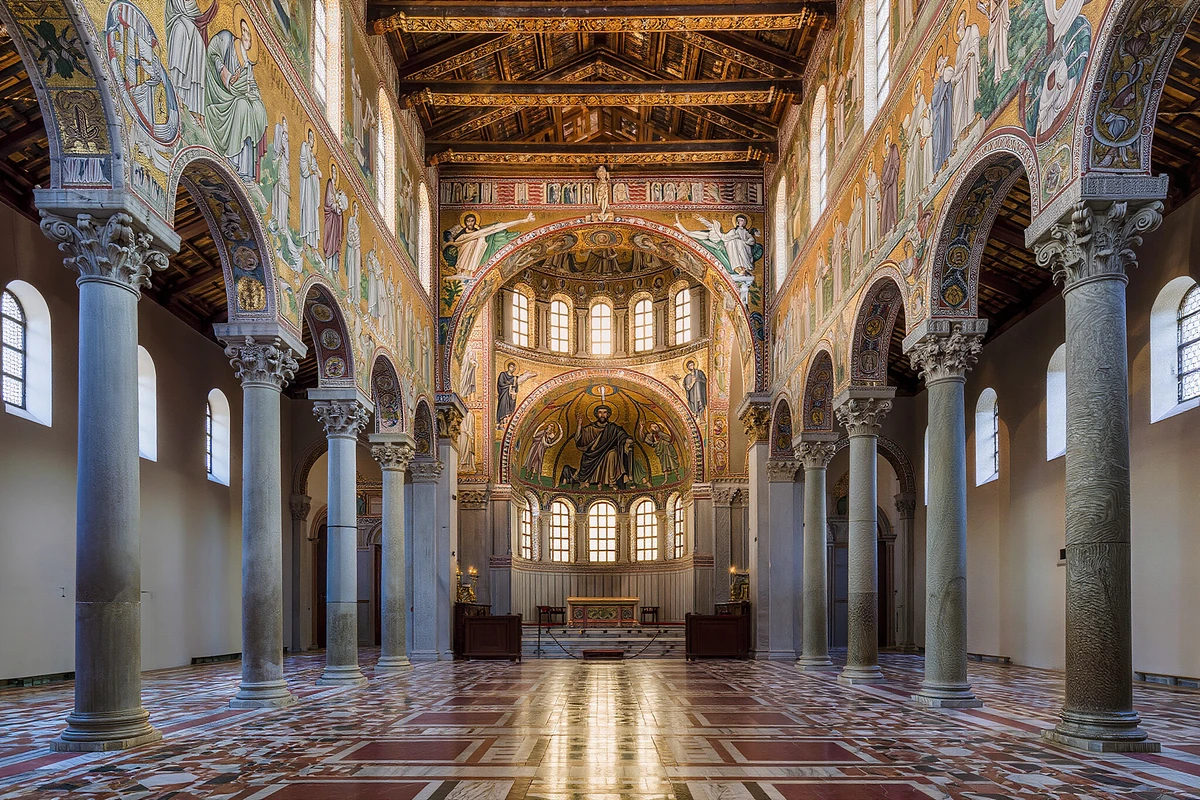
The Basilica of San Vitale was begun in 526 and consecrated in 547, during the Byzantine period. Its octagonal plan, with a high central dome and an upper gallery, was unusual in the West and influenced later imperial churches north of the Alps. Light falls from the windows onto marble columns with carved capitals that look like lace, and onto the mosaics of the apse, in shining green and gold.
The most famous panels show the emperor and the empress of Constantinople with their courts and soldiers, bearing gifts for the church: rare portraits of real figures from the sixth century, dressed in purple, pearls and precious stones. Around them are scenes from the Old Testament, landscapes full of birds and plants, and a beardless young figure enthroned on a blue globe in the apse. Many visitors consider San Vitale the highlight of any Ravenna mosaics tour.
The Mausoleum of Galla Placidia
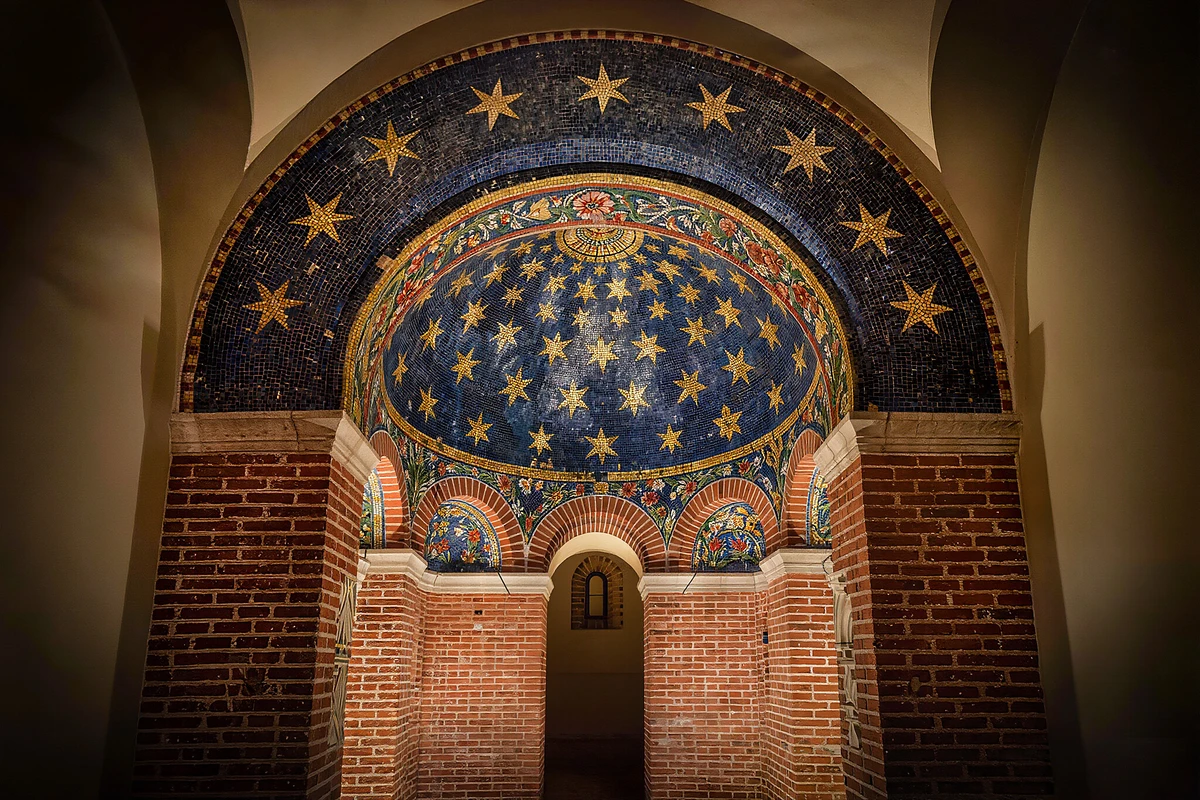
In the grassy courtyard behind San Vitale stands a small cross-shaped brick building that looks very simple from outside. The Mausoleum of Galla Placidia dates from the second quarter of the fifth century and, despite its name, probably never served as a tomb. Step inside and the walls disappear under the oldest and best-preserved mosaics in Ravenna.
The vault is a deep night-blue sky covered with golden stars around a central cross, and the lunettes show deer drinking from a spring among acanthus scrolls and a shepherd surrounded by his flock. The light filters through thin alabaster windows, giving the interior a warm glow. Visits to the mausoleum are short and in small numbers, which is one reason why going with a guide who manages the entry times saves effort and waiting.
The Basilica of Sant'Apollinare Nuovo
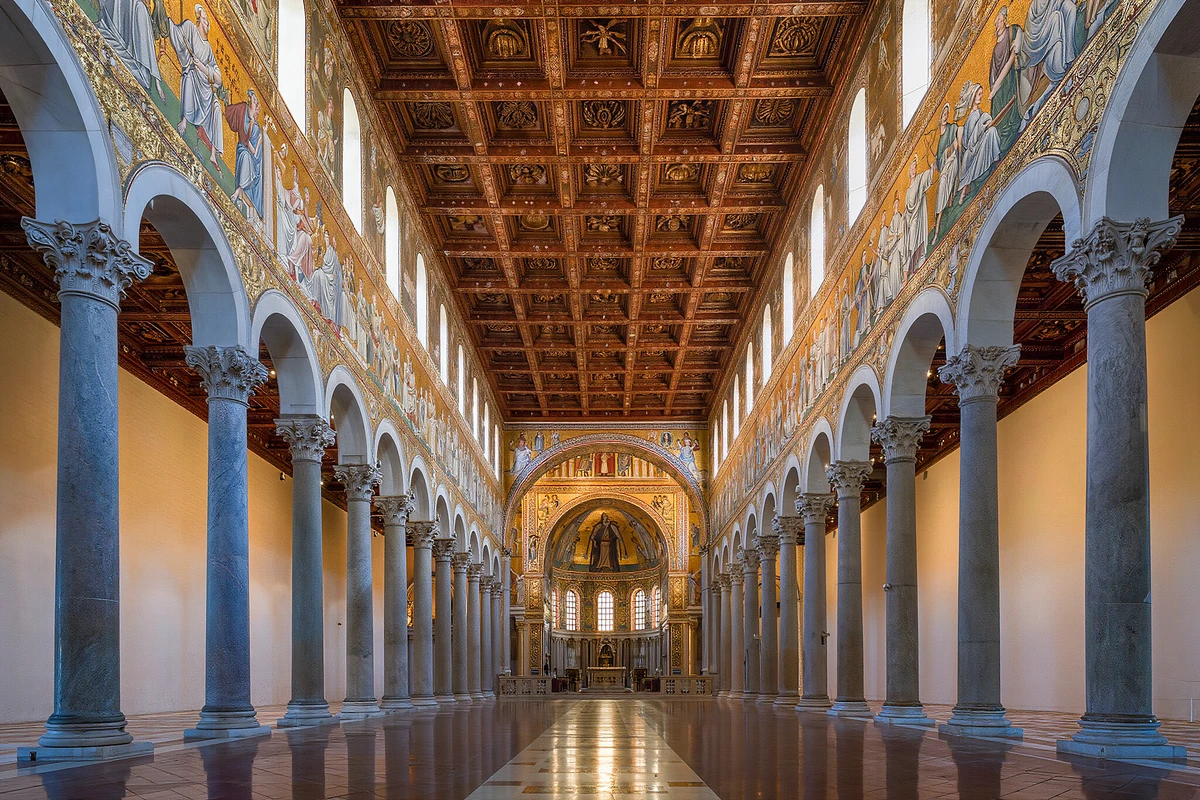
Sant'Apollinare Nuovo was built in the early sixth century as the palace church of the Ostrogothic king who ruled Ravenna. Its long nave keeps one of the greatest mosaic cycles in the world: along both walls, long processions of white-robed figures move towards the apse between palm trees, while the upper bands show scenes from the Gospels in small panels.
Look closely at the ends of the processions: on one side is the royal palace of Ravenna, on the other the old port of Classe with its ships and lighthouse. When the Byzantines took the city, some figures in the palace scene were removed, and you can still see hands left on the columns. This basilica closes the complete tour; in the shorter option you visit it on your own with the ticket included.
Itinerary
- Meet at Piazza San FrancescoMeet your guide in the heart of Ravenna's old centre at 14:45, receive the radio guide and the plan of the visit.
- Archiepiscopal Chapel and MuseumVisit the small mosaic chapel and the ivory throne inside the Archbishop's Museum, about 25 minutes (complete option only).
- Neonian BaptisteryLearn how to read the dome mosaic in Ravenna's oldest baptistery, about 20 minutes.
- Basilica of San VitaleExplore the octagonal church and its famous apse mosaics, about 35 minutes.
- Mausoleum of Galla PlacidiaStep into the small chapel with the starry vault, in the courtyard next to San Vitale, about 15 minutes.
- Basilica of Sant'Apollinare NuovoFinish with the great mosaic processions of the nave, about 30 minutes; the tour ends here, about three hours after the start.
What's included
- Expert English-speaking guide
- Entry tickets to the monuments visited
- Basilica of San Vitale
- Mausoleum of Galla Placidia
- Neonian Baptistery
- Self-guided entry to Sant'Apollinare Nuovo after the tour
Not included
- Transport to and from Ravenna
- Earphones for the radio guide system (bring your own with a jack plug)
- Meals and drinks
- Archiepiscopal Chapel and Archbishop's Museum
Is this right for you?
Great for
- Families with children — a child price for ages 6–10
- A short visit — about 2 hours
- Travellers who want a proven choice — rated 4.8/5 by past travellers
Think twice if
- You want a private tour — this one is shared with other travellers
Not suitable for
- Pets
Meeting point
The tour starts at 14:45 in Piazza San Francesco, in Ravenna's historic centre, next to the Basilica of San Francesco; please arrive ten minutes early. Transport to and from Ravenna is not included: the square is about fifteen minutes on foot from Ravenna railway station, and if you are coming from Bologna we can arrange a private transfer on request.
Important information
- Bring a passport or ID card (a copy is accepted)
- Bring your own earphones with a standard jack plug for the radio guide system
- Dress modestly: shoulders and knees should be covered in the churches
- Wear comfortable shoes; the route includes cobblestones and uneven surfaces
- Not all monuments have seating and you may stand for parts of the visit
- Flash photography is not allowed inside the monuments
- In the shorter option, keep your ticket safe: it must be shown at each monument
- Pets are not allowed
- Halal food is limited in Ravenna; vegetarian and seafood options are easy to find and we can advise
Good to know
Frequently Asked Questions
Straight answers to what travellers ask us most, before they book.
Is this a shared or a private tour?
It is a shared guided tour: you join other travellers with an expert guide, using radio headsets so you hear clearly inside the monuments.
Is the tour at a fixed time?
Yes. The tour runs at a fixed start time, shown in the booking panel for your date; the default complete option starts at 14:45.
Is the price per person or per group?
The price is per person, with different categories for adults, youths, children and infants. The booking panel on this page shows the current price of each option.
Are the entry tickets included?
Yes. Entry to all the monuments visited is included, so you do not queue at the ticket office.
Is hotel pickup included?
No. The tour starts in Piazza San Francesco in Ravenna. We can arrange a private transfer from Bologna or your hotel on request.
What is the difference between the two options?
The complete three-hour option visits all five monuments with the guide, including the Archiepiscopal Chapel. The essential two-hour option covers the Neonian Baptistery, San Vitale and the Mausoleum of Galla Placidia, then you visit Sant'Apollinare Nuovo on your own.
How long is the tour?
About three hours in the default option, or about two hours in the essential option.
How do I get to Ravenna from Bologna?
Direct regional trains take about an hour to an hour and twenty minutes, and the drive takes about an hour and a quarter. Our team can arrange a private transfer if you prefer.
Is it suitable for children or people with reduced mobility?
Children are welcome, and the stories behind the images keep them interested. The route is generally accessible, but there are cobblestones and limited seating; contact us before booking if you use a wheelchair.
What should I bring?
ID, your own earphones with a jack plug, comfortable shoes and clothing that covers shoulders and knees.
What is the best season to visit Ravenna?
Spring and autumn are mild and pleasant. Summer is hot but the monuments are cool inside; winter is quiet, and the mosaics glow beautifully in the low light.
How do I book and confirm?
Choose your date and option in the booking panel and send your request. Our team confirms your booking on WhatsApp within minutes.
More in Bologna
Getting to & around Bologna
Popular across Italy
-
-
-
-
-
-