
Poland
Medieval old towns, salt mines and countryside estates make up a Poland itinerary our Arabic-speaking desk plans out stop by stop.
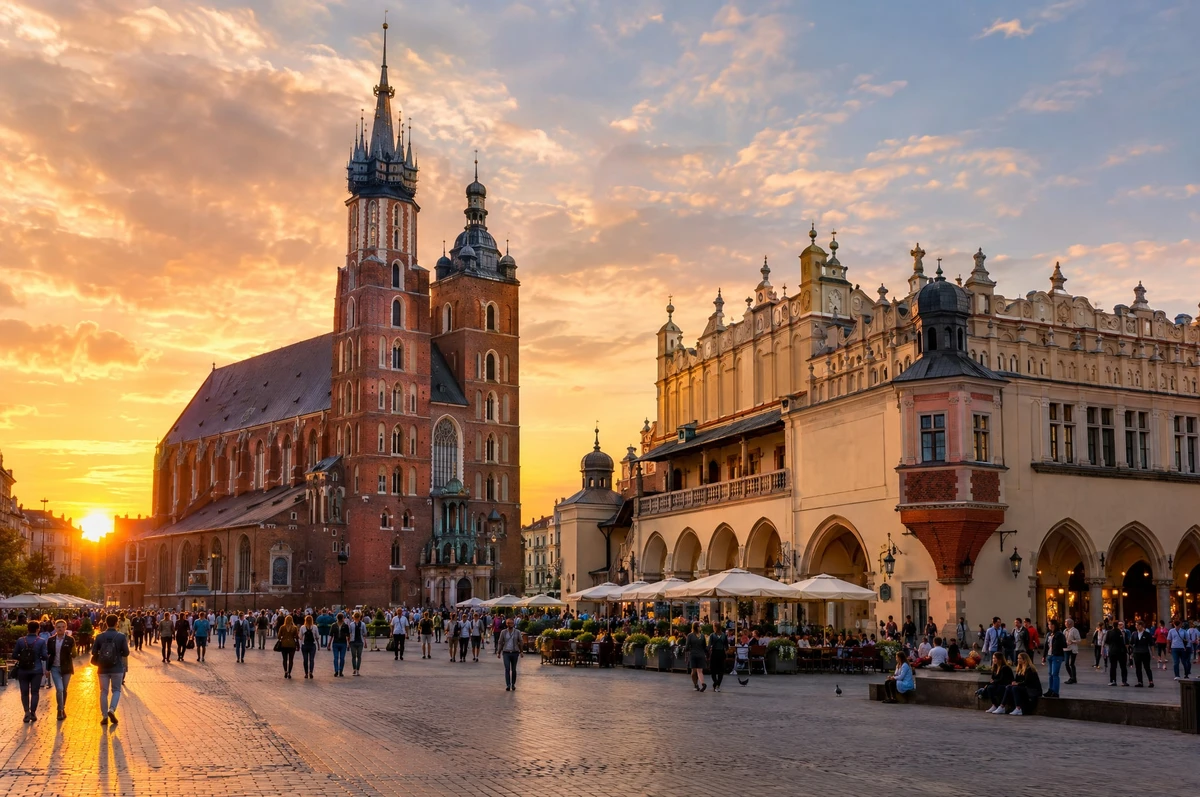
Early morning on Krakow's Main Market Square, a trumpeter in the tower of St Mary's Basilica plays the hejnał, a melody that breaks off mid-note as it has for centuries. Pigeons scatter over the cobbles, flower sellers arrange tulips beneath the arcades of the Cloth Hall, and the smell of warm obwarzanek, a braided bread ring sprinkled with poppy seeds, drifts from a little blue street cart. Students hurry past Renaissance façades while the spires of the old town catch the first pale gold of the day.
Destinations
Choose a city to see everything we arrange there.


Services by city in Poland
Ferry Tickets
The essence of Poland
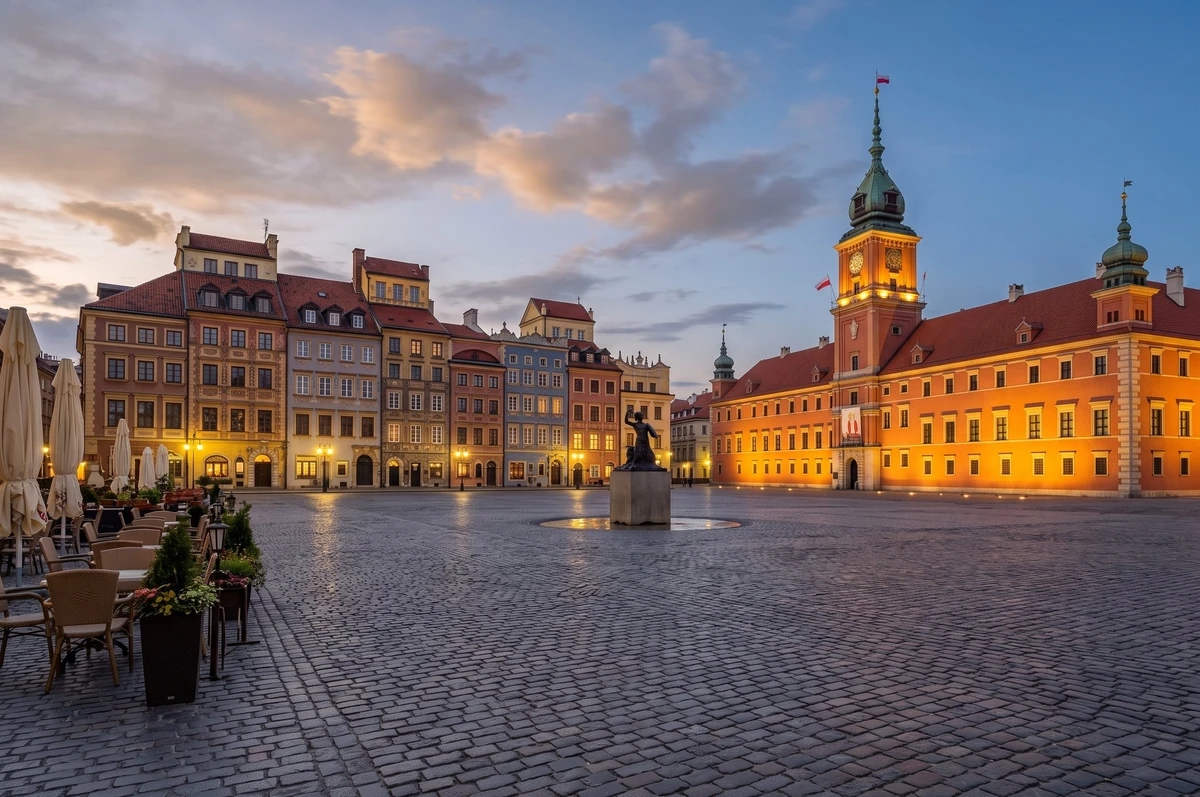
Poland is a country that rebuilt itself with astonishing will. Warsaw's Old Town, reduced to rubble in the Second World War, was raised again brick by brick from old paintings and is now UNESCO-listed. Beyond the cities lie primeval forests, Baltic dunes, countless lakes and the granite peaks of the Tatras. For travellers it offers deep history, warm hospitality and excellent value, with a calm, safe rhythm that rewards slow exploration, and families from around the world are increasingly discovering its cool summers and green countryside.
Why visit Poland?
A Thousand Years of Kings, Scholars and Survival
Poland's story runs from Wawel Castle, seat of kings for five centuries, to the Jagiellonian University, where Copernicus first studied the heavens. Krakow's medieval old town escaped wartime destruction, while Warsaw's was painstakingly reconstructed. The red-brick Teutonic fortress of Malbork, the Gothic churches of Gdańsk and the solemn memorial at Auschwitz-Birkenau together tell a story of glory, tragedy and a nation that refused to disappear.
Forests, Lakes and the Tatra Peaks
Poland stretches from the sandy Baltic coast to the jagged Tatra mountains. In the northeast, the Masurian Lake District links thousands of lakes by rivers and canals, while Białowieża Forest, one of Europe's last primeval woodlands, shelters herds of wild European bison. In the south, Zakopane sits beneath granite peaks and alpine meadows, and near Krakow the Ojców valley hides limestone cliffs, caves and quiet castle ruins.
Pierogi, Folk Art and Warm Kitchens
Polish food is hearty and comforting: pierogi filled with potato and cheese or forest mushrooms, ruby beetroot barszcz, smoked oscypek sheep's cheese from the mountains, and pączki doughnuts filled with rose jam. Halal restaurants can be found in Warsaw and Krakow. Folk traditions live on in the flower-painted cottages of Zalipie, intricate paper cut-outs and Highlander music in the Tatras, while Chopin's music fills Warsaw's parks on summer Sundays.
Experiences Unique to Poland
Descend into the Wieliczka Salt Mine, where miners carved an entire chapel, chandeliers included, from rock salt. Stand in silence at Auschwitz-Birkenau, the most important memorial of its kind in Europe. Ride the funicular up Gubałówka above Zakopane, walk the restored Royal Route from Warsaw's Castle Square towards Wilanów Palace, and listen for the trumpeter's call echoing over Krakow's Main Market Square on every hour.
Who is Poland for?
Ideal for
- History lovers drawn to castles, old towns and twentieth-century stories
- Families seeking cool summers, green parks and good value
- Couples wanting romantic old towns and Christmas markets
- Nature lovers heading for the Tatras, lakes and forests
- Music lovers following Chopin and classical concerts
- Value-minded travellers wanting authentic Europe with fewer crowds
Pace & travel style
- Steady and comfortable, with excellent trains between cities
- Base yourself in Krakow for day tours, then add Warsaw
- Easy walking in compact, safe old towns
- Combine city culture with mountain air in Zakopane
When to visit Poland
Peak season · June–August
Summer is warm and bright, with long evenings perfect for café terraces on Krakow's Main Market Square and Chopin concerts in Warsaw's Łazienki Park. Families enjoy the cool mountain air of Zakopane and the green countryside. It is the busiest season at Wieliczka and Auschwitz-Birkenau, where timed entry slots sell out, so we secure attraction tickets well ahead of your visit.
Shoulder season · April–May, September–October
Spring brings blossom to the Planty park that rings Krakow and fresh green to the Tatras, while autumn turns the forests copper and gold under crisp blue skies. Temperatures are pleasant for walking, crowds at the major sites are lighter, and hotels have more availability. September is often the sweetest month of all, warm enough for outdoor dining and calm everywhere.
Low season · November–March
Winter is cold, grey and often snowy, with short days. In return, Krakow's Christmas market sparkles beneath the Cloth Hall, Zakopane becomes a resort for skiing and sledging, and museums, castles and the salt mine are far quieter. It suits travellers who love festive atmosphere, snowy landscapes and good value. Pack a warm coat, gloves and waterproof boots.
The regions of Poland and how to combine its cities
Poland is a broad, open country that rises gently from north to south. The Baltic coast in the north is a land of dunes, seaside resorts and the historic port of Gdańsk, while the northeast is a watery realm of Masurian lakes and ancient forests reaching to Białowieża. The heart of the country is a plain of farmland and birch woods, with Warsaw, the capital, on the Vistula river.
The south is where Poland grows most dramatic. Lesser Poland, around Krakow, is rich in castles, salt mines and wooden churches, and beyond it the Carpathians rise into the Tatra mountains around Zakopane. To the west, Silesia and Wrocław carry a layered Central European heritage of bridges, river islands and Gothic halls.
Our directory below covers Warsaw and Krakow, the two cities that best tell Poland's story. Warsaw shows the reborn capital, from its rebuilt Old Town to Chopin's parks and modern museums; Krakow is the historic royal city and the base for our guided day tours to Wieliczka, Auschwitz-Birkenau and Zakopane. Linked by fast trains in under three hours, they pair beautifully, and we arrange private airport transfers, attraction tickets and train and flight tickets for both.
Before you go: practical tips for Poland
Entry & visas
Poland is part of the Schengen area, so a Schengen visa or visa-free status for eligible passports covers short stays across most of Europe. Some nationalities enter visa-free for short stays, while others must apply in advance through a Polish consulate or visa centre. The EU is also introducing new electronic entry checks. Requirements depend on your passport, so check the official government portal or embassy before booking.
Money, cards & tipping
Poland uses the złoty, not the euro, although some hotels and shops accept euros at their own rate. Cards and contactless payments are accepted almost everywhere, including small cafés and taxis, and ATMs are common, though standalone machines with poor exchange rates are best avoided. Tipping around ten percent in restaurants is customary for good service. Prices are fixed in shops, so bargaining is not expected outside flea markets.
Etiquette & dress code
Poles are polite and a little formal at first, then warm quickly. Greet with dzień dobry when entering shops. Churches are active places of worship, so dress modestly and keep quiet during Mass. At Auschwitz-Birkenau, behave with deep respect: dress soberly, speak softly and avoid posed or cheerful photos. Most shops close on many Sundays by law, so plan shopping for other days.
Getting around
Poland has an efficient, modern rail network, and fast intercity trains link Warsaw and Krakow in under three hours; we issue train tickets for these routes. Domestic flights connect Warsaw with Gdańsk and Wrocław, though trains are often just as convenient. Within cities, trams and buses are reliable. For airports, day trips and family travel, our private chauffeured transfers are the most comfortable choice.
Must-do things in Poland
- Hear the trumpeter's call from St Mary's Basilica over Krakow's Main Market Square.
- Explore Wawel Castle and Cathedral on the hill above the Vistula.
- Descend into the Wieliczka Salt Mine to see chapels carved from salt.
- Pay your respects on a guided visit to the Auschwitz-Birkenau memorial and museum.
- Wander Warsaw's rebuilt Old Town and its colourful Market Square.
- Listen to an open-air Chopin concert in Łazienki Park on a summer Sunday.
- Take a day trip to Zakopane and ride up Gubałówka for Tatra views.
- Taste pierogi, barszcz and oscypek cheese at a traditional Polish restaurant.
- Stroll Kazimierz, Krakow's historic Jewish quarter of synagogues and cafés.
- Walk Warsaw's Royal Route all the way to the Baroque palace at Wilanów.
Do’s and don’ts in Poland
Do
- Say dzień dobry when entering shops, cafés and small hotels.
- Book Wieliczka and Auschwitz-Birkenau entry well ahead in summer.
- Carry a warm layer, even on summer evenings in the mountains.
- Dress modestly and stay quiet when visiting active churches.
- Keep our WhatsApp line handy for drivers, tickets and timings.
Don’t
- Don't take cheerful selfies or posed photos at Auschwitz-Birkenau.
- Don't plan big shopping trips on Sundays, when many shops close.
- Don't assume prices are in euros; Poland uses the złoty.
- Don't cross on a red pedestrian light; police do fine jaywalkers.
- Don't rush Krakow; it rewards slow wandering and lingering.
Poland at a glance
Plan Poland with Haqqi Tours
Every option is confirmed by our team on WhatsApp before you pay, and delivered by our own people or by trusted local partners we work with in every city. Because we send travellers from all over the world, our partners give us special rates and priority, so you always receive the best. Prices are per person unless marked per vehicle.
About Haqqi Tours: About us Contact us Legal NoticePrivacy PolicyCookies & Marketing PreferencesTerms & ConditionsBooking, Payment & Refunds
Good to know
Frequently Asked Questions
Straight answers to what travellers ask most about Poland.
Is it safe to visit Poland?
Yes. Poland is one of Europe's safer destinations, with low violent crime and calm, well-kept city centres in Warsaw and Krakow. Families and solo travellers move around comfortably, even in the evening. Watch for pickpockets on busy trams and in crowded squares. Check your government's official travel advice before departure and keep our WhatsApp line handy.
How many days do I need for a first trip to Poland?
Five to seven days suits a first trip to Poland. Spend three or four nights in Krakow for the old town, Kazimierz and day tours to Wieliczka, Auschwitz-Birkenau or Zakopane, then two nights in Warsaw. With ten days you can add Gdańsk on the Baltic coast or more time in the Tatra mountains.
What is the best way to travel between Poland's major cities?
Fast intercity trains are the best way to travel between Poland's major cities, linking Warsaw and Krakow in under three hours with comfortable seating. Domestic flights reach Gdańsk and Wrocław. We issue train and flight tickets, and our private chauffeured transfers handle airports, hotel doors and day trips to places the trains do not reach.
Can a trip to Poland be tailored for luxury or private travel?
Yes. We tailor Poland around private airport transfers, chauffeured cars, private guides on our day tours to Wieliczka, Auschwitz-Birkenau and Zakopane, and attraction tickets timed to your rhythm. Families can request first-class train seats, flexible schedules, halal restaurant suggestions and prayer breaks. Tell our team your priorities on WhatsApp and we build every day around them.
Is Poland tourist friendly?
Yes. Poland's cities are clean, well signed and easy to navigate, and English is widely spoken by younger people and in hotels. Public transport is simple, and Poland feels excellent value compared with Western Europe. Halal food is limited but available in Warsaw and Krakow, and our team on WhatsApp helps with every detail of your stay.
Is it safe to travel to Poland now?
Poland is generally calm and stable for visitors, and Warsaw and Krakow welcome travellers throughout the year. Conditions anywhere can change, so check the official travel advice of your own government shortly before departure. While you travel, our team and drivers remain reachable on WhatsApp, and we adapt plans if anything affects your route.
What is the best time to visit Poland?
The best time to visit Poland is May to September, when days are long and mild, parks are green and outdoor concerts and festivals fill the calendar. September is especially lovely, with fewer crowds. December brings Christmas markets to Krakow, while January to March is ideal for skiing and snow in Zakopane.
What is Poland famous for?
Poland is famous for Krakow's medieval old town, Wawel Castle and the Wieliczka Salt Mine, for Warsaw's rebuilt Old Town, and for Chopin and Copernicus. It is also known for pierogi, the Tatra mountains, primeval forests, the Auschwitz-Birkenau memorial and the resilience of a nation that rebuilt itself after the Second World War.
Can a family combine Warsaw and Krakow in one Haqqi Tours booking?
Yes, the WhatsApp desk can sequence a Warsaw airport transfer, a train ticket such as Warsaw to Krakow, and a further connection like Krakow to Zakopane into a single itinerary agreed and written down before the trip.
How does the Zakopane mountain transfer from Krakow airport work?
A vetted partner driver collects the family at Krakow airport and continues directly toward Zakopane, so there is no need to arrange a separate train or bus once the airport transfer has been booked through the desk.
Is it possible to continue from Poland into Czechia by train?
Yes, this page lists Krakow to Prague Train Tickets for families continuing their trip southward, and the same WhatsApp desk that arranged the Poland leg can also confirm that onward journey in writing.
Which cities in Poland does Haqqi Tours cover?
Gdańsk, Krakow and Warsaw. Each city has its own page with everything available there, and a trip across several cities is planned in one WhatsApp conversation.
What can I book in Poland?
Day tours, attraction tickets, private airport transfers, flight tickets, train tickets and ferry tickets - all run or confirmed by Haqqi Tours, each with a fixed price agreed on WhatsApp before you pay.
How do I book a tour or transfer in Poland?
Fill in the form on the page you are interested in, or message us on WhatsApp with the date, the number of travellers and your hotel. A member of our team confirms the price and the details in writing within minutes.
Are the prices fixed?
Yes. Every price is agreed in writing on WhatsApp before you travel and does not change on the day - not for traffic, not for a late flight, not for the hour.
Do you arrange transfers between cities in Poland?
Yes. Intercity transfers by private car or van are booked the same way as airport transfers; tell the desk the two hotels and the date and it quotes a fixed price for the whole vehicle.