
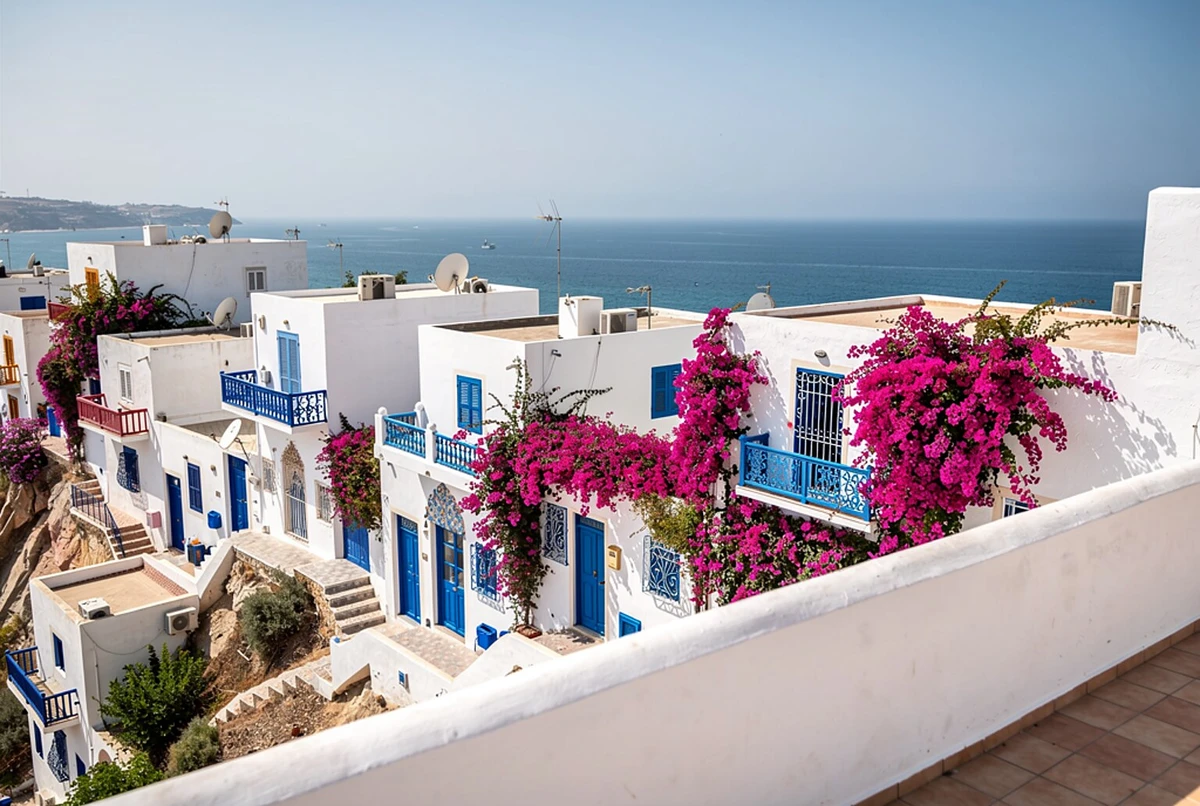
Tunis
Plan Tunis with Haqqi Tours: day tours, private airport transfers, attraction tickets and packages, run by our own team and confirmed on WhatsApp in Arabic or English.
Early morning in the Medina of Tunis, and the shutters of the souqs are rolling up one by one. The scent of jasmine and fresh bread drifts through vaulted lanes, perfume sellers set out their tiny glass bottles, and the minaret of the Zitouna Mosque rises above the rooftops. A few steps outside the old gate, Avenue Habib Bourguiba stretches wide and leafy, its cafés already busy with mint tea topped with pine nuts and the morning papers.
Nothing matches those filters yet. Widen your search or message us on WhatsApp.
Tunis Day Tours
View all Tunis at first sight
Tunis is a capital of layers. Phoenician Carthage, Roman baths, a medieval Arab-Islamic medina, Ottoman palaces and French boulevards all sit within a short ride of each other, and the blue-and-white village of Sidi Bou Said looks out over the Mediterranean from its cliff. It is the perfect gateway to Tunisia, from ancient ruins on the coast to the dunes of the Sahara in the south.
Why include Tunis in your itinerary?
- Three thousand years in one city. The UNESCO-listed Medina, the ruins of ancient Carthage and the great mosaic halls of the Bardo Museum make Tunis one of the richest cultural capitals of North Africa, all within a compact and easy area.
- Sidi Bou Said and the Mediterranean coast. Whitewashed houses with blue doors, bougainvillea and sweeping sea views make this hilltop village one of the most photographed places in the country, linked to the city by a short coastal railway.
- A natural gateway to the Sahara. From Tunis you can head south to the amphitheatre of El Jem, the holy city of Kairouan, the troglodyte houses of Matmata and the golden dunes around Douz, a journey that reveals the full variety of Tunisia.
Signature experiences in Tunis
The Medina and the Zitouna Mosque
The Medina of Tunis is a labyrinth of covered souqs, each once devoted to a single trade: perfumes, chechia caps, gold, carpets and spices. At its heart stands the Zitouna Mosque, among the oldest in North Africa, while grand houses such as Dar Ben Abdallah reveal tiled courtyards and carved ceilings. Our guided day tours lead you through the lanes with a local guide who knows the craftsmen and the stories behind every door.
Carthage and Its Ruins
On the coast north of the city lie the remains of Carthage, the great Phoenician and later Roman metropolis. Walk among the Antonine Baths beside the sea, climb Byrsa Hill for wide views over the bay, and see the circular Punic ports and Roman villas. Our guided day tours combine Carthage with the Medina, Sidi Bou Said and the Bardo, with comfortable transport between sites.
The Bardo Museum Mosaics
Housed in a former palace, the Bardo Museum holds one of the finest collections of Roman mosaics in the world, from scenes of sea gods and harvests to vivid portraits of daily life in Roman Africa. The rooms themselves, with painted ceilings and tiled walls, are a delight. A guide brings the mosaics to life and helps you focus on the masterpieces in a limited time.
Sidi Bou Said by the Sea
Perched on a cliff above the Mediterranean, Sidi Bou Said is a village of white walls, blue shutters and studded doors. Wander its cobbled streets, taste a warm bambalouni doughnut, sip mint tea on a terrace with views over the water, and browse for ceramics and birdcages. We include Sidi Bou Said in our guided day tours, ideally late in the afternoon when the light is soft.
Two Days to the Sahara
A short desert journey from Tunis crosses the heart of the country: the Roman amphitheatre of El Jem, the troglodyte houses of Matmata, the shimmering salt flats of Chott el Jerid and the dunes at Douz, where you can ride a camel at sunset and sleep in a desert camp. It is a full and rewarding trip, best done with our guided tours, which handle the long drive and all the logistics.
Neighbourhoods and quarters to know in Tunis
The Medina
The historic Medina is the soul of Tunis, with restored guest houses set in traditional courtyard dwellings. Staying here puts the souqs, mosques and palaces at your doorstep and offers an authentic atmosphere. Lanes are quiet at night and some are hard to reach by car, so our transfers take you to the nearest gate and help with luggage.
The Ville Nouvelle
Built during the French period, the modern centre around Avenue Habib Bourguiba has elegant facades, the Municipal Theatre, the cathedral and many cafés. It is the most practical base for first-time visitors, with large hotels, the tram and easy access to the Medina on foot. The avenue is lively in the evening and pleasant for a stroll.
Les Berges du Lac
North-east of the centre, Les Berges du Lac is a modern district of wide avenues, business hotels, shopping centres and restaurants along a lagoon promenade. It is calm, clean and close to the airport, making it convenient for families and business travellers who prefer contemporary comfort, while still being a short drive from the Medina and Carthage.
Carthage, Sidi Bou Said and La Marsa
The northern coastal suburbs combine history, sea views and a relaxed pace. Carthage has ruins among gardens, Sidi Bou Said has charming small hotels, and La Marsa has a long beach, a lively seafront and good restaurants. The suburban railway links them to the city, making this a lovely base for a slower, seaside stay.
How long to stay in Tunis and how to pair it
Recommended stay
We recommend three nights in Tunis. One day for the Medina and the Bardo Museum, one for Carthage and Sidi Bou Said, and a third for a slower pace in La Marsa or a trip to Kairouan. Add two more nights for the Sahara journey to the dunes of Douz and the south.
How to pair it
Tunis pairs naturally with Hammamet, about an hour by road, for beaches and a relaxed medina by the sea, and with Sousse and its UNESCO-listed old town about two hours south. A week can combine Tunis, Kairouan, El Jem and the Sahara around Douz and Tozeur. With ten days, add the island of Djerba, a short domestic flight from Tunis, for sandy beaches and traditional villages.
Best time to visit Tunis and the rhythm of the day
Best months
The best time to visit Tunis is from April to June and from September to October, when days are warm and sunny and the sea breeze keeps evenings pleasant. July and August are hot and the coast is busy with summer visitors. Winters are mild but can be rainy, and they are the best season for the Sahara.
The daily rhythm
Tunis starts the day early in the Medina, when the souqs open and the lanes are cool. Late morning suits the Bardo Museum, followed by a long lunch of couscous or grilled fish. Afternoons are made for Carthage and Sidi Bou Said, with mint tea at sunset, and evenings bring families out along Avenue Habib Bourguiba and the seafront at La Marsa.
On-the-ground logistics in Tunis
Arrival
Tunis-Carthage International Airport (TUN) lies just north-east of the city, usually about fifteen to twenty-five minutes from the centre and the Medina, and about twenty minutes from Les Berges du Lac and Carthage. The ferry port of La Goulette receives ships from Europe. Our private transfers meet you at the airport or the port and take you straight to your hotel.
Getting around
The Medina is best explored on foot, while the tram serves the modern centre and the suburban light railway runs along the coast to La Goulette, Carthage, Sidi Bou Said and La Marsa. Yellow taxis are plentiful and use meters. For full days combining distant sites, a private car with driver arranged by our team is the most comfortable choice.
Local etiquette tip
Tunisia is a Muslim-majority country with a relaxed and open atmosphere, but modest dress is appreciated in the Medina and essential in mosques, where non-Muslims usually view courtyards from the entrance. Arabic and French are widely spoken. Halal food is the norm everywhere. Bargaining is expected in the souqs, a friendly greeting goes a long way, and always ask before photographing people.
Must-do things in Tunis
- Get lost in the covered souqs of the Medina of Tunis
- Admire the Zitouna Mosque from its arcaded entrance
- See the great Roman mosaics of the Bardo Museum
- Walk among the Antonine Baths beside the sea at Carthage
- Climb Byrsa Hill for views over Carthage and the coast
- Sip mint tea with pine nuts on a terrace in Sidi Bou Said
- Taste brik, couscous and lablabi in a local restaurant
- Stroll along Avenue Habib Bourguiba in the evening
- Visit the holy city of Kairouan and its Great Mosque
- Watch the sunset over the dunes of the Sahara near Douz
Do’s and don’ts in Tunis
Do
- Do dress modestly in the Medina and at religious sites
- Do bargain politely and with a smile in the souqs
- Do learn a few words of Arabic or French
- Do carry small change for taxis and small purchases
- Do start sightseeing early in the warmer months
Don’t
- Don't enter mosque prayer halls unless invited
- Don't photograph people without asking first
- Don't follow unofficial guides who approach you in the Medina
- Don't rush Carthage and the Bardo into a single hour
- Don't forget sun protection on the open ruins of Carthage
Tunis at a glance
Plan Tunis with Haqqi Tours
Every option is confirmed by our team on WhatsApp before you pay, and delivered by our own people or by trusted local partners we work with in every city. Because we send travellers from all over the world, our partners give us special rates and priority, so you always receive the best. Prices are per person unless marked per vehicle.
About Haqqi Tours: About us Contact us Legal NoticePrivacy PolicyCookies & Marketing PreferencesTerms & ConditionsBooking, Payment & Refunds
More services in Tunis
Good to know
Frequently Asked Questions
Straight answers to what travellers ask most about Tunis.
Where should first-time visitors stay in Tunis?
First-time visitors usually stay in the modern centre near Avenue Habib Bourguiba, close to the Medina and the tram, or in Les Berges du Lac for calm, modern comfort near the airport. For a seaside atmosphere, Sidi Bou Said and La Marsa are lovely. Our team can suggest a hotel and arrange your private airport transfer.
Can Tunis be done as a day trip, or does it need an overnight stay?
Day trips to Tunis are possible from Hammamet or Sousse, and they cover the highlights at a brisk pace. To enjoy the Medina, the Bardo, Carthage and Sidi Bou Said properly, two or three nights are much better. We arrange private transfers and guided day tours to suit your plans.
What is the dress code and etiquette in Tunis?
Tunis is relaxed by regional standards, but modest clothing covering shoulders and knees is respectful in the Medina and at religious sites. Women may wish to carry a scarf. Bargain politely in the souqs, ask before photographing people and greet shopkeepers before browsing. Our guides explain local customs along the way.
Is Tunis tourist friendly?
Yes. Tunis welcomes visitors from all over the world, and hotels, guides and restaurants are used to international travellers. French and Arabic are widely spoken and English is common in tourist areas. Halal food is available everywhere, and exploring with our guided day tours makes everything easier.
Is it safe to travel to Tunis now?
Tunis is generally considered safe for visitors, with a visible police presence in central areas and at major sites. Use licensed taxis, keep valuables secure in crowded souqs and follow your guide's advice. Before departure, check your own government's official travel advice, and keep our WhatsApp line handy throughout your stay.
What are the must-do things in Tunis?
The must-do things in Tunis include the Medina and its souqs, the Zitouna Mosque, the Bardo Museum mosaics, the ruins of Carthage, the blue-and-white village of Sidi Bou Said and an evening on Avenue Habib Bourguiba. Our guided day tours combine these in the best order and timing.
How many days do you need in Tunis?
Three days is ideal for Tunis: one for the Medina and the Bardo, one for Carthage and Sidi Bou Said, and one for La Marsa, Kairouan or a slower pace. Two days covers the highlights quickly, while five allows a two-day journey to the Sahara.
What can I book in Tunis with Haqqi Tours?
Day tours, including Private Tunis Medina, Carthage, Sidi Bou Said and Bardo Museum Tour and 2-Day Sahara Express Tour from Tunis, Hammamet or Sousse. Each has its own page, and the WhatsApp desk combines any of them into one plan with one written price.
How do I get from the airport to my hotel in Tunis?
With a private transfer: a driver at arrivals, flight tracking and a fixed price for the whole vehicle, door to door. Tell the desk the flight number and the hotel.
Is there public transport from the airport to Tunis?
Public options vary by airport and end at a station rather than your hotel; the private transfer starts at the arrivals door and ends at your door.
Which tours are available in Tunis?
Among them: Private Tunis Medina, Carthage, Sidi Bou Said and Bardo Museum Tour and 2-Day Sahara Express Tour from Tunis, Hammamet or Sousse. Each page says whether the day is private or small-group, what it includes and how long it lasts.
Are the tours private or in a group?
Both exist, and each tour page says which. A private tour has a vehicle and guide for your party alone; the desk can make most group tours private on request.
How do I book?
Fill in the form on any page or message us on WhatsApp with the date, the number of travellers and the hotel. A member of our team confirms the price and the details in writing within minutes.
Are the prices fixed?
Yes - every price is agreed in writing on WhatsApp before you travel and does not change on the day.
Do the drivers and guides speak Arabic or English?
It depends on the city and the day, so we do not promise a particular language; tell us your preference and we do our best. The WhatsApp desk always works in Arabic and English.
Can I change or cancel a booking in Tunis?
Yes, in the same WhatsApp conversation. The terms depend on the product and on how close to the date the change comes; the desk states them before you pay.