Bath City Walking Tour with Optional Roman Baths Entry
- Duration1.5 hours
- Daily
- Group
Some images are AI-generated for illustration. While we confirm your booking, just ask and we will send you the original photos.
- Fair, honest prices
- Real people, not bots
- Confirm, then pay
- Secure payment

Overview
This walking tour of Bath shows the city's Roman, medieval and Georgian layers in one easy loop on foot, then hands you a ticket to its greatest treasure. Meeting outside Bath Abbey, a local guide leads you over Pulteney Bridge, past the Pump Room and up through elegant Georgian streets to the Upper Assembly Rooms, the Circus and the Royal Crescent, telling the stories of the spa town that drew high society for its hot springs. The walk finishes at the Roman Baths, and the default option includes your entry ticket so you can explore the bathing complex and temple at your own pace. It is a shared group walk of about two hours, with no hotel pickup, suited to first-time visitors, couples and families.
Highlights
- Entry ticket to the Roman Baths included on the default option
- Bath Abbey and its west front with angels climbing stone ladders
- Pulteney Bridge, lined with small shops above the River Avon weir
- The Pump Room, where Georgian visitors came to drink the spa water
- The Upper Assembly Rooms, once the centre of the city's social season
- The Circus and the sweeping curve of the Royal Crescent
- Stories of the Roman, medieval and Georgian city from a local guide
- Morning and afternoon departures from the heart of the city
Full Description
Bath Abbey
A church has stood on this site in the centre of Bath since the 7th century, but the building you see today was begun in 1499 and is often described as the last great medieval church built in England. Its tall windows earned it the nickname the Lantern of the West, and inside, a soaring fan-vaulted ceiling runs the full length of the nave. Outside, the west front is carved with angels climbing ladders up towards heaven, a detail your guide points out before the walk begins.
The tour meets right outside the abbey, in the paved churchyard between the abbey and the Roman Baths, so it is the perfect place to orient yourself. The abbey is usually open to visitors from Monday to Saturday, with services on Sundays, and you can come back after the tour to see the interior or climb the tower on a separate visit.
Pulteney Bridge and the River Avon
Completed in 1774, Pulteney Bridge is one of the most graceful sights in Bath. Designed in the elegant Palladian style, it carries a row of small shops along both sides of its span, so that when you walk across it you feel you are on a street rather than a bridge. It was built to link the old city with new Georgian streets planned on the far bank of the river.
The best view is from Parade Gardens or the riverside path below, where the curved, stepped Pulteney Weir spreads the water of the Avon into a horseshoe of white foam. Your guide stops here to tell the story of how the bridge was built and why the planned new town on the other side was only partly completed. It is one of the classic photo stops of any walk through the city.
The Pump Room and the Upper Assembly Rooms
In the 18th century Bath became the most fashionable spa in Britain, and the Pump Room, built in the 1790s beside the Roman Baths, was the place to be seen. Visitors came each morning to drink a glass of the warm mineral water for their health while musicians played. The elegant hall, with its tall windows and chandelier, still has a fountain where you can taste the spa water today.
Further uphill, the Upper Assembly Rooms opened in 1771 as the venue for evening balls, concerts and card games during the social season. The ballroom, the tea room and the octagon room were designed for large gatherings, and your guide explains the strict etiquette that ruled who danced with whom. Together these two buildings show how Bath turned health into high society.
The Circus and the Royal Crescent
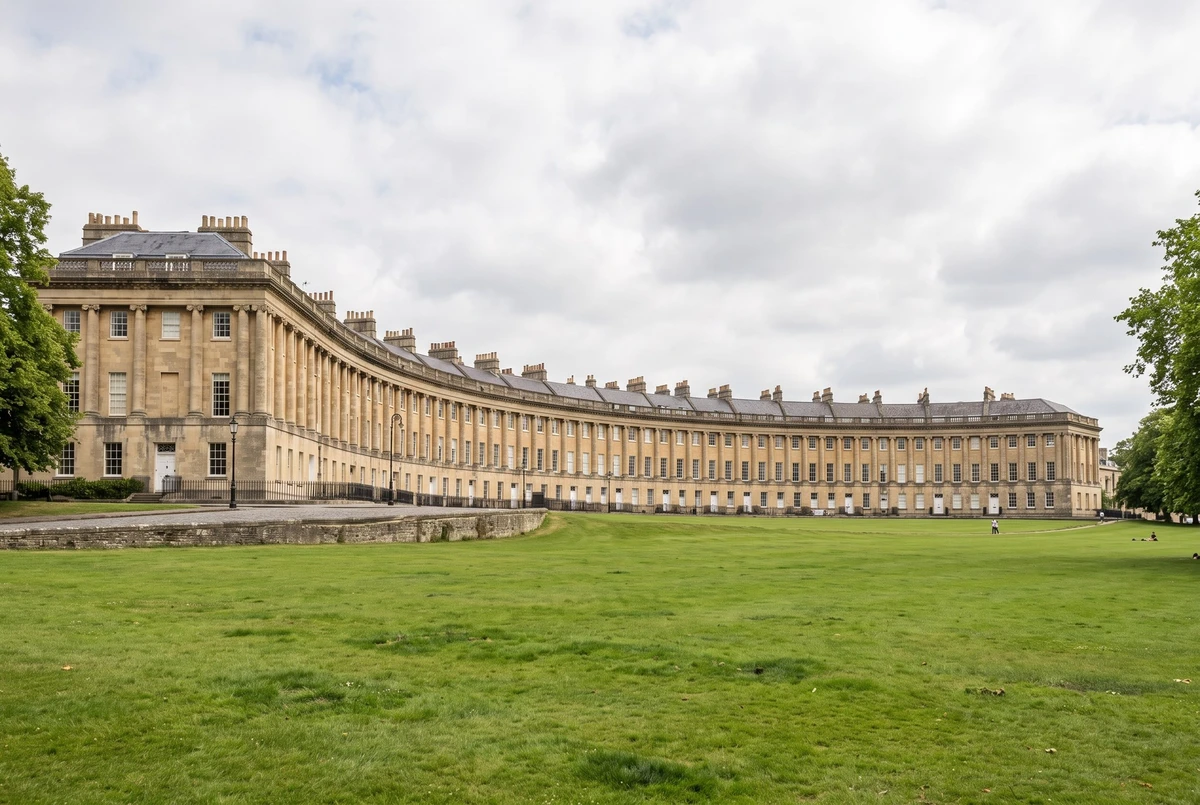
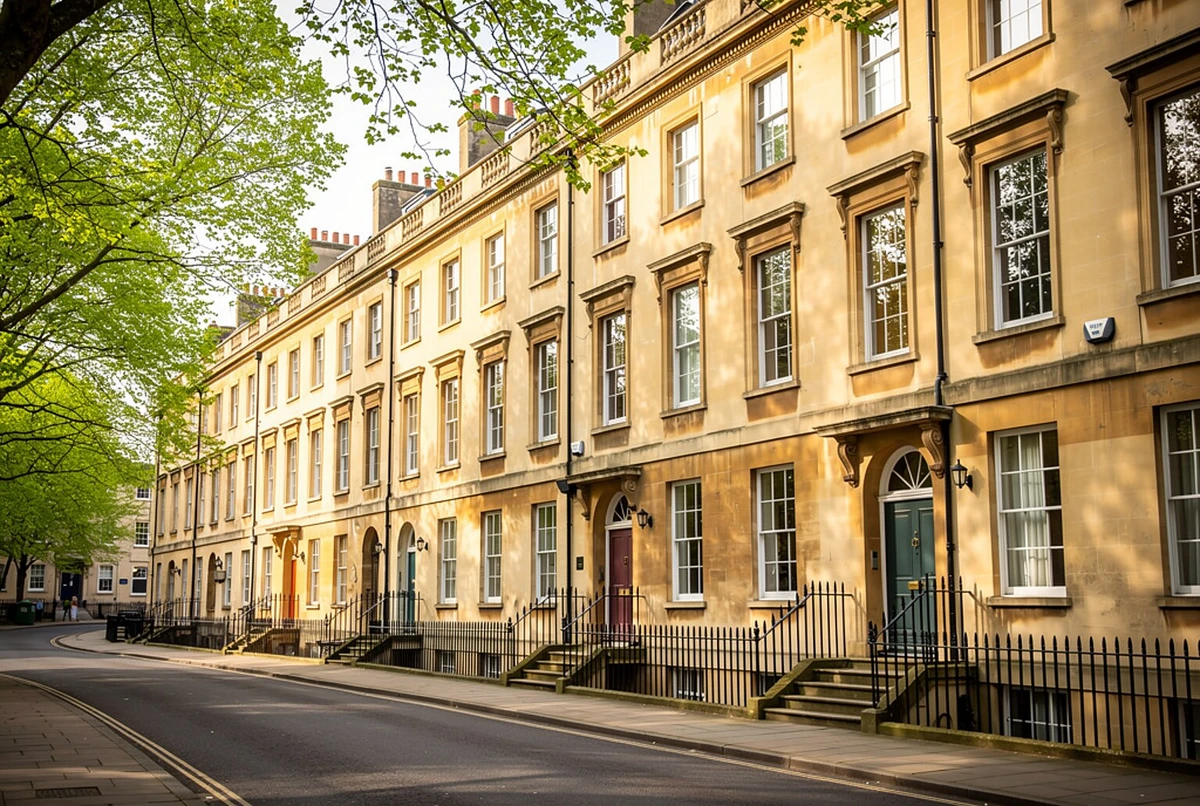
The Circus, built between 1754 and 1768, is a perfect ring of grand townhouses divided into three curved segments around a circle of plane trees. Each façade stacks three orders of classical columns, one above the other, and stone acorns line the parapet. Your guide explains the symbols carved in the frieze and the ancient stone circles that may have inspired the design.
A short walk along Brock Street leads to the Royal Crescent, finished in 1774, a sweeping half-ellipse of terraced houses with Ionic columns looking over a wide lawn and Royal Victoria Park. It is the most famous Georgian address in Britain and the high point of the walk, with time for photos of the full curve. Number 1 Royal Crescent is a museum of Georgian life that you can visit another time.
The Roman Baths
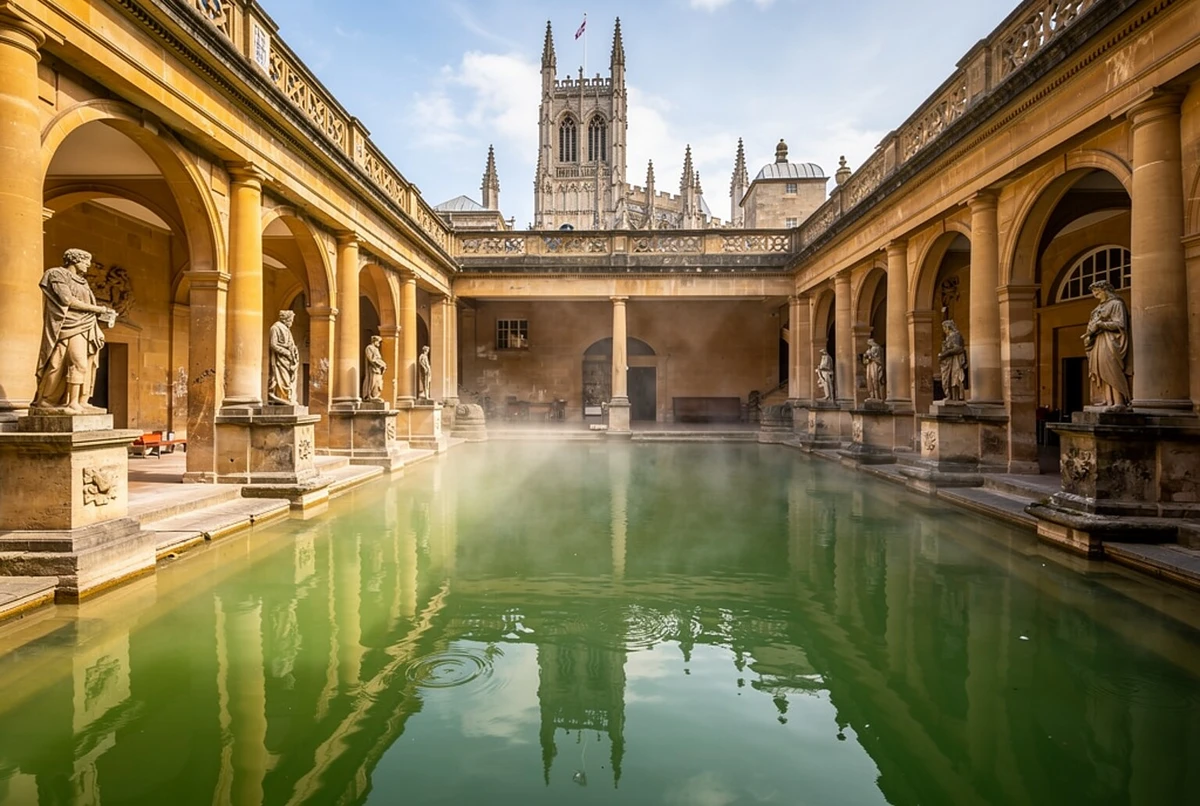
Bath exists because of its hot springs, the only ones in Britain, where water at about 46°C rises from deep underground. The Romans built a temple to the goddess Sulis Minerva here around 60 to 70 AD and a bathing complex around it, naming the town Aquae Sulis. The Great Bath, still lined with Roman lead, is filled with steaming green water, and the terrace above it is lined with statues added in the 19th century.
Your walk ends outside the entrance, and the default option includes your Roman Baths ticket so you can head straight in. Inside, plan about 1.5 to 2 hours to see the sacred spring, the temple courtyard, the gilded bronze head of the goddess and curse tablets scratched with requests to punish thieves. Roman Baths opening hours usually run from morning to early evening, with later closing in summer. Is Bath worth visiting? With this ticket and walk combined, you see the very best of it in half a day.
Itinerary
- Meet outside Bath AbbeyMeet your local guide in the abbey churchyard at 11:00 or 14:00 for an introduction to the city.
- Pulteney BridgeWalk to the river for the view of the bridge and weir and the story of the new Georgian town; about 15 minutes.
- The Pump RoomStop outside the Georgian spa hall beside the Roman Baths; about 10 minutes.
- Upper Assembly RoomsWalk uphill through Georgian streets to the venue of the city's balls and concerts; about 15 minutes.
- The Royal Crescent and the CircusTime for photos of the crescent and the story of the Circus and its symbols; about 25 minutes.
- Finish at the Roman BathsThe walk ends at the Roman Baths, where you use your entry ticket to explore at your own pace; allow 1.5 to 2 hours inside.
What's included
- Guided walking tour of Bath with a local English-speaking guide
- Bath Abbey, Pulteney Bridge and the Pump Rooms
- Upper Assembly Rooms, Royal Crescent and the Circus
- Talk on the Roman Baths and the hot springs outside the site
Not included
- Roman Baths entry ticket
- Hotel pickup and drop-off
- Tips
Is this right for you?
Great for
- Families with children — a child price for ages 4–15
- Groups who want privacy — a private option is available
- First-time visitors who want the highlights
- A short visit — about 1.5 hours
Think twice if
- Walking is difficult for you — expect active parts
Not suitable for
- Travellers who cannot walk for about 1.5 hours, including some uphill sections
Meeting point
Meet your guide outside Bath Abbey in the abbey churchyard, in the city centre a short walk from Bath Spa railway station. Tours start at 11:00 or 14:00; please arrive 10 minutes early. There is no hotel pickup. The walk finishes outside the Roman Baths, a few steps from where it started, and we send you the guide's contact details on WhatsApp when we confirm your booking.
Important information
- Wear comfortable walking shoes; some streets climb gently uphill
- Bring an umbrella or rain jacket, as the tour runs in all weather
- The Roman Baths entry ticket is included only on the default option
- Inside the Roman Baths, allow 1.5 to 2 hours for your visit
- Children aged 4 to 15 have a reduced rate on some options
- Food, drinks and tips are not included
- There is no hotel pickup; the tour starts and finishes in the city centre
Good to know
Frequently Asked Questions
Straight answers to what travellers ask us most, before they book.
Is this a shared or a private experience?
The default option is a shared group walking tour. A private walking tour without Roman Baths entry is also available in the booking panel.
How long does the Bath walking tour take?
About two hours on the default option, ending at the Roman Baths. Your self-guided visit inside the baths takes another 1.5 to 2 hours.
Is hotel pickup included?
No. The tour meets outside Bath Abbey in the city centre and finishes outside the Roman Baths.
What is included?
A guided walking tour with a local English-speaking guide covering Bath Abbey, Pulteney Bridge, the Pump Room, the Upper Assembly Rooms, the Royal Crescent and the Circus, plus an entry ticket to the Roman Baths on the default option. Food, drinks and tips are not included.
Is the price per person or per group?
The shared options are priced per person and the private option per group. The booking panel on this page shows the current price of each option.
Is it suitable for children or travellers with reduced mobility?
Children aged 4 and over enjoy the stories, and the Roman Baths are a favourite with families. The route has some gentle uphill streets and pavements, so it is best for travellers who can walk comfortably for 1.5 hours.
What should I bring?
Comfortable shoes, an umbrella or rain jacket, a camera and a bottle of water. In winter, a warm coat and gloves make the walk more pleasant.
How do I get to Bath from London?
Direct trains run from London Paddington to Bath Spa in about 1 hour 30 minutes, and the meeting point outside Bath Abbey is about a 5-minute walk from the station, which makes this tour an easy day trip to Bath from London.
What are the Roman Baths opening hours?
The Roman Baths open daily from morning until early evening, with later closing in summer. Our team can help you choose a tour time that leaves enough time for your visit.
What is the best time to visit Bath?
Late spring and early autumn bring mild weather and fewer crowds. Summer is lively but busy, and December brings festive lights to the city centre.
What happens in bad weather?
The tour runs rain or shine, so bring an umbrella. Your visit inside the Roman Baths is largely under cover.
How do I book and confirm?
Choose your date, time and option in the booking panel and complete the booking. Our team confirms on WhatsApp within minutes.
More in Bath
Popular across United Kingdom
-
-

-
-
-
-