Sofia Landmarks Guided Walking Tour with Audio Guide
- Duration2.5 hours
- Daily
- Group
Some images are AI-generated for illustration. While we confirm your booking, just ask and we will send you the original photos.
- Fair, honest prices
- Real people, not bots
- Confirm, then pay
- Secure payment

Overview
This Sofia walking tour covers the landmarks of the Bulgarian capital on foot in about two and a half hours, with a live guide leading the group and an audio guide through headphones so you hear the commentary in English, French, Spanish, Italian, German, Russian, Bulgarian or Polish wherever you stand. It is a shared experience that goes inside the main churches: the gold-domed Alexander Nevsky Cathedral, the ancient St Sophia basilica, the Russian Church and the fourth-century St George Rotunda, then passes the Roman remains of Serdica, the Central Mosque, the Synagogue and the History Museum before finishing with the changing of the guard at the Presidency. It suits first-time visitors of all ages; hotel pickup is not included, and a longer option adds Vitosha mountain.
Highlights
- Go inside Alexander Nevsky Cathedral, St Sophia Church, the Russian Church and St George Rotunda
- Audio guide and headphones in eight languages, with a live guide leading the route
- Walk over the Roman city of Serdica: amphitheatre remains, the eastern gate and the excavations under the Largo
- See the Central Mosque, the Synagogue and the History Museum standing a few steps apart
- Monument to the Tsar Liberator, the National Assembly and the former royal palace
- Finish with the changing of the guard in front of the Presidency
- Four departures a day from the City Garden, from 09:30 to 16:30
- Option to continue by small-group transport to Aleko Hut on Vitosha mountain
Full Description
Alexander Nevsky Cathedral
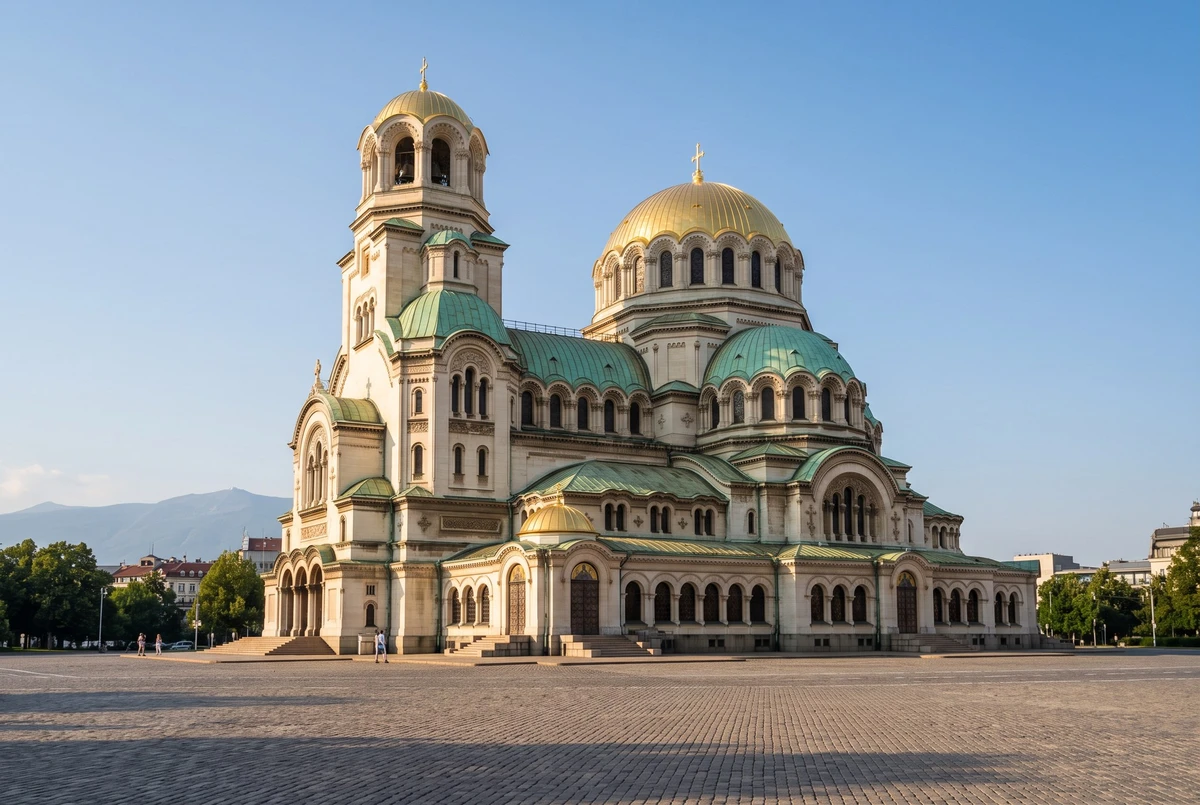
The Alexander Nevsky Cathedral is the building everyone searching for a Sofia walking tour wants to see first: a neo-Byzantine cathedral of gilded and green domes, built between 1882 and 1912 as a memorial to the soldiers who died in the war that brought Bulgaria independence in 1878. The central dome rises about 45 metres and the bell tower a little higher, while inside the marble, onyx and alabaster, the painted ceilings and the wide dim nave are overwhelming on a first visit. Your headphones let you wander the aisles while still hearing the guide's explanation.
The guide points out the thrones, the mosaics above the doors and the icon of the cathedral's patron saint. Alexander Nevsky Cathedral opening hours are long and entry is free, but a guided visit explains the symbolism that is easy to miss. About fifteen minutes are spent inside and on the wide square outside, where the whole facade fits into a photograph.
St Sophia Church and the Monument of the Unknown Soldier
Across the square from the cathedral stands the red-brick St Sophia Church, a plain, sturdy basilica from the sixth century that is the second-oldest building in the capital and gave the city its name in the fourteenth century, when Sofia replaced the older name Sredets. Under the Ottomans it served as a mosque, lost its minaret to an earthquake and was later restored as a church; beneath the floor an archaeological level shows the Roman and early Christian tombs and mosaics on which it was built.
Beside it burns the eternal flame of the Monument of the Unknown Soldier, unveiled in 1981 with a bronze lion and verses carved in stone, guarded by Bulgaria's national symbol. The contrast between the huge cathedral and the ancient basilica next door is one of the best lessons in Sofia's history, and the guide uses it to explain how the city grew from Serdica to the modern capital.
The Russian Church, the Tsar Liberator and the National Assembly
Walking down from the cathedral square you reach the Russian Church of St Nicholas, a small jewel of 1914 with five gilded onion domes, green glazed tiles and painted facades, built for the Russian diplomatic community. Inside it is dark and intimate, with frescoes in the style of the old Russian masters; in the crypt visitors leave written wishes beside the tomb of a revered archbishop, a custom the guide explains before you go in.
A short stretch further stands the equestrian Monument to the Tsar Liberator, raised in 1907 to the Russian emperor who led the war of 1877–1878, facing the National Assembly building of 1884 with its motto Unity Makes Strength on the pediment. The route then passes the former royal palace, which now houses the National Art Gallery, and the City Garden where the tour began, so you see the whole official heart of the capital in a few hundred metres.
Ancient Serdica: the amphitheatre, the eastern gate and the Largo excavations
Sofia stands on the Roman city of Serdica, a favoured residence of Roman emperors, and this walking tour shows its remains at three points. First the amphitheatre, built in the third and fourth centuries and discovered only in 2004; part of its curved stone seating is visible from the street. Then the eastern gate of the city, preserved at underpass level between the Presidency and the Council of Ministers, with sections of the Roman street and the walls.
The largest site is the archaeological complex under the Largo, opened in 2016, where whole streets, houses, a bath and an early Christian basilica lie beneath glass roofs and open courtyards. The guide explains how the metro construction uncovered them and how the city decided to display them in place. Together these stops answer the question many visitors ask: is Serdica worth seeing? With explanation, very much so.
St George Rotunda and the changing of the guard at the Presidency
Hidden in the courtyard between the Presidency and a hotel stands the St George Rotunda, a round red-brick church from the fourth century that is the oldest building in Sofia. It began as a Roman bath or public building, became a church, then a mosque, and inside the dome carries three layers of medieval frescoes, the finest from the tenth to the fourteenth century, with angels circling the cupola. The audio guide lets you look up in silence while the guide's commentary continues in your ears.
The walk ends a few steps away in front of the Presidency, where the ceremonial guard in red-plumed uniforms changes on the hour. The guide times the route so that you arrive just before the ceremony, which lasts a few minutes and is best photographed from the pavement opposite. It is a cheerful finish and leaves you in the exact centre of the city, beside the Serdika metro station.
The Square of Tolerance: Central Mosque, Synagogue and History Museum
A short section of the route crosses what Sofians call the Square of Tolerance, where four faiths share a few hundred metres. The Central Mosque, built in 1566 with a single minaret and a large dome, is the only working mosque in the city and stands beside the former Central Mineral Baths, a striped 1913 building in Vienna Secession style that now houses the Sofia History Museum, with hot mineral water still flowing from fountains outside.
Just behind rises the dome of the Sofia Synagogue, completed in 1909 and the largest in south-eastern Europe, with a huge brass chandelier inside, while the Catholic cathedral and the Orthodox St Nedelya church are within sight. The guide tells the story of each community in a few minutes each, and the area's covered market and street stalls make it a good place to return to after the tour for lunch or souvenirs.
Itinerary
- Meeting in the City Garden by the National TheatreMeet the guide near the National Theatre, collect your headphones and choose your language. Departures at 09:30, 10:30, 13:30 and 16:30.
- National Art Gallery and the Russian ChurchThe former royal palace from outside, then a visit inside the Russian Church with its gilded domes. About 15 minutes.
- Tsar Liberator monument and National AssemblyThe equestrian monument and the parliament building on the square. About 5 minutes.
- Alexander Nevsky CathedralVisit inside the great cathedral and photo time on the square. About 15 minutes.
- Monument of the Unknown Soldier and St Sophia ChurchThe eternal flame, then a visit inside the sixth-century basilica. About 10 minutes.
- Serdica amphitheatre and eastern gateRoman remains seen from the street and at underpass level. About 10 minutes.
- Ulpia Serdica complex, Central Mosque, Synagogue and History MuseumThe excavations under the Largo and the Square of Tolerance. About 15 minutes.
- St George Rotunda and the PresidencyVisit inside the fourth-century rotunda, then the changing of the guard on the hour, where the tour ends about two and a half hours after the start.
What's included
- Live guide leading the group
- Audio guide with headphones in English, French, Spanish, Italian, Russian, German, Bulgarian or Polish
- Visits inside the Russian Church, Alexander Nevsky Cathedral, St Sophia Church and St George Rotunda
- Roman Serdica remains, the Central Mosque, the Synagogue and the History Museum
- Changing of the guard at the Presidency at the end
Not included
- Tips
- Food and drinks
- Hotel pickup
Is this right for you?
Great for
- Families with children — a child price for ages 3–11
- Nature and wildlife lovers
- First-time visitors who want the highlights
- A half-day plan — about 2.5 hours
Think twice if
- You want a private tour — this one is shared with other travellers
- Walking is difficult for you — expect active parts
Not suitable for
- People with limited mobility
- Wheelchair users
Meeting point
Meet your guide in the City Garden in central Sofia, next to the National Theatre, the grand columned building facing the park. The guide carries the headphones and will help you select your language before setting off. Departures are at 09:30, 10:30, 13:30 and 16:30; please arrive ten minutes early. The tour ends in front of the Presidency, about five minutes on foot from the starting point and next to Serdika metro station. Hotel pickup is not included.
Important information
- Dress code for the churches: no shorts, short skirts or bare shoulders; bring a scarf or light cover-up
- High-heeled shoes are not allowed on the route; wear comfortable flat shoes for about four kilometres of walking
- Baby strollers are not permitted on the tour; small children can be carried
- The audio guide is available in English, French, Spanish, Italian, German, Russian, Bulgarian and Polish
- Photography inside the churches may be restricted; the guide will tell you where it is allowed
- Services and ceremonies occasionally close a church for a few minutes; the guide adjusts the order of stops
- Bring water in summer and warm clothes in winter; the tour runs in all weather
- The Vitosha mountain extension is listed as a separate option on this page
Good to know
Frequently Asked Questions
Straight answers to what travellers ask us most, before they book.
Is this a shared or a private tour?
It is a shared group walk with a live guide leading the route and headphones for the commentary. For a private guide, contact us and we will arrange it.
How long does the Sofia walking tour take?
About two and a half hours. The version with Vitosha mountain lasts about six and a half hours including transport and free time at Aleko Hut.
Is hotel pickup included?
No. The meeting point by the National Theatre in the City Garden is a short walk from most hotels in central Sofia and close to Serdika metro station.
What is included?
A live guide, an audio guide with headphones in your language, visits inside the Russian Church, Alexander Nevsky Cathedral, St Sophia Church and St George Rotunda, the Roman remains of Serdica, the mosque, synagogue and History Museum seen from outside, and the changing of the guard at the end.
Is the price per person or per group?
Per person. The booking panel on this page shows the current price for each option.
Is it suitable for children or people with reduced mobility?
Children are welcome but strollers are not permitted, so very small children need to be carried. The walk uses pavements, underpasses and church steps, so it is not suitable for wheelchair users or people with limited mobility.
What should I bring and wear?
Comfortable flat shoes, clothes that cover shoulders and knees for the churches, water in summer and a warm layer in winter. Headphones are provided.
Which departure time is best?
The 09:30 and 10:30 walks have quieter churches and cooler streets in summer; the 13:30 and 16:30 walks suit arrival days. All finish with the changing of the guard, which takes place on the hour.
Is Alexander Nevsky Cathedral free to enter?
Yes, entry to the cathedral is free and it is included in the walk; the guide explains the architecture, the icons and the memorial purpose of the building while you are inside.
Why is Sofia named after St Sophia Church?
The sixth-century basilica was so prominent that by the fourteenth century the city took its name, replacing the older name Sredets. You visit the church and its underground archaeological level on the tour.
What happens in bad weather?
The tour runs rain or shine. Much of the route is inside churches and underpasses, and the guide shortens outdoor stops if it rains heavily.
How do I book and confirm?
Choose your date and departure time in the booking panel and complete the booking. Our team confirms on WhatsApp within minutes and sends the meeting-point details.
More in Sofia