Erfurt Old Town Guided Walking Tour
- Duration2 hours
- Daily
- Group
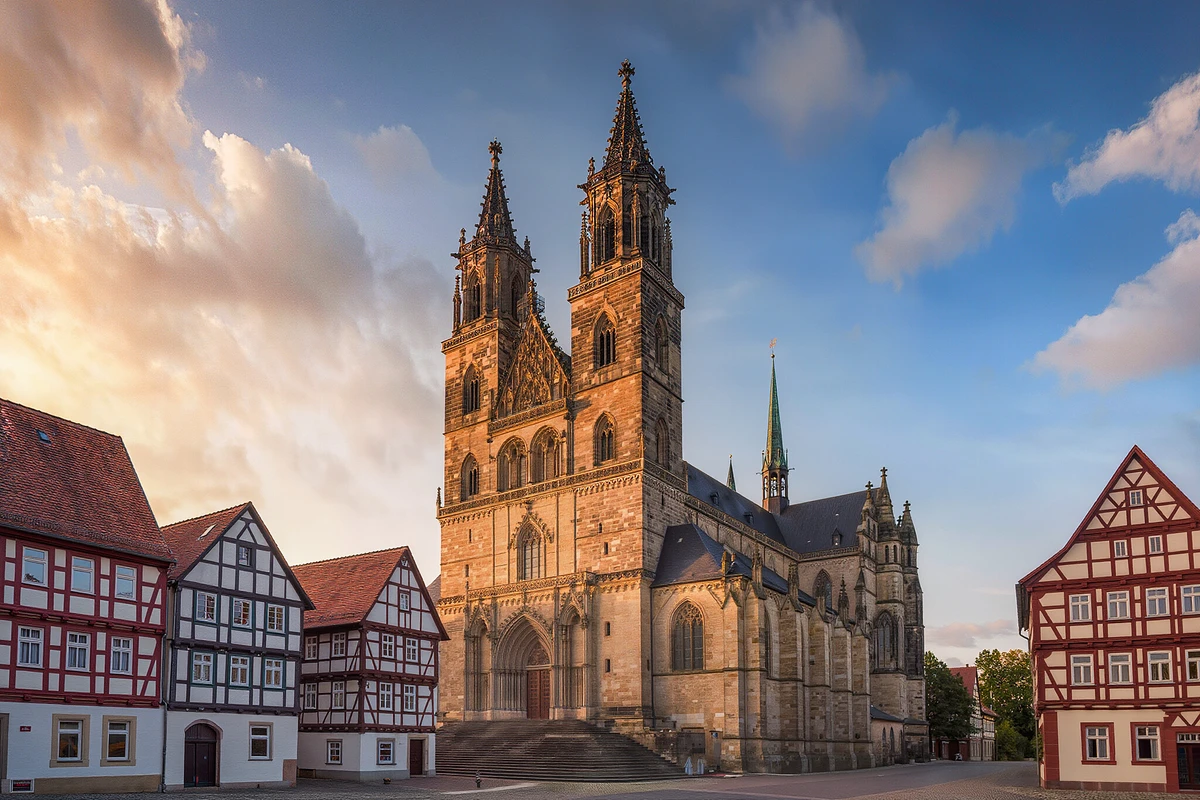
Some images are AI-generated for illustration. While we confirm your booking, just ask and we will send you the original photos.
- Fair, honest prices
- Real people, not bots
- Confirm, then pay
- Secure payment

Overview
This Erfurt walking tour is a shared two-hour guided walk, held in German, through the historic Old Town of the capital of Thuringia, a city first recorded in 742 and one of the best-preserved medieval centres in Germany. You meet your guide at the Eulenspiegel monument behind the Tourist Information on Benediktsplatz at 14:00 and set off across the Krämerbrücke, the bridge lined with half-timbered houses, to the Fischmarkt with its Gothic Revival Town Hall and patrician townhouses, through the University District and the lanes of timber-framed houses and churches, and finally to Domplatz for the outside of the Cathedral of St Mary, where the Gloriosa bell hangs. The route is wheelchair accessible, runs rain or shine, and there is no hotel pickup.
Highlights
- Two-hour guided walk through the 1,270-year-old Old Town of Erfurt
- Krämerbrücke, the medieval bridge lined with inhabited half-timbered houses
- Fischmarkt with the Gothic Revival Town Hall and Renaissance patrician houses
- The University District and the old college buildings of the fourteenth century
- Lanes of half-timbered houses and the many church towers of the city of spires
- Domplatz and the outside of the Cathedral of St Mary with the Gloriosa bell
- Local guide with stories and legends from twelve centuries of history
- Flat, wheelchair-accessible route starting in the centre; reduced rate for children
Full Description
Benediktsplatz and the Krämerbrücke
The walk begins at the Eulenspiegel monument behind the Tourist Information on Benediktsplatz, a small square at the western end of the Krämerbrücke, the Merchants' Bridge. The bridge is the sight people search for first when planning a trip to Erfurt: about 120 metres long, built in stone in 1325 after its wooden predecessors burned, and lined on both sides with narrow half-timbered houses that are still lived in and used as workshops and shops for chocolate, pottery, puppets and Thuringian blue print fabric. It is the longest inhabited bridge in Europe, and from the street you would never know you were crossing the Gera river.
Your guide explains how the bridge grew out of the trade route between east and west, the Via Regia, and points out the Ägidienkirche at the eastern end, whose tower can be climbed for the best view of the bridge roofs. Allow about twenty minutes here, with time for photos from the riverbank below.
Fischmarkt and the Town Hall
A few steps from the bridge the Fischmarkt opens up, the old market square of Erfurt where fish was sold in the Middle Ages and where the city's wealth is written on the facades. The Town Hall was built between 1870 and 1875 in Gothic Revival style with a tall tower and a staircase hall painted with legends of Thuringia and scenes from the city's history; it is open on weekdays and worth a look inside after the tour. Beside it stand two of the finest Renaissance townhouses in Germany, the House of the Broad Hearth of 1584 and the House of the Red Ox, built by patrician families with ornate gables and carved window frames.
In the middle of the square the statue of a Roman warrior, the Erfurt Roland, has symbolised the city's market rights since 1591. The guide spends about fifteen minutes on the square decoding the houses and the city's rivalry with the archbishops of Mainz who ruled it for centuries.
The University District and the patrician houses
Erfurt's university was founded in 1379 and opened in 1392, making it one of the oldest in Germany, and the Old University quarter north of the Fischmarkt keeps its original college building, the Collegium Maius, with a late Gothic facade rebuilt after the war. Around it the Michaelisstrasse, once the main street of the medieval student town, is lined with Gothic and Renaissance houses, the Michaeliskirche where lectures were held, and the Old Synagogue, one of the oldest surviving synagogues in Europe with parts from the eleventh century, which is now a UNESCO World Heritage site.
The guide walks you through the quarter for about twenty-five minutes, explaining how dyers made Erfurt rich with woad, the blue plant that coloured Europe's cloth before indigo arrived, and how the patricians spent that wealth on the townhouses, courtyards and churches you pass. The Augustinian monastery, where one of Europe's most famous monks lived, is seen on the way.
Lanes of half-timbered houses and the city of spires
Between the University District and Domplatz the route follows lanes that look much as they did five hundred years ago: Erfurt escaped heavy war damage, so whole streets of half-timbered houses, stone merchant halls and hidden courtyards survive, and the city's nickname, the Thuringian Rome, comes from the church towers that rise above the roofs at every turn. The guide picks the most atmospheric lanes, such as the Waagegasse with its medieval warehouses and the Allerheiligenstrasse, and tells the stories of the guilds, the floods of the Gera and the fires that shaped the ground plan.
This is the part of any Erfurt old town guided tour where you understand why the city is on so many lists of the most beautiful medieval towns in Germany. About twenty minutes of walking bring you to the edge of the great square under the cathedral hill.
Domplatz, the Cathedral of St Mary and the Gloriosa bell
The walk ends on Domplatz, the vast square at the foot of the cathedral hill, where the Cathedral of St Mary and the church of St Severus stand side by side on a terrace reached by a monumental flight of seventy steps, the most photographed view in Erfurt. The cathedral grew from a church founded in 742 into the Gothic building you see, with a high choir of the 1350s set on huge vaulted substructures. In its central tower hangs the Gloriosa, cast in 1497 and weighing more than eleven tonnes, the largest free-swinging medieval bell in the world, famous for the purity of its tone; it rings only on major feast days.
The guide explains the cathedral from outside, including the Triangle Portal with its statues of the wise and foolish virgins, before saying goodbye after about two hours. Entry to the cathedral is not included but is usually free during opening hours, so you can go in afterwards.
Itinerary
- Meeting at the Eulenspiegel monumentMeet your guide behind the Erfurt Tourist Information at Benediktsplatz 1, at the Eulenspiegel sculpture, a few minutes before 14:00.
- KrämerbrückeCross the Merchants' Bridge with its inhabited half-timbered houses and see it from the riverbank, about twenty minutes.
- Fischmarkt and Town HallThe Gothic Revival Town Hall, the Roland statue and the Renaissance patrician houses, about fifteen minutes.
- University DistrictCollegium Maius, Michaelisstrasse, the Old Synagogue from outside and the stories of woad and wealth, about twenty-five minutes.
- Half-timbered lanes and churchesThrough the medieval lanes and past the church towers towards the cathedral hill, about twenty minutes.
- Domplatz and the Cathedral of St MaryThe cathedral and St Severus from outside, the great staircase and the story of the Gloriosa bell; the walk ends here after about two hours.
What's included
- 2-hour guided walking tour of Erfurt's Old Town
- German-speaking guide
- Krämerbrücke, Town Hall, University District and the patrician townhouses
- Exterior visit of the Cathedral of St. Mary with stories of the Gloriosa bell
- Wheelchair-accessible route
Not included
- Hotel pickup and drop-off
- Entrance tickets to the cathedral or museums
- Food and drinks
Is this right for you?
Great for
- Families with children — a child price for ages 6–17
- History and culture lovers
- First-time visitors who want the highlights
- A short visit — about 2 hours
Think twice if
- You want a private tour — this one is shared with other travellers
- Walking is difficult for you — expect active parts
Not suitable for
- People who do not understand German, as the tour is held in German only
Meeting point
Meet your guide at the Eulenspiegel monument, the small bronze sculpture directly behind the Erfurt Tourist Information at Benediktsplatz 1, at the western end of the Krämerbrücke, a few minutes before 14:00. There is no hotel pickup or drop-off; Benediktsplatz is in the centre of the Old Town, about five minutes on foot from the Fischmarkt tram stop and fifteen minutes from the main station. The walk ends on Domplatz, which has its own tram stop.
Important information
- The tour is held in German only
- The walk takes place rain or shine, so bring weather-appropriate clothing, an umbrella or sun protection
- Wear comfortable shoes: the route is about two and a half kilometres on cobbles and flat paving
- The route is wheelchair accessible and suitable for strollers
- Entrance tickets to the cathedral, the Old Synagogue or museums are not included; all sights are seen from outside
- Children aged 6 to 17 pay the reduced rate
- Bring your booking confirmation on your phone
- Food and drinks are not included; the Old Town has plenty of cafés for afterwards
Good to know
Frequently Asked Questions
Straight answers to what travellers ask us most, before they book.
Is this a shared or a private experience?
It is a shared group walking tour with a local German-speaking guide and other travellers.
How long does the Erfurt walking tour take?
About two hours, starting at 14:00 on Benediktsplatz and ending on Domplatz by the cathedral.
Is hotel pickup included?
No. The meeting point behind the Tourist Information at Benediktsplatz 1 is in the centre of the Old Town and easy to reach on foot or by tram.
What is included?
A two-hour guided walk in German past the Krämerbrücke, the Fischmarkt and Town Hall, the University District, the patrician houses, the half-timbered lanes and the outside of the Cathedral of St Mary. Entrance tickets, food and drinks are not included.
Is the price per person or per group?
The price is per person, with a reduced rate for children aged 6 to 17. The booking panel on this page shows the current price of each ticket.
Is the tour in English?
No, this walk is held in German. The route and the sights are the same for everyone, but the explanations are in German.
Do we go inside the cathedral or the Old Synagogue?
No, both are explained from outside. The cathedral is usually open free of charge after the tour, and the Old Synagogue museum sells its own tickets a few steps from the route.
Is it suitable for children and for people with reduced mobility?
Yes. The route is flat and wheelchair accessible, and children from six pay the reduced rate; the bridge houses and the legends keep them interested.
What should I bring?
Comfortable shoes, clothing for the weather, your booking confirmation on your phone and a camera for the Krämerbrücke and the cathedral staircase.
What is the best time to visit Erfurt?
May to September for the flower beds on Domplatz and long evenings; late November and December for the Christmas market under the cathedral, considered among the most beautiful in Germany. The tour runs year-round at 14:00.
What happens in bad weather?
The walk takes place rain or shine; the guide uses the arcades and church porches for shelter when needed, so bring an umbrella.
How do I book and confirm?
Choose your date in the booking panel and complete the booking; our team confirms on WhatsApp within minutes.
More in Erfurt
Getting to & around Erfurt
Popular across Germany
-
-
-
-
-
-