Sarajevo Grand Guided Walking Tour Through History and Cultures
- Duration3 hours
- Daily
- Group
Some images are AI-generated for illustration. While we confirm your booking, just ask and we will send you the original photos.
- Fair, honest prices
- Real people, not bots
- Confirm, then pay
- Secure payment

Overview
This Sarajevo walking tour is a three-hour guided walk on foot through the heart of the Bosnian capital, led by a licensed local guide in English. It is a shared small-group experience that starts beside the Latin Bridge and crosses the Ottoman old town of Baščaršija, the Austro-Hungarian centre and the streets where a mosque, a Catholic cathedral, an Orthodox cathedral and a historic synagogue stand within a few minutes of each other. You visit the City Hall, the Sebilj fountain, Morića Han, the Gazi Husrev-beg Mosque, a traditional baklava shop and the city market hall. It suits first-time visitors, history lovers and families with older children. Hotel pickup is not included; a private version with a choice of guide language is also available.
Highlights
- Walk the Ottoman lanes of Baščaršija, the coppersmiths' street and the Sebilj fountain
- Stand on the Latin Bridge, where the shot that started the First World War was fired in 1914
- Visit the rebuilt City Hall, Sarajevo's neo-Moorish landmark on the Miljacka river
- See the Gazi Husrev-beg Mosque and Morića Han, the city's preserved caravanserai
- Cross the Sarajevo Meeting of Cultures line from Ottoman east to Austro-Hungarian west
- Four faiths side by side: mosque, Catholic cathedral, Orthodox cathedral and old synagogue
- Stop at a traditional baklava shop and the Austro-Hungarian city market hall
- Licensed local guide, city map and two daily departures at 10:00 and 14:00
Full Description
Baščaršija and the Sebilj fountain
Baščaršija is the Ottoman bazaar founded in the fifteenth century that still works as Sarajevo's living old town. Low shops with wooden shutters line lanes that are named after the trades once practised in them, and the air carries the smell of grilled ćevapi and Bosnian coffee roasted in copper pots. The guide leads you through Kazandžiluk, the coppersmiths' street where hammered coffee sets and trays are still made by hand, and Bravadžiluk, the former locksmiths' lane that is now the place for ćevapi, all of it halal as a matter of course in a city with a Muslim majority.
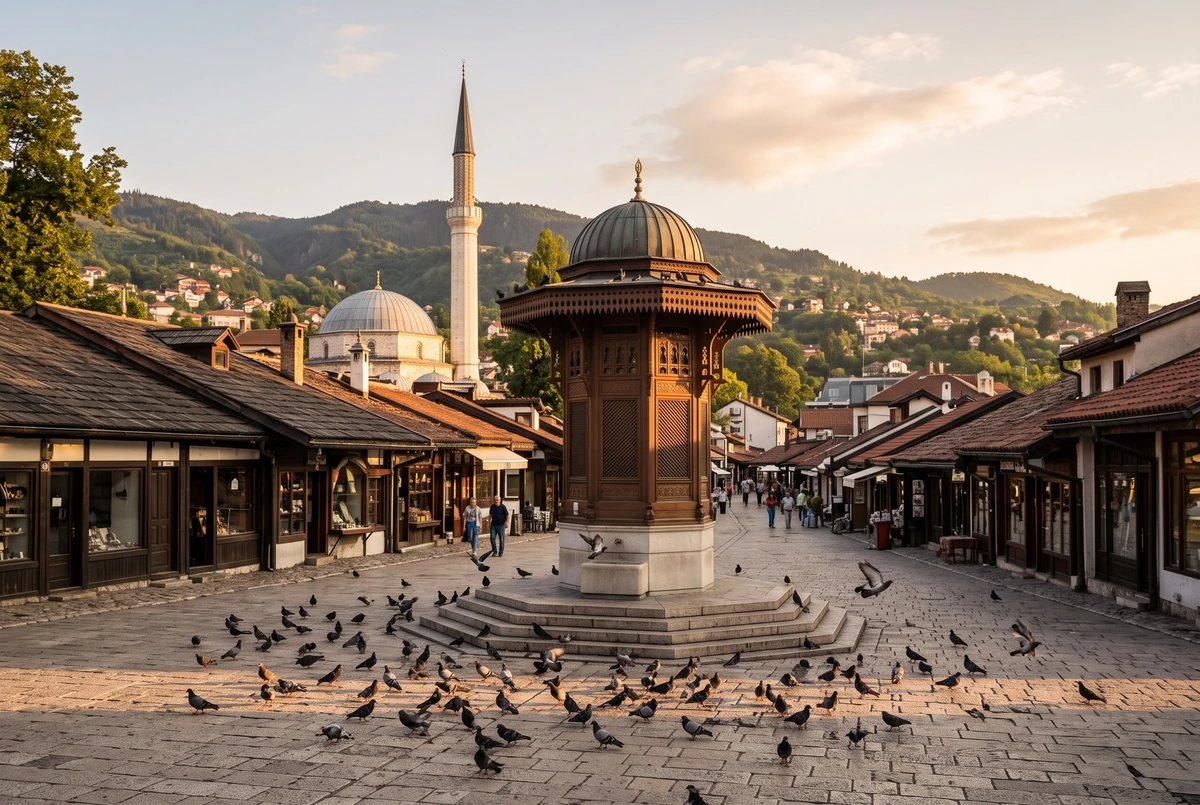
At the centre stands the Sebilj, the wooden-style public fountain built in 1891 that has become the symbol of the city, surrounded by the pigeons of Pigeon Square. Any Baščaršija tour revolves around this square, and the guide explains how the bazaar grew around a caravan road, a mosque and a public bath. You pass here twice, so there is time for photos and a quick browse.
The Latin Bridge and the Emperor's Mosque
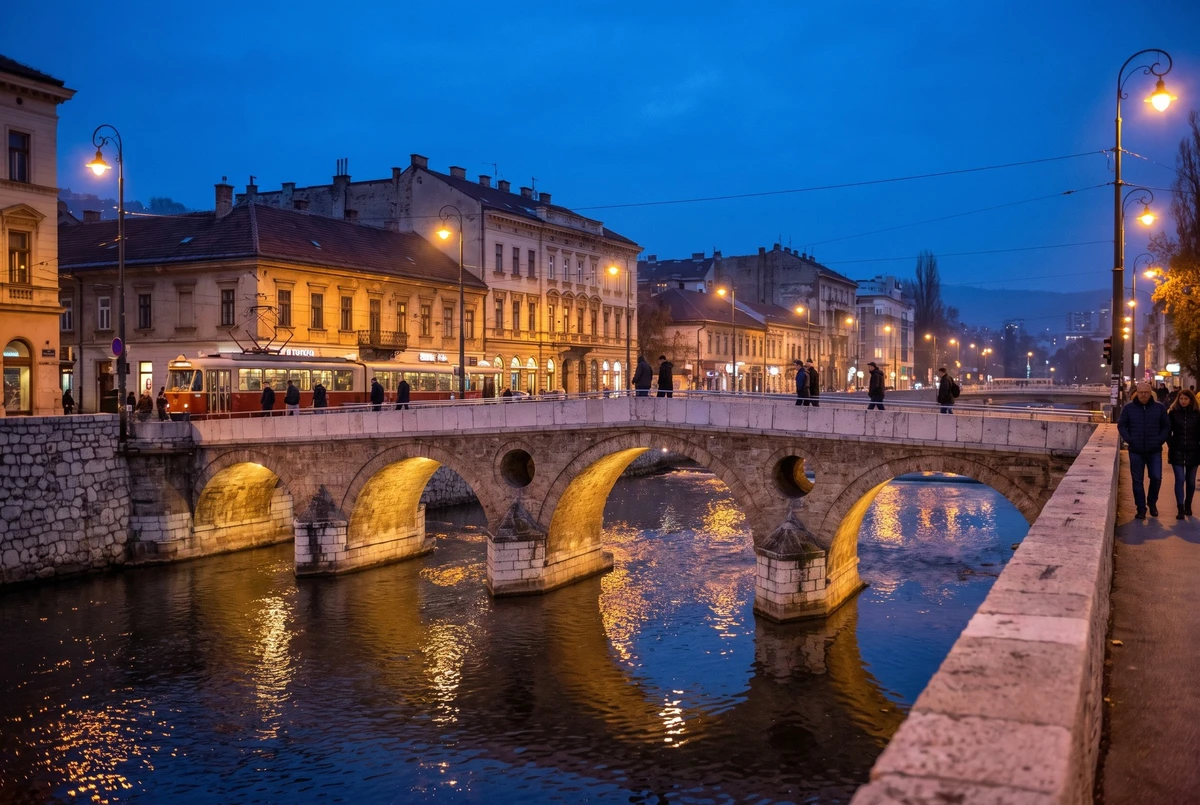
The walk begins beside the Latin Bridge, a small Ottoman stone bridge over the Miljacka river with three arches and a long history as the crossing between the old town and the south bank. It is famous for a single moment: on 28 June 1914, at its northern end, the shots were fired that triggered the First World War. The guide tells the story at the spot itself, in front of the small museum on the corner, and explains how the event changed Sarajevo, Bosnia and the whole of Europe.
A few steps along the river stands the Emperor's Mosque, the first mosque built in Sarajevo after the Ottoman arrival in the fifteenth century and rebuilt in its present form in the sixteenth. Its calm courtyard and river setting make it one of the quietest corners of the walk and a good introduction to Ottoman religious architecture before the busier Gazi Husrev-beg complex later on.
Vijećnica, the Sarajevo City Hall
Few buildings sum up Sarajevo like the City Hall, known locally as Vijećnica. Completed in 1896 by the Austro-Hungarian administration in a striped neo-Moorish style, it later became the National and University Library, and in August 1992, during the siege, it was shelled and burned with most of its collection. The restoration took years and the building reopened in 2014 with its coloured glass dome, horseshoe arches and painted ceilings recreated in detail. Today it hosts the city council, exhibitions and a memorial to what was lost.
On this walking tour you go inside, which is something many visitors to Sarajevo miss, and the guide explains both the Ottoman-inspired design and the modern story of destruction and rebirth. From the terrace opposite, across the river, you get the classic photograph of the facade reflected in the Miljacka. Allow about twenty minutes here; it is one of the longest stops of the route.
Gazi Husrev-beg Mosque, Morića Han and the clock tower
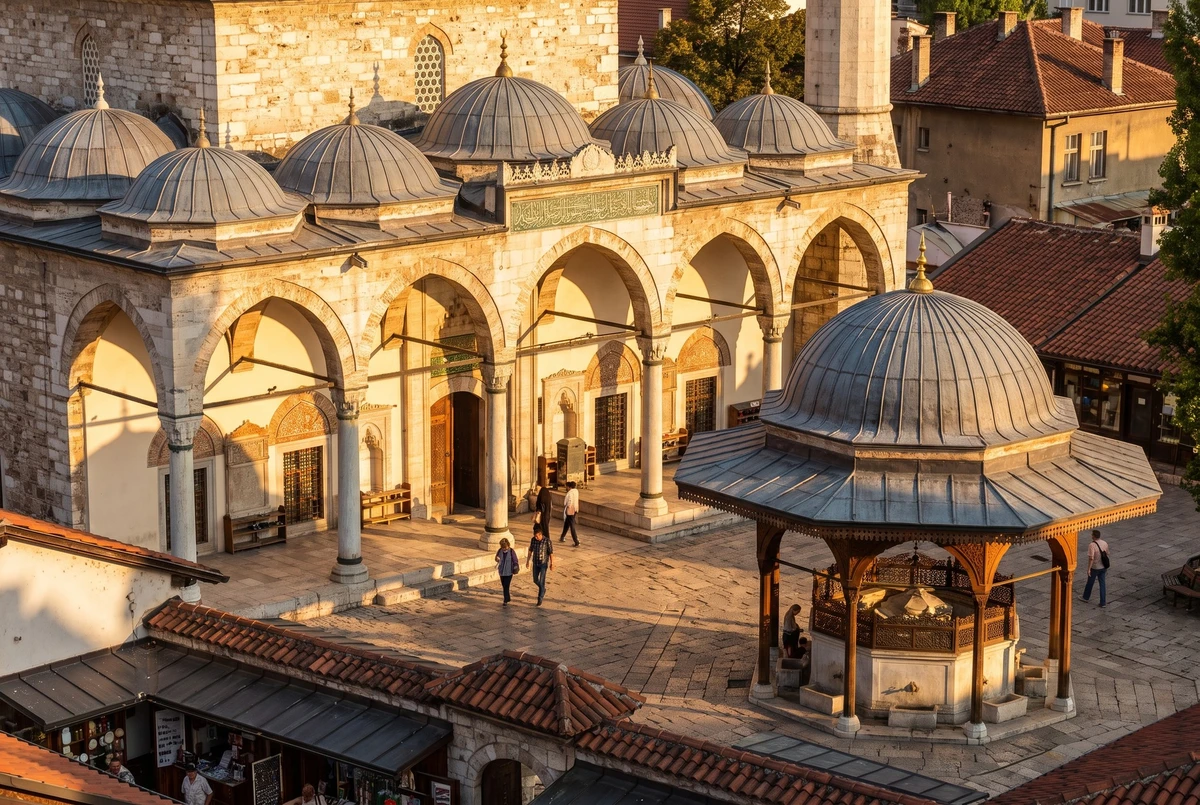
The Gazi Husrev-beg Mosque, finished in 1532, is the largest historic mosque in Bosnia and the centre of an endowment that shaped the whole old town: a madrasa, a covered market, a library, a public kitchen and a clock tower that still shows lunar time so that prayer hours can be read from it. The courtyard with its fountain is open to visitors outside prayer times, and the guide explains the Ottoman system of charitable foundations that paid for all of this.
Nearby is Morića Han, the only preserved caravanserai in Sarajevo, where merchants arriving along the trade routes stabled their horses downstairs and slept upstairs; today the arcaded courtyard holds carpet sellers and coffee tables. This part of the route also includes the visit to a traditional baklava shop, a chance to taste the walnut and syrup pastry that Sarajevo makes in its own style.
Sarajevo Meeting of Cultures and the Austro-Hungarian quarter
On Ferhadija street a line set into the pavement marks the Sarajevo Meeting of Cultures: behind you the low Ottoman bazaar, ahead the tall Central European facades built after 1878. Standing on it is the simplest way to understand the city, and it makes a popular photo. From here the walk continues past the Sacred Heart Cathedral, the neo-Gothic Catholic cathedral of 1889, and the Orthodox Cathedral of the Nativity of the Theotokos, completed in 1868 with its five domes and tall baroque bell tower.
A short walk away stands the Old Temple, a Sephardic synagogue from the sixteenth century that now houses the Museum of the Jews of Bosnia and Herzegovina. Within a few hundred metres you have seen a mosque, two cathedrals and a synagogue, which is why Sarajevo is often described as the Jerusalem of Europe, and the guide explains how these communities lived together across the centuries.
City Market Hall and the Eternal Flame
The City Market Hall, called Markale, was built in 1895 as a covered market in the style of the great Austro-Hungarian cities, with cast-iron columns and a glass roof over stalls of cheese, cured meat, honey and dried fruit. It is still a working market where locals shop, and the guide takes you inside for a few minutes to see the produce and explain the market's role in the city's daily life, including the hard years of the 1990s.
The route ends at the Eternal Flame on Ferhadija, a memorial lit in 1946 to the liberation of Sarajevo in the Second World War, set in a niche beneath a dedication to the city's military and civilian victims. The flame is a natural finishing point: the pedestrian street leads back towards Baščaršija in one direction and towards the modern centre in the other, and the guide is happy to recommend where to eat afterwards.
Itinerary
- Meeting at Zelenih beretki 30Meet your licensed guide at the office near the Latin Bridge at 10:00 or 14:00. Introduction and city map.
- Latin Bridge and Emperor's MosqueThe 1914 assassination site and the oldest mosque of the city on the south bank. About 20 minutes.
- City Hall (Vijećnica)Inside visit to the restored neo-Moorish City Hall, then the view from across the river. About 20 minutes.
- House of Spite and the river viewpointThe famous house that was moved brick by brick across the Miljacka, and a short viewpoint stop over the old town roofs. About 15 minutes.
- Baščaršija: Bravadžiluk, Kazandžiluk and the SebiljThe ćevapi street, the coppersmiths' lane and the Sebilj fountain in Pigeon Square. About 30 minutes.
- Morića Han, baklava shop and Gazi Husrev-beg MosqueThe Ottoman caravanserai, a tasting stop at a traditional baklava shop and the great mosque complex with its clock tower. About 35 minutes.
- Sarajevo Meeting of Cultures and the places of worshipThe east-west line on Ferhadija, the Old Temple and Jewish museum, the Catholic cathedral and the Orthodox cathedral. About 30 minutes.
- City Market Hall and Eternal FlameA short visit inside the market hall, then the end of the walk at the Eternal Flame on Ferhadija, around three hours after the start.
What's included
- Licensed local guide in English
- Three-hour guided walk through Baščaršija and the Austro-Hungarian centre
- Stops at the Latin Bridge, City Hall, Sebilj, Morića Han and Gazi Husrev-beg Mosque
- Visit to a traditional baklava shop and the city market hall
- City map
Not included
- Food and drinks
- Tips
- Hotel pickup
Is this right for you?
Great for
- Families with children — a child price for ages 7–14
- Groups who want privacy — a private option is available
- First-time visitors who want the highlights
- A half-day plan — about 3 hours
Think twice if
- Walking is difficult for you — expect active parts
Not suitable for
- People with limited mobility
- Wheelchair users
Meeting point
Meet your guide at the local office at Zelenih beretki 30, Sarajevo 71000, a two-minute walk from the Latin Bridge in the old town. Departures are at 10:00 and 14:00; please arrive ten minutes early. The tour ends at the Eternal Flame on Ferhadija street, about ten minutes on foot from the starting point. Hotel pickup is not included, but the meeting point is easy to reach on foot from any hotel in the centre or by tram to the Latin Bridge stop.
Important information
- Wear comfortable shoes: the route is about three hours on foot over cobbles and a few short slopes
- Dress modestly for the mosque visit; shoulders and knees covered, and shoes are removed inside
- Mosque courtyards may be closed briefly at prayer times; the guide adjusts the order of stops
- Bring water in summer and a light rain jacket in spring and autumn; the walk runs in all weather
- Food and drinks are not included; bring some cash for baklava, coffee or market produce
- The City Hall visit may be replaced by an outside view on days with official events
- Children are welcome when accompanied by an adult; strollers manage most of the route
- A private version in English, Croatian, Spanish, French or Italian can be chosen in the booking panel
Good to know
Frequently Asked Questions
Straight answers to what travellers ask us most, before they book.
Is this a shared or a private walking tour?
The standard option is a shared walk with a licensed guide in English. If you prefer your own guide and a flexible pace, a private version in English, Croatian, Spanish, French or Italian is listed as a separate option on this page.
How long does the Sarajevo walking tour take?
About three hours, with departures at 10:00 and 14:00. The route is a loop of roughly three kilometres through the old town and the Austro-Hungarian centre.
Is hotel pickup included?
No. You meet the guide at Zelenih beretki 30, two minutes from the Latin Bridge, which is a short walk or tram ride from any hotel in central Sarajevo.
What is included?
A licensed local guide in English, the three-hour guided walk, entry to the City Hall, a visit to a traditional baklava shop and the city market hall, and a city map. Food, drinks and tips are not included.
Is the price per person or per group?
Per person. The booking panel on this page shows the current price of each option for adults and children.
Is the tour suitable for children and people with reduced mobility?
Children are welcome with an adult and most families find three hours manageable with a break at the baklava shop. The cobbled lanes and steps make it unsuitable for wheelchair users and people with limited mobility; contact us for a shorter private alternative.
What should I bring?
Comfortable walking shoes, water in summer, a light jacket in cooler months, modest clothing for the mosque visit and some cash for snacks and coffee.
What is the best time of day for the walk?
The 10:00 departure sees the bazaar opening and the market hall at its busiest; the 14:00 departure is better if you arrive in the city that morning. In July and August the morning walk is cooler.
Do we go inside the Gazi Husrev-beg Mosque?
You visit the courtyard and, outside prayer times and with modest dress, the guide can take you into the prayer hall. During prayers the visit is limited to the courtyard.
Is Baščaršija worth visiting with a guide?
Yes. The bazaar looks like a cluster of souvenir lanes until someone explains the trades, the caravanserai, the endowments and the stories behind each street. The guide also shows you which shops still make copper and leather goods by hand.
What happens in bad weather?
The walk runs rain or shine. Several stops are indoors (City Hall, market hall, baklava shop, museum entrances) and the guide shortens outdoor stops if it rains heavily.
How do I book and confirm?
Pick your date, time and option in the booking panel and complete the booking. Our team confirms on WhatsApp within minutes and sends the exact meeting point.
More in Sarajevo