Munich Third Reich & WWII History Walking Tour
- Duration2.5 hours (165 minutes)
- Daily
- Group
Some images are AI-generated for illustration. While we confirm your booking, just ask and we will send you the original photos.
- Fair, honest prices
- Real people, not bots
- Confirm, then pay
- Secure payment

Overview
This Munich Third Reich and WWII walking tour is a shared 2.5-hour walk in English with an expert guide, starting at 10:30 am on Marienplatz. On foot you follow how the Nazi movement rose in Munich after World War I: the revolution and hyperinflation of the early 1920s, the first mass meeting at the Hofbräuhaus, the failed attempt to seize power at the Feldherrnhalle in 1923, the party quarter around Königsplatz and the student resistance of the White Rose, remembered in the Hofgarten. The guide explains the sites that still stand, those removed after 1945 and how the city deals with this history today. The flat, wheelchair-accessible route ends at Königsplatz. It suits history-minded adults and teenagers from thirteen; a private version is available, and there is no hotel pickup.
Highlights
- 2.5-hour history walk in English with an expert guide, from Marienplatz to Königsplatz
- Munich after World War I: revolution, hyperinflation and the roots of the Nazi movement
- The Hofbräuhaus hall where the party held its first mass meeting in 1920
- The Feldherrnhalle, scene of the failed attempt to seize power in November 1923
- Viscardigasse, the lane where Munich residents avoided the compulsory salute
- The Hofgarten and the story of the White Rose student resistance
- Königsplatz, the former party quarter and the NS Documentation Centre
- Flat, wheelchair-accessible route; private option available for your own group
Full Description
Marienplatz and Munich after World War I
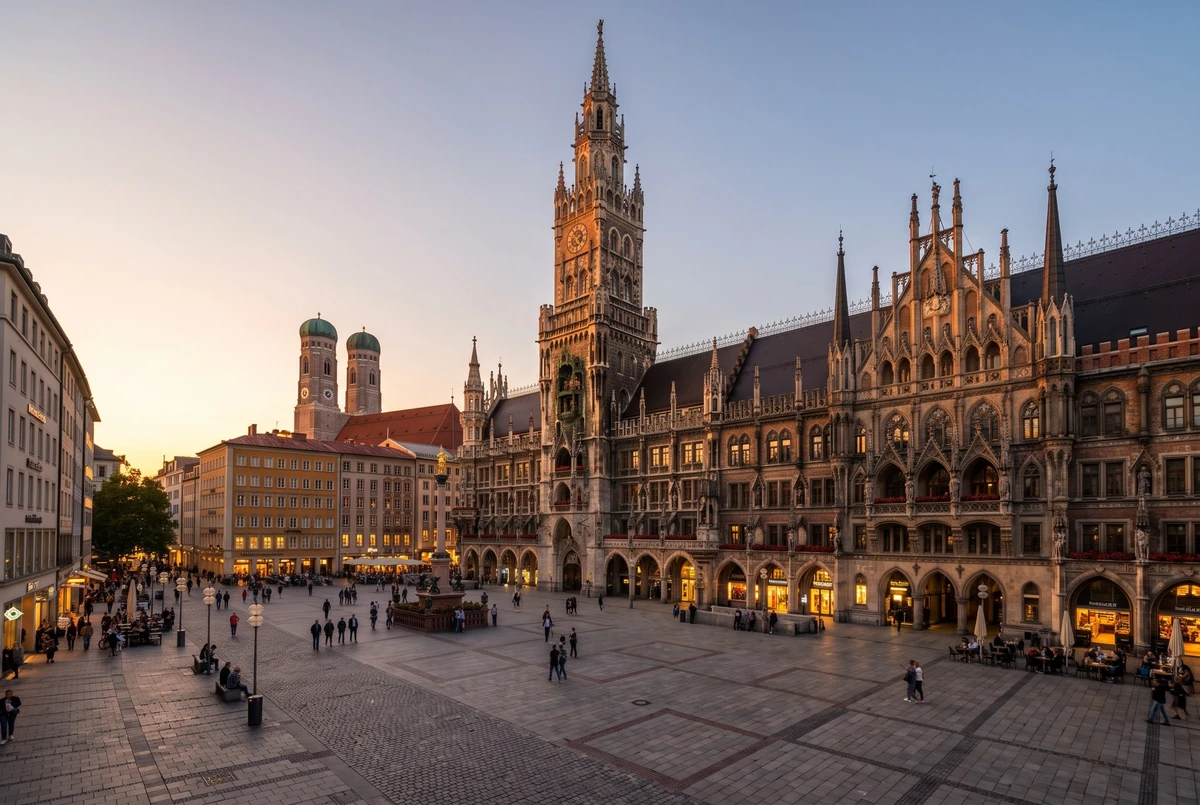
The Munich history walking tour begins on Marienplatz in front of the New Town Hall, the neo-Gothic building of 1867 to 1908 whose Glockenspiel draws the crowds at eleven. Your guide uses the square to set the scene of 1918 and 1919: a defeated Germany, a revolution that toppled the Bavarian monarchy, a short-lived Soviet republic crushed by troops in the streets around you and the hyperinflation that wiped out savings in 1923.
This chaos is the soil in which the Nazi movement grew, and the guide explains why Munich of all cities became its birthplace: the army units stationed here, the nationalist clubs, the fear of another revolution. You also see how the square itself was rebuilt after the bombing of World War II, which destroyed much of the Old Town. About twenty minutes are spent here before the walk heads to Platzl.
The Hofbräuhaus and the first mass meeting
A few minutes from Marienplatz, on the small square called Platzl, stands the Hofbräuhaus, a historic hall founded in 1589 and rebuilt in its present form in 1897. Its festival hall on the upper floor could hold two thousand people, which is why the young party chose it for its first mass meeting on 24 February 1920, when its twenty-five-point programme was read out to a packed room.
The guide explains what was said that evening, who listened and how a small group of agitators used halls like this to grow from a fringe club into a mass movement within three years. The building is seen from outside, and it is a good place to understand how ordinary the beginnings looked. Visitors who search for Munich Third Reich sites often start here; the tour puts it in context before moving on to the Residenz and Odeonsplatz. Allow about fifteen minutes.
The Feldherrnhalle, Odeonsplatz and Viscardigasse
The Feldherrnhalle is the open loggia on Odeonsplatz built in the 1840s in the style of Florence to honour the Bavarian army. On 9 November 1923 it became the place where the party's attempt to seize power ended: marchers coming from the river were stopped here by state police, shots were exchanged, sixteen marchers and four policemen died and the leaders were arrested and tried. After 1933 the regime turned the spot into a shrine with an honour guard that every passer-by had to salute.
Behind the loggia runs Viscardigasse, a narrow lane that residents used to avoid the salute; a line of bronze cobbles set into the paving now marks their small act of refusal. Your guide tells the story of the march, the trial that followed and the way the site was used for propaganda. With the Theatine Church and the Residenz around you, this is also one of the most beautiful corners of Munich. Plan about twenty-five minutes here.
The Hofgarten and the White Rose resistance
Next to Odeonsplatz lies the Hofgarten, the Renaissance court garden of 1613 with its central temple, fountains and arcades. On its eastern edge stands the Bavarian State Chancellery, built around the preserved dome of the former Army Museum, which was left in ruins as a reminder of the war, and in front of it the war memorial sunk into the lawn.
Here the tour pauses to tell the story of the White Rose, the group of Munich university students and a professor who printed and distributed leaflets against the regime in 1942 and 1943, were caught after scattering them in the university's atrium and were executed within days. The guide explains who they were, what they wrote and how Munich remembers them today, with a memorial of leaflets set into the pavement outside the university a short walk away. It is the most moving stop of the walk, around twenty minutes in a quiet setting.
Königsplatz and the former party quarter
The walk ends on Königsplatz, the neoclassical square laid out in the early nineteenth century with the Glyptothek, the State Collection of Antiquities and the Propylaea gate. In the 1930s the party made this its ceremonial centre: the lawns were paved with granite slabs for rallies and torchlight parades, two temples of honour were built for the dead of 1923 and the surrounding streets filled with party offices.
Your guide shows what remains and what was removed: the temples were blown up in 1947 and their foundations are now overgrown, while the former party administration building and the so-called Führerbau, where the Munich Agreement was signed in 1938, survive as the University of Music and Theatre, where the tour finishes. On Brienner Straße the site of the former party headquarters is now the NS Documentation Centre, opened in 2015, which is free to visit and the natural next step after the tour; many guests spend an hour or two there.
Itinerary
- Meeting at MarienplatzMeet the guide in front of the Munich Tourist Information in the New Town Hall on Marienplatz a few minutes before 10:30.
- Marienplatz and the aftermath of World War IRevolution, hyperinflation and why the movement began in Munich; about 20 minutes.
- Hofbräuhaus on PlatzlThe hall of the first mass meeting in 1920, seen from outside; around 15 minutes.
- Feldherrnhalle, Odeonsplatz and ViscardigasseThe failed attempt to seize power in 1923, the shrine and the lane of the refusers; about 25 minutes.
- HofgartenThe court garden, the State Chancellery and the story of the White Rose; around 20 minutes.
- Brienner Straße to KönigsplatzWalk through the former party quarter past the NS Documentation Centre to the rally ground; about 30 minutes.
- End at KönigsplatzThe tour ends in front of the University of Music and Theatre; the Documentation Centre and the museums are steps away.
What's included
- 2.5-hour guided walking tour with an English-speaking guide
- Marienplatz and the story of Munich after World War I
- The Hofbräuhaus, site of the first mass meeting of the Nazi movement
- The Feldherrnhalle and the failed attempt to seize power in 1923
- The Hofgarten and the White Rose resistance movement
- Königsplatz, the site of the party rallies
- Wheelchair-accessible route
Not included
- Meals and drinks
- Hotel pickup
- Gratuities
Is this right for you?
Great for
- Families with children — a child price for ages 13–17
- Groups who want privacy — a private option is available
- First-time visitors who want the highlights
- A half-day plan — about 2.5 hours
Think twice if
- Walking is difficult for you — expect active parts
Meeting point
The tour starts in front of the Munich Tourist Information in the New Town Hall on Marienplatz, directly under the Glockenspiel tower in the city centre. Please arrive about ten minutes before the 10:30 start so the guide can check your booking; Marienplatz has its own S-Bahn and U-Bahn station, two stops from the main station. The walk ends at Königsplatz in front of the University of Music and Theatre, next to the Königsplatz U-Bahn station. There is no hotel pickup for this walking tour.
Important information
- Duration about 2.5 hours (165 minutes) on flat city streets; wear comfortable shoes
- The tour is in English; the route is wheelchair accessible and stroller-friendly
- All sites are seen from outside; no entrance fees are needed
- The walk takes place in all weather; bring a rain jacket or umbrella on wet days and water in summer
- The subject matter is serious; we recommend the tour for ages thirteen and above
- Pets are allowed on the walk
- Meals, drinks, hotel pickup and gratuities are not included
- A private version with flexible start times is available for your own group
- Have your booking voucher ready on your phone when you meet the guide
Good to know
Frequently Asked Questions
Straight answers to what travellers ask us most, before they book.
Is this a shared or a private experience?
The standard option is a shared group walk with an English-speaking guide. A private version of the same route for your own group, with hourly start times through the day, can be chosen in the booking panel.
How long does the Munich Third Reich walking tour take?
About 2.5 hours, from 10:30 am to around 1:15 pm, ending at Königsplatz.
Is hotel pickup included?
No. You meet the guide on Marienplatz, which is served by all S-Bahn lines and two U-Bahn lines.
What is included?
A 2.5-hour guided walk with an expert English-speaking guide covering Marienplatz, the Hofbräuhaus, the Feldherrnhalle, the Hofgarten and Königsplatz, with all the history explained. Meals, drinks and gratuities are not included.
Is the price per person or per group?
The shared tour is priced per person and the private option per group. The booking panel on this page shows the current price of each option.
Is it suitable for children and for people with reduced mobility?
The route is flat and wheelchair accessible. Because of the subject matter we recommend it for teenagers from thirteen and adults rather than small children.
Do we go inside any buildings or museums?
No, the sites are seen from outside and explained by the guide. The NS Documentation Centre at Königsplatz, where the tour ends, is free to visit afterwards.
What should I bring?
Comfortable shoes, water in summer, a rain jacket on wet days and your phone with the booking voucher.
Is the tour respectful of the subject?
Yes. It is a serious history walk led by trained guides who explain how the movement rose, who resisted and how Munich remembers; there is no glorification of any kind.
What happens in bad weather?
The tour runs rain or shine; the arcades at the Hofgarten and the Residenz give shelter at several stops.
What is the best time to visit Munich for this tour?
Any season works. Spring and autumn are most comfortable for a 2.5-hour walk; the morning start keeps the squares quiet before the lunchtime crowds.
How do I book and confirm?
Choose your date and option on this page and send the booking; our team confirms on WhatsApp within minutes and sends your voucher.
More in Munich

Getting to & around Munich
Popular across Germany
-
-
-
-
-
-