Porto Historic City Centre Guided Walking Tour
- Duration3 hours
- Daily
- Group
Some images are AI-generated for illustration. While we confirm your booking, just ask and we will send you the original photos.
- Fair, honest prices
- Real people, not bots
- Confirm, then pay
- Secure payment

Overview
This guided walking tour of Porto's historic centre covers the heart of the UNESCO-listed old town in about three hours. In the default shared option, a local English-speaking guide meets you in front of Porto Cathedral and leads a small group from the cathedral square to the viewpoint by the Luís I Bridge, then through the medieval lanes of Pena Ventosa and Rua da Bainharia to Rua das Flores, where you take a short break. The walk continues to São Bento Station and its famous tile panels, Avenida dos Aliados and Rua dos Clérigos. Along the way you learn how Porto grew from a hilltop settlement into a merchant city. It suits curious travellers aged twelve and over. There is no pickup, and a private option is also available.
Highlights
- Porto Cathedral and the Terreiro da Sé terrace
- Views over the Douro from beside the Luís I Bridge
- Pena Ventosa, the oldest quarter of the city
- Medieval Rua da Bainharia and elegant Rua das Flores
- São Bento Station and its blue-and-white azulejo panels
- Avenida dos Aliados and Rua dos Clérigos
- Small group with a local English-speaking guide
- Morning and afternoon starts, about three hours
Full Description
Terreiro da Sé and Porto Cathedral
The walk starts on the Terreiro da Sé, the wide granite terrace in front of Porto Cathedral. Begun in the twelfth century, the cathedral looks more like a fortress than a church, with twin square towers and battlements, and it has been rebuilt in Gothic and Baroque styles over the centuries. Its cloister, lined with eighteenth-century azulejo tiles, can be visited separately with an entrance ticket.
From the terrace you get a sweeping view over the rooftops of the old town down to the Douro, and your guide uses it to explain how the city developed on this hill. Next to the cathedral stands the Episcopal Palace, and in the middle of the square a carved stone column recalls the medieval symbols of municipal justice. It is the perfect place to begin a Porto historic centre tour.
Views from the Luís I Bridge
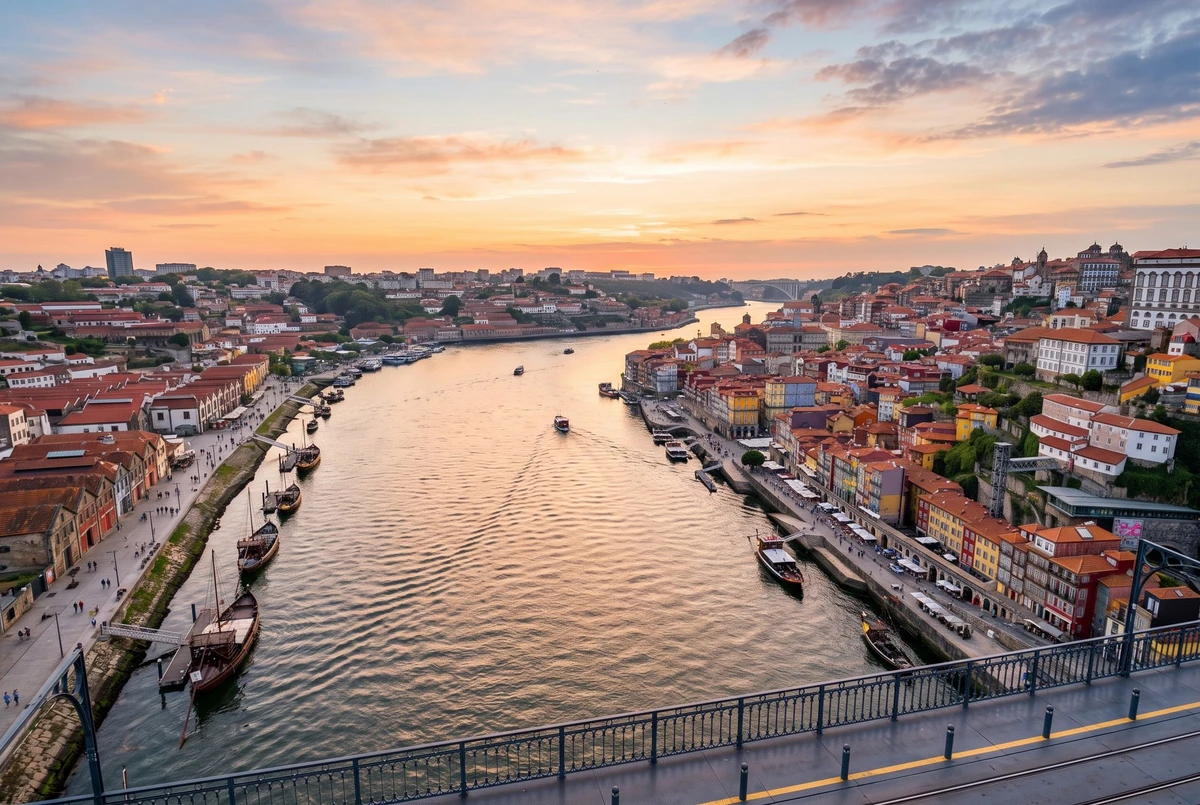
A few steps from the cathedral, the route reaches the upper level of the Luís I Bridge, the iron arch of 1886 that links Porto with Vila Nova de Gaia. Stopping here for about fifteen minutes, you look straight down the river: the colourful façades of Ribeira on one bank, the hillside of Gaia with its old riverside warehouses on the other, and the traditional rabelo boats moored below.
Your guide explains how the bridge transformed the city in the nineteenth century, when a double deck allowed traffic to cross both at river level and at the height of the upper town. It is one of the most photographed spots in Porto, and in the morning light or late afternoon the view of the Douro is at its very best.
Pena Ventosa and Rua da Bainharia: medieval Porto
Behind the cathedral lies Pena Ventosa, the rocky hill where Porto began. Settlements stood here before the Romans, and in the Middle Ages the first city wall encircled this small summit; a few stretches of it and a reconstructed medieval tower can still be seen. Largo da Pena Ventosa is a quiet square of tall, narrow houses with iron balconies and washing hanging from the windows.
From here you descend Rua da Bainharia, a twisting medieval street named after the makers of sword scabbards who once worked along it. The lane follows the slope of the hill, with granite steps, tiled façades and tiny shops, and it gives a real sense of how dense and vertical the old town was. This is the part of Porto many visitors never find on their own.
Rua das Flores
Rua das Flores was opened in the early sixteenth century on land that once belonged to the bishop's gardens, which gave it its name, the street of flowers. Wealthy merchant families built their mansions here, many still marked by coats of arms above the doors, and the street became famous for its goldsmiths and silversmiths.
Today it is a pedestrian street of restored façades, craft shops, bookshops and cafés, and the Church of Mercy, with its richly decorated Baroque front, stands halfway along. The tour pauses here for a short break of about twenty minutes, giving you time for a coffee or a pastry at your own expense, before continuing towards São Bento. It is one of the most charming streets for photos in the whole city.
São Bento Station and its azulejo panels
São Bento Station was built on the site of a sixteenth-century Benedictine convent and opened in 1916. Its great entrance hall is covered with tile panels of blue and white azulejos, created in the early twentieth century, showing episodes of Portuguese history, from medieval battles to royal arrivals, together with colourful friezes illustrating rural life and transport in the north of the country.
The tour spends about thirty minutes here, the longest stop of the walk, so your guide can read the panels with you and explain the art of azulejos, which arrived in Portugal from Spain and the Islamic world and became a national tradition. Is São Bento Station worth visiting? Absolutely, and it is still a working station, with trains leaving for the Douro Valley and the coast.
Avenida dos Aliados and Rua dos Clérigos
From the station you walk up to Avenida dos Aliados, the grand boulevard of the early twentieth century, lined with banks and offices in Beaux-Arts style and crowned by the granite City Hall and its clock tower. Your guide explains how this modern city centre was built over old streets and gardens, and how it became the stage for celebrations and public life.
The last stretch climbs Rua dos Clérigos, a steep street of shops and cafés leading to the Clérigos Church and its slender eighteenth-century tower, the symbol of the city. The tour ends nearby, in the upper part of the old town, close to Livraria Lello, the university area and plenty of places for lunch. Your guide shares tips for the rest of your stay before saying goodbye.
Itinerary
- Terreiro da SéMeet your guide in front of Porto Cathedral and enjoy the views from the terrace; about 20 minutes.
- Luís I BridgePhoto stop and views over the Douro, Ribeira and Gaia; about 15 minutes.
- Largo da Pena VentosaExplore the oldest quarter of Porto and the remains of its first wall; about 20 minutes.
- Rua da BainhariaWalk down the twisting medieval street of the scabbard makers; about 20 minutes.
- Rua das FloresStroll the elegant pedestrian street with a short break; about 20 minutes.
- São Bento StationDiscover the famous azulejo panels of the station hall; about 30 minutes.
- Avenida dos AliadosSee the grand boulevard and City Hall; about 20 minutes.
- Rua dos ClérigosClimb towards the Clérigos Church and tower, where the tour ends; about 20 minutes.
What's included
- English-speaking local guide
- Terreiro da Sé and the cathedral square
- Views from the Luís I Bridge
- Largo da Pena Ventosa and Rua da Bainharia in the medieval quarter
- Rua das Flores with a short break
- São Bento Station and its tile panels
- Avenida dos Aliados and Rua dos Clérigos
Not included
- Food and drinks
- Entrance tickets to monuments
- Not suitable for people with mobility impairments
Is this right for you?
Great for
- Families with children — a child price for ages 12–17
- Groups who want privacy — a private option is available
- History and culture lovers
- First-time visitors who want the highlights
Think twice if
- Walking is difficult for you — expect active parts
Not suitable for
- People with mobility impairments
Meeting point
Meet your guide in front of Porto Cathedral on the Terreiro da Sé, the large terrace beside the cathedral, at 10:00 or 15:00. It is about five minutes on foot uphill from São Bento Station. There is no pickup. The tour ends near Rua dos Clérigos in the upper old town. We send the exact meeting point and map pin with your confirmation.
Important information
- Arrive 10 minutes before the start in front of the cathedral
- Wear comfortable shoes and clothes; Porto's streets are steep and cobbled
- Food, drinks and monument entrance tickets are not included
- The short break on Rua das Flores is at your own expense
- Child tickets cover ages 12 to 17
- The tour runs in light rain, so bring an umbrella in the cooler months
- Bring water and sunscreen in summer
Good to know
Frequently Asked Questions
Straight answers to what travellers ask us most, before they book.
Is this a shared or a private experience?
The default option is a shared small-group walking tour. A private option with a guide for your group only is also available in the booking panel.
How long does the walking tour take?
About three hours, including a short break on Rua das Flores.
Is hotel pickup included?
No. The tour starts in front of Porto Cathedral, about five minutes on foot from São Bento Station.
What is included?
A local English-speaking guide and the walk through the cathedral square, the Luís I Bridge viewpoint, Pena Ventosa, Rua da Bainharia, Rua das Flores, São Bento Station, Avenida dos Aliados and Rua dos Clérigos.
Is the price per person or per group?
The tour is priced per person, with child tickets for ages 12 to 17. The booking panel on this page shows the current price of each option.
Is it suitable for children or people with reduced mobility?
It suits older children and teenagers who enjoy walking. It is not suitable for people with mobility impairments, as the route includes steep slopes, steps and cobblestones.
Do we go inside the cathedral or other monuments?
The tour is a walk through the streets and squares; monument entrance tickets are not included. São Bento Station is the exception, as its hall is open to everyone.
How much walking is involved?
Around three kilometres at a gentle pace, with some climbs, especially on Rua dos Clérigos at the end.
What should I bring?
Comfortable shoes, water, a camera, sunscreen in summer and an umbrella in winter.
Is the morning or afternoon tour better?
The 10:00 walk is cooler in summer and catches the morning light on the river, while the 15:00 walk ends close to the golden hour. Both follow the same route.
Is Porto's historic centre worth visiting?
Yes. It has been a UNESCO World Heritage Site since 1996, and its medieval lanes, tiled churches and river views make it one of the most atmospheric old towns in Europe.
How do I book and confirm?
Choose your date and time in the booking panel and send your request. Our team confirms your booking on WhatsApp within minutes.
More in Porto
Popular across Portugal
-
-
-
-

-
-