Lyon Old Town and Fourviere Guided Walking Tour
- Duration1.5 hours (about 2-3 km of walking)
- Daily
- Group
Some images are AI-generated for illustration. While we confirm your booking, just ask and we will send you the original photos.
- Fair, honest prices
- Real people, not bots
- Confirm, then pay
- Secure payment

Overview
This Lyon walking tour is a shared small-group walk of up to ten guests with a native English-speaking guide, covering the top sights in about two hours. It starts on Place Bellecour, rides the funicular up Fourvière hill with tickets included, and visits the Basilica of Notre-Dame de Fourvière with its viewpoint over the rooftops, then the ancient Roman theatres before walking down into Vieux Lyon: Saint-Jean-Baptiste Cathedral, the hidden Longue Traboule and the Renaissance streets with their bouchon restaurants. The route crosses the Saône to end at Place des Terreaux with the Bartholdi Fountain and the City Hall. It suits first-time visitors who want Lyon's Roman, Renaissance and modern layers in one relaxed five-kilometre walk. There is no hotel pickup; a shorter ninety-minute version is also offered.
Highlights
- Two-hour small-group walk, maximum ten guests, with a native English-speaking guide
- Funicular ride up Fourvière hill with tickets included
- Basilica of Notre-Dame de Fourvière and the panoramic esplanade over Lyon
- The ancient Roman theatres of Lugdunum on the hillside
- Saint-Jean-Baptiste Cathedral and a hidden Renaissance traboule
- Vieux Lyon, the UNESCO-listed old town, with tips on traditional bouchon restaurants
- The banks of the Saône, Place des Terreaux, the Bartholdi Fountain and the City Hall
- Photo stops at the best viewpoints along the way
Full Description
Place Bellecour and the funicular to Fourvière
The walk starts on Place Bellecour, the vast open square at the centre of the Presqu'île, the peninsula between the Rhône and the Saône; it is among the largest pedestrian squares in Europe, with an equestrian statue in the middle, a Ferris wheel in winter and the tourist office on one side, so it is the natural starting point for any Lyon city highlights tour. From here the guide leads you across the Saône to the Vieux Lyon metro station, where the Fourvière funicular, running since 1900, climbs the steep hill in a few minutes; your tickets are included in the tour.
Our guide spends about ten minutes on Bellecour setting out the geography of the city, which makes the rest of the walk easy to follow: Roman hill, medieval and Renaissance old town below it, and the Presqu'île of merchants and silk weavers across the river. The funicular saves the long staircase that otherwise makes Fourvière hard work.
Basilica of Notre-Dame de Fourvière and the viewpoint
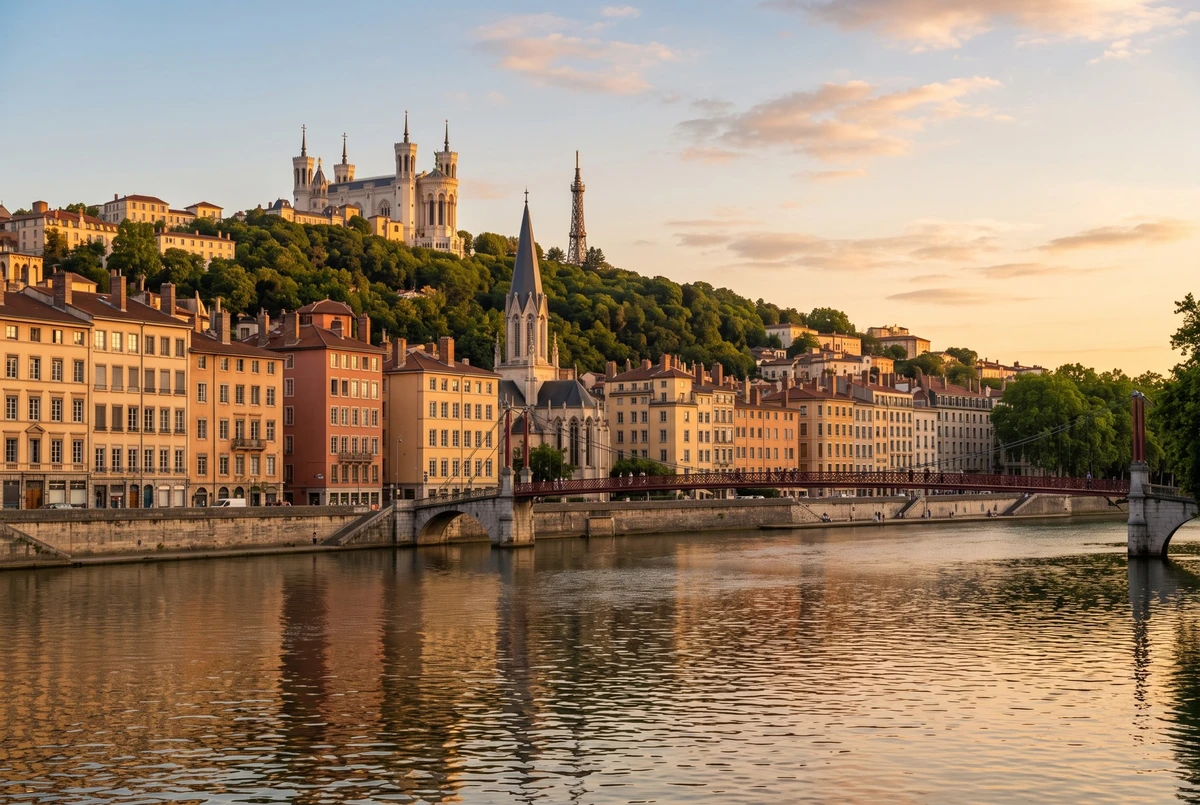
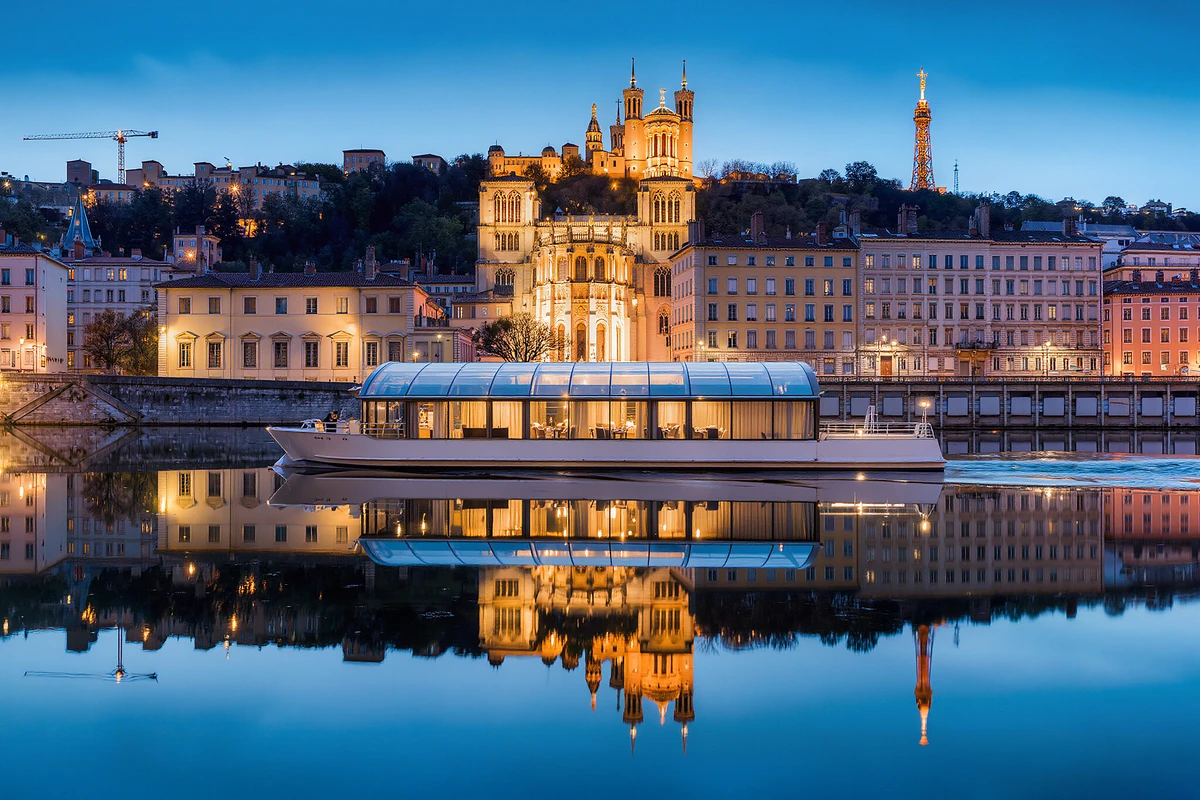
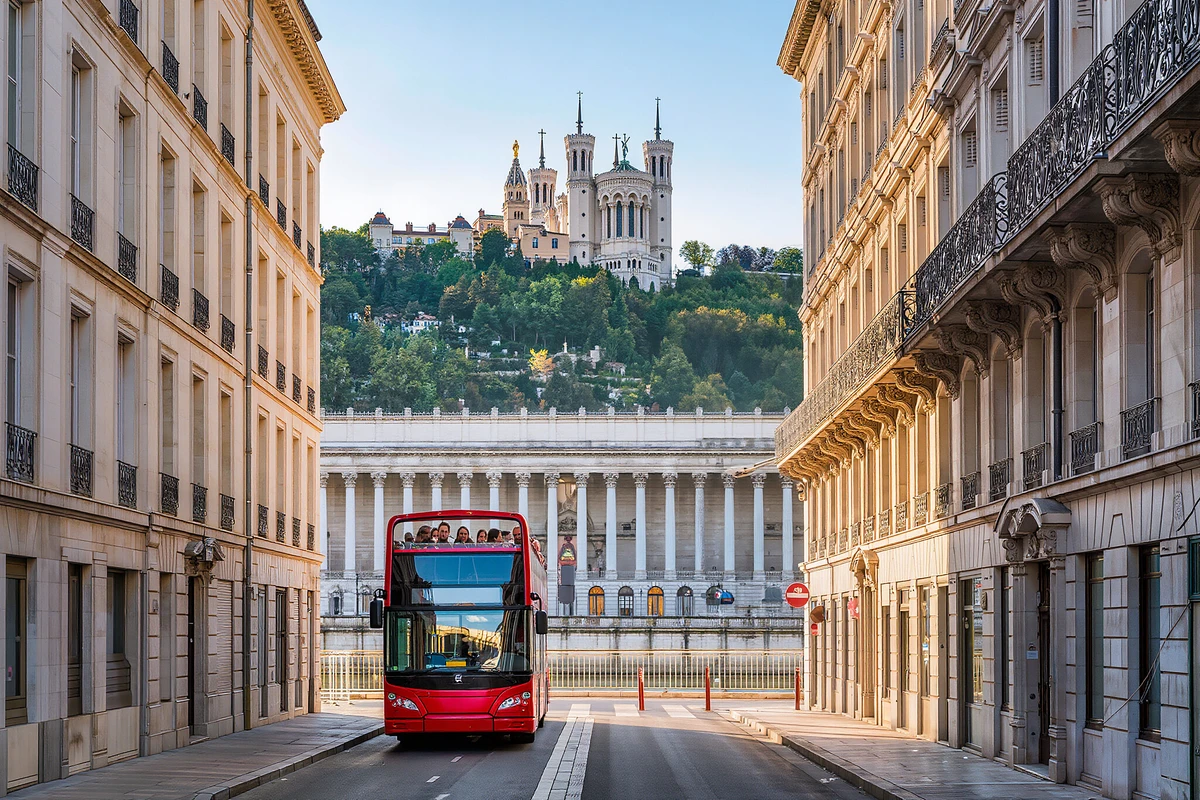
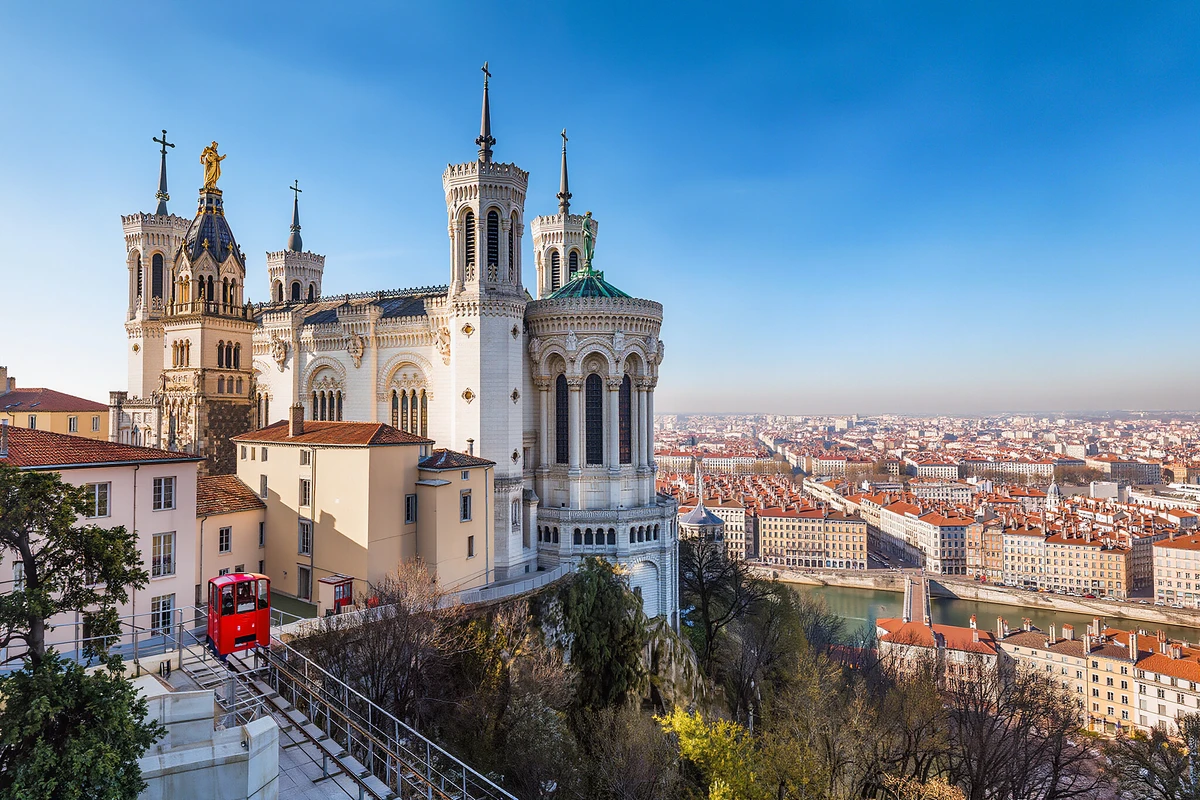
At the top of the hill stands the Basilica of Notre-Dame de Fourvière, built between 1872 and 1896 in a mix of Byzantine and Gothic styles that Lyonnais fondly call the upside-down elephant because of its four towers. The interior is covered in mosaics, marble and gilded detail, and the crypt below is a second church in its own right. Beside it the esplanade gives the classic panorama of Lyon: the red roofs of Vieux Lyon, the two rivers, the Presqu'île and, on a clear day, the white line of the Alps on the horizon.
The group spends about fifteen minutes here, enough for the guide to explain why the basilica was built, for a look inside if a service is not in progress, and for photos from the terrace. The Fourvière Basilica is open daily and entry is free, so you can return later for the rooftop tour or the museum of religious art, which are not included.
The ancient Roman theatres of Lugdunum
A few minutes' walk from the basilica the hillside opens onto the Roman theatres of Lugdunum, the colony founded in 43 BC that became the capital of Roman Gaul. The Grand Theatre, begun around 15 BC, is the oldest in France and once seated some ten thousand spectators on its curved stone tiers; beside it the smaller Odeon was used for music and readings and keeps its marble floor. Both are still used for a summer festival of concerts, and the archaeological museum built into the slope displays the mosaics, inscriptions and everyday objects found on the site.
The guide gives about ten minutes here, which is time to walk onto the tiers and understand how the Romans laid out the city on the hill before medieval Lyon moved down to the riverbank. Entry to the theatres is free and open daily; the museum beside them is a separate paid visit for another day.
Saint-Jean Cathedral and the Longue Traboule
Walking down the hill brings you into Vieux Lyon at the Cathedral of Saint-Jean-Baptiste, built between the 12th and 15th centuries and famous for its 14th-century astronomical clock, which still strikes and sets its figures moving several times a day. The square in front is the heart of the old town and the point where the three Renaissance quarters, Saint-Jean, Saint-Paul and Saint-Georges, meet. From here the guide leads you into the Longue Traboule, the longest of the hidden passageways that run from street to street through private courtyards and stairwells.
The traboules were built so that silk weavers and merchants could move goods between parallel streets without going round the block, and later served as escape routes for the Resistance during the Second World War. About fifteen minutes at the cathedral and ten in the traboule give you a real sense of how the old town works behind its doors.
Vieux Lyon and the bouchon restaurants
Vieux Lyon is the largest Renaissance district in France and the reason the city's historic centre was listed by UNESCO in 1998: rue Saint-Jean, rue du Bœuf and rue Juiverie are lined with 15th- and 16th-century merchants' houses in pink and ochre stone, with spiral staircase towers, galleried courtyards and carved doorways. This is also where you find the bouchons, the small traditional restaurants of Lyon serving quenelles of pike, salade lyonnaise, sausages with lentils, praline tart and the cheese spread called cervelle de canut on chequered tablecloths.
The guide walks the district for about twenty minutes, pointing out the Rose Tower and the finest courtyards, then shares recommendations for genuine bouchons rather than the tourist imitations, because food is the other reason people come to Lyon. Lunch or dinner is not included, so keep an appetite for after the tour.
The Saône, Place des Terreaux and the City Hall
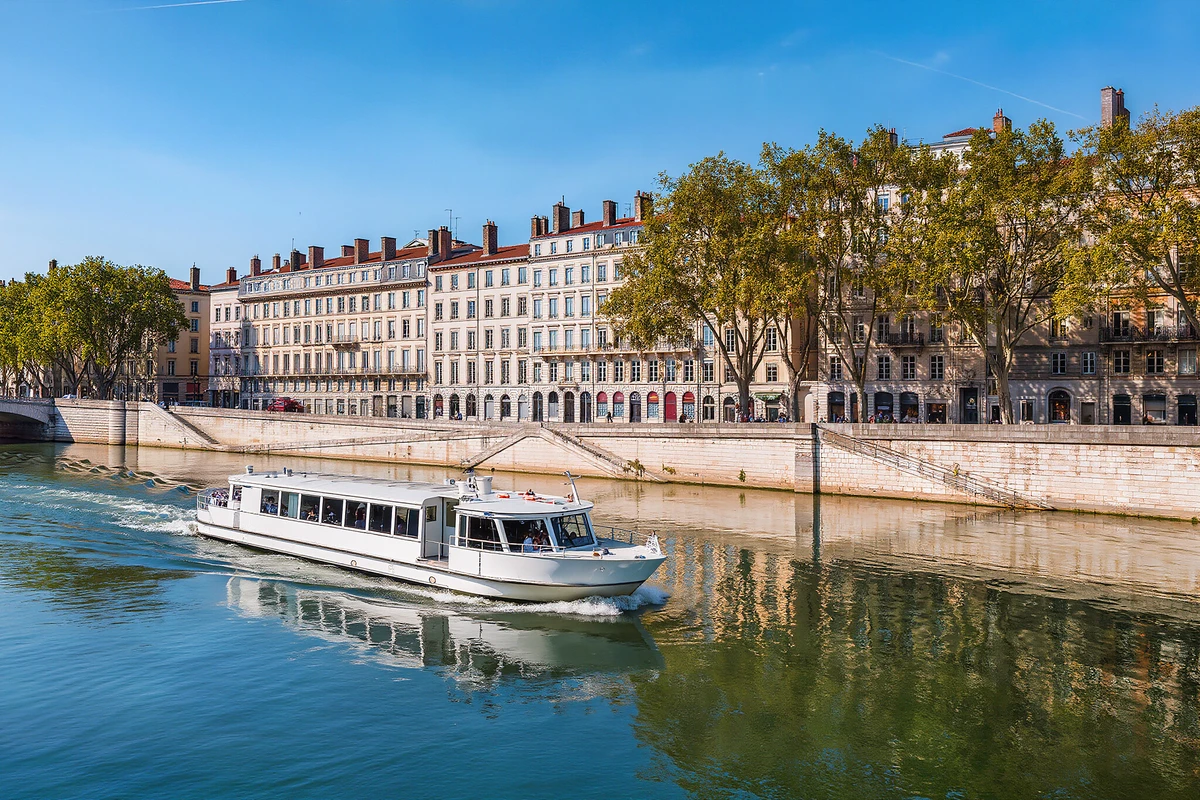
The final stretch follows the bank of the Saône, the gentler of Lyon's two rivers, past the footbridges and the painted facades that face the old town, and climbs onto the Presqu'île at Place des Terreaux. The square is framed by the 17th-century City Hall, with its grand facade and slate domes, and by the Palais Saint-Pierre, a former abbey that now houses the Museum of Fine Arts, one of the largest in France outside Paris. In the centre splashes the Bartholdi Fountain of 1889, four straining horses pulling a chariot that represents a river rushing to the sea.
The tour ends here after about two hours with ten minutes each at the fountain and the City Hall. From Terreaux you are a short walk from the Opera, the shopping streets of the Presqu'île and the Hôtel-Dieu, so the guide's final tips point you to the best things to do in Lyon for the rest of your day.
Itinerary
- Meeting at Place BellecourMeet our guide at the exact spot on the square confirmed with your booking a few minutes before the 15:00 start; about ten minutes of introduction.
- Funicular to FourvièreAround ten minutes by metro and funicular up the hill, tickets included.
- Basilica of Notre-Dame de FourvièreAbout fifteen minutes at the basilica and the panoramic esplanade.
- Roman theatresTen minutes on the tiers of the ancient theatre and the Odeon.
- Saint-Jean-Baptiste CathedralAbout fifteen minutes at the cathedral and its astronomical clock.
- La Longue TrabouleTen minutes through the hidden passageway and its courtyards.
- Vieux LyonTwenty minutes in the Renaissance streets with bouchon recommendations.
- Saône riverbank to Place des TerreauxA walk along the river and about ten minutes on the square.
- Bartholdi Fountain and City HallPhoto stop and finish after about two hours.
What's included
- Native English-speaking guide
- 1.5-hour guided walk, group of maximum 18
- Saint-Jean Cathedral and Vieux Lyon
- Traboules (hidden Renaissance passageways) and the Rose Tower
- Saône riverside path, the Grand Hôtel-Dieu and Place Bellecour
- Bouchon restaurant recommendations
Not included
- Fourvière funicular tickets and Fourvière hill
- Food
- Drinks
- Hotel pickup and drop-off
Is this right for you?
Great for
- Families with children — a child price for ages 3–11
- History and culture lovers
- First-time visitors who want the highlights
- A short visit — about 1.5 hours
Think twice if
- You want a private tour — this one is shared with other travellers
- Walking is difficult for you — expect active parts
Not suitable for
- People over 95 years
Meeting point
The walk begins in central Lyon at Place Bellecour; the exact meeting spot on the square is confirmed with your booking. Please arrive a few minutes before the 15:00 departure. The square is served by metro lines A and D (Bellecour station). There is no hotel pickup, and the tour ends at Place des Terreaux, about fifteen minutes' walk or one metro stop from the start.
Important information
- Wear comfortable shoes: the two-hour tour covers about five kilometres, mostly on flat ground, with the hill handled by the funicular
- Bring water and a hat in summer and a rain jacket in the cooler months; the tour runs in all weather
- Funicular tickets are included; no other entrance tickets are needed, as the basilica and theatres are free to enter
- Food and drinks are not included; the guide recommends bouchon restaurants for after the tour
- Modest dress is appreciated if you enter the basilica or the cathedral
- The group is limited to ten guests on the two-hour tour; a ninety-minute option with a larger group is available on this page
- Children are welcome at the child rate shown in the booking panel
Good to know
Frequently Asked Questions
Straight answers to what travellers ask us most, before they book.
Is this a shared or a private experience?
It is a shared small-group walking tour with a maximum of ten guests and a native English-speaking guide.
How long does the Lyon walking tour take?
About two hours and roughly five kilometres on foot, from Place Bellecour to Place des Terreaux, with the Fourvière hill covered by funicular.
Is hotel pickup included?
No. The tour starts at Place Bellecour in the city centre, on metro lines A and D, and the exact meeting spot is confirmed with your booking.
What is included?
The guided walk, funicular tickets, visits to the Fourvière Basilica, the Roman theatres, Saint-Jean Cathedral, the Longue Traboule, Vieux Lyon, the Saône riverbank, Place des Terreaux, the Bartholdi Fountain and the City Hall, photo stops and bouchon recommendations. Food and drinks are not included.
Is the price per person or per group?
The price is per person. The booking panel on this page shows the current price of each option.
What is a traboule?
A covered passageway that cuts through buildings and courtyards from one street to the next; Vieux Lyon has dozens, built for the silk trade, and the tour takes you through the longest one.
Do we go inside the Fourvière Basilica?
Yes, if no service is taking place; the guide gives time for a look at the mosaics and for photos from the esplanade.
Is it suitable for children or for people with reduced mobility?
Children enjoy the funicular, the Roman theatre and the secret passageways. The ground is mostly flat, but the traboule has stairs and the old town is cobbled; the ninety-minute option is the easier choice if walking is difficult.
What should I bring?
Comfortable shoes, water, a camera for the Fourvière viewpoint and, in summer, sun protection.
When is the best time to visit Lyon?
April to June and September to October are the most pleasant for walking; early December brings the Festival of Lights, when the tour fills quickly.
What is the difference between the two options?
The default two-hour tour includes Fourvière by funicular and the full route for up to ten guests; the ninety-minute option stays in Vieux Lyon and the Presqu'île with a larger group and no funicular.
How do I book and confirm?
Choose your date and option in the booking panel on this page; our team confirms your booking on WhatsApp within minutes with the exact meeting spot.
More in Lyon
Popular across France
-
-
-
-
-
-