Islamic Cairo Walking Tour with El Moez Street & Khan El Khalili
- Duration3 hours
- Daily
- Group
- Pickup available
Some images are AI-generated for illustration. While we confirm your booking, just ask and we will send you the original photos.
- Fair, honest prices
- Real people, not bots
- Confirm, then pay
- Secure payment

Overview
This Islamic Cairo walking tour is a shared 4-hour experience through the medieval heart of the city, led by a professional Egyptologist guide, with hotel pickup and drop-off in Cairo or Giza. On foot you pass through Bab al-Futuh gate, visit the Fatimid mosque of Al-Hakim and the Ottoman-era house of Bayt al-Suhaymi, then walk the length of El Moez Street past the Sultan Barquq and Qalawun complexes to Al-Hussein Mosque and the lanes of Khan el-Khalili. Entrance fees, bottled water, a sweet snack such as zalabya or halabessa and a street-food tasting of koshary or Egyptian pie are included. It suits history lovers, first-time visitors and families. A version without transfers and a private option are also available.
Highlights
- Shared 4-hour walk with hotel pickup in Cairo or Giza, starting 09:30, 12:30 or 13:30
- Enter the old city through Bab al-Futuh, an 11th-century Fatimid gate
- Al-Hakim Mosque, one of Cairo's largest Fatimid mosques
- Bayt al-Suhaymi, a 17th-century merchant's house with mashrabiya screens
- The Qalawun Complex and Sultan Barquq's madrasa on El Moez Street
- Street food: koshary or Egyptian pie, plus zalabya or halabessa
- Khan el-Khalili bazaar with an Egyptologist who knows its lanes
- All entrance fees and bottled water included
Full Description
Bab al-Futuh and the Fatimid city walls
The walk begins at Bab al-Futuh, the Gate of Conquests, one of the northern gates of Fatimid Cairo. Built in 1087 in fine limestone with rounded towers, it replaced an earlier mud-brick wall and still stands beside its twin, Bab al-Nasr, linked by a stretch of the old rampart. Inside the towers you can see arrow slits and vaulted chambers designed by architects from northern Syria.
Your Egyptologist introduces the story of Cairo here: the city founded by the Fatimids in 969 as a walled royal enclosure, later opened to merchants and craftsmen under the Mamluks. The gate is about 15 minutes of the tour and the best place to understand the layout of the old city. It is also where travellers on the version without transfers meet the guide, so if you wonder how to get to Islamic Cairo on your own, Bab al-Futuh is the classic starting point.
Al-Hakim Mosque
Right inside the walls stands the Mosque of Al-Hakim, begun in 990 and completed in 1013, one of the largest mosques of the Fatimid era. Its vast open courtyard is framed by arcades, and its two distinctive minarets rise from massive stone bastions that were later built around them. After centuries of use as a fort, a stable and a school, it was restored in 1980 with white marble that now gleams in the sun.
About 25 minutes here gives time to walk the arcades and photograph the minarets against the sky. Shoes are removed at the entrance, and women cover their hair; a scarf in your bag makes the visit easy. The calm of the courtyard contrasts with the busy street outside, and the guide explains how Friday prayers, scholarship and daily life once revolved around this building.
Bayt al-Suhaymi
Hidden down Darb al-Asfar alley, Bayt al-Suhaymi is the finest surviving merchant's house in Cairo. Built in 1648 and enlarged in 1796, it spreads around a garden courtyard with a well, palm trees and shaded seating. Wooden mashrabiya screens let the women of the family watch the courtyard unseen, while wind catchers and high ceilings kept rooms cool long before air conditioning.
Is Bayt al-Suhaymi worth visiting? It is often the favourite stop of the day, because it shows how a wealthy Cairo family actually lived: the reception hall with its marble fountain, the painted wooden ceilings, coloured glass windows and the separate women's quarters. The visit lasts about 25 minutes, and your entrance ticket is included. The house is quiet and well preserved, perfect for photographs of the courtyard and the screens.
El Moez Street and Khan el-Khalili
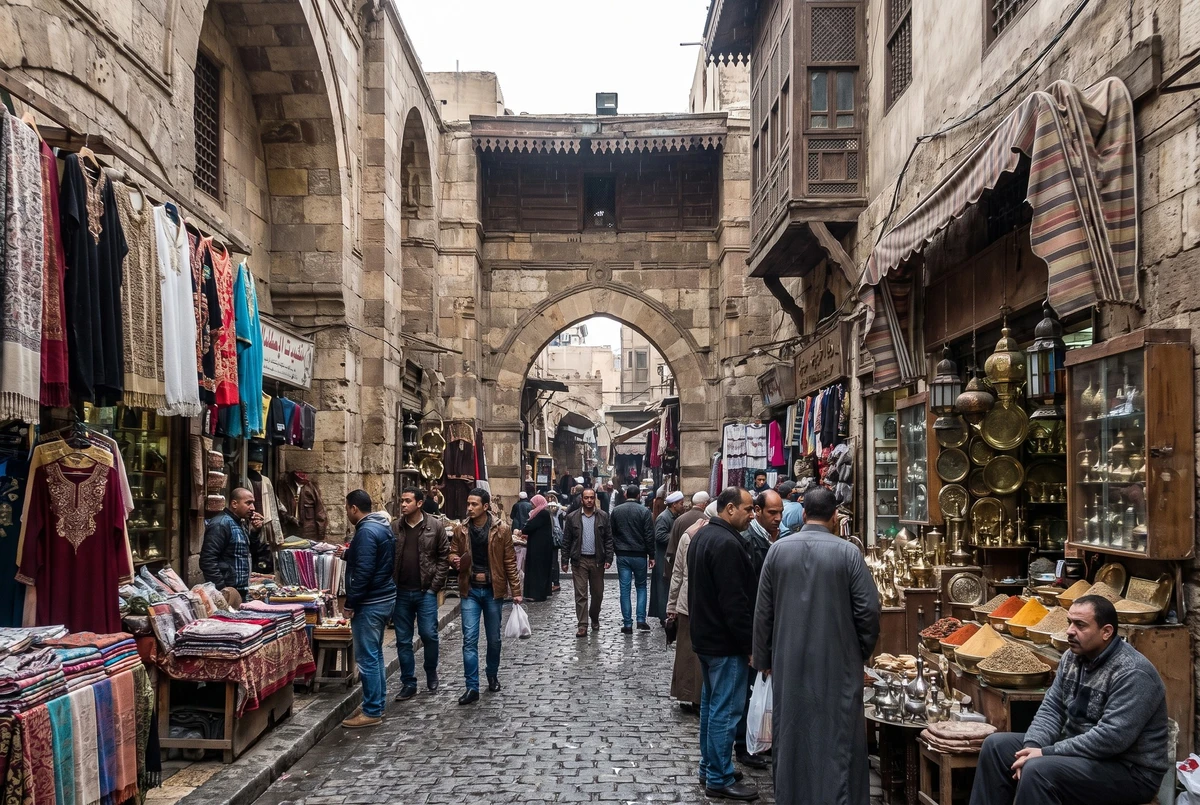
El Moez Street, named after the Fatimid caliph Al-Muizz li-Din Allah who founded the city, was the ceremonial spine of medieval Cairo. Today its northern half is a pedestrian open-air museum of mosques, madrasas, fountains and tiled facades, restored as part of Historic Cairo, a UNESCO World Heritage Site since 1979. Coppersmiths and lantern makers still work in the side lanes, and the street lights up beautifully in the evening, the best time to visit El Moez Street for photos.
Along the way you taste Cairo's favourite street food: koshary, a hearty mix of rice, lentils, pasta, chickpeas, tomato sauce and crispy onions, or a flaky Egyptian pie, plus zalabya, warm fried dough balls in syrup, or halabessa, a spiced chickpea drink, all naturally halal. The walk ends in Khan el-Khalili, the bazaar founded in 1382, with its spice stalls, brass lamps, perfume shops and silver jewellery. Most shops open from morning until late at night, and your guide gives tips for friendly bargaining.
Sultan Barquq's madrasa and the Qalawun Complex
In the middle of El Moez Street stands the Bayn al-Qasrayn stretch, lined with the grandest Mamluk monuments in Cairo. The Qalawun Complex, built in about 13 months in 1284 and 1285, combined a madrasa, a mausoleum and a hospital that treated patients for centuries. Its mausoleum is a masterpiece of carved stucco, coloured marble, mother-of-pearl inlay and stained glass beneath a high dome.
Next door, the madrasa and khanqah of Sultan Barquq, completed in 1386, served as a mosque, a school of law and a lodge for Sufis. Look for its striped stone facade, bronze-plated doors and the cross-shaped courtyard with its blue-and-gold ceiling. Together the two buildings take about 45 minutes, and your guide explains the symbols carved in the stone and how Mamluk sultans used architecture to show power and piety.
Al-Hussein Mosque and its square
The walk ends at Al-Hussein Mosque, one of the most revered shrines in Egypt, believed to hold a relic of the Prophet's grandson brought to Cairo in 1154. The present building, with its Gothic-style stone facade and slender Ottoman minaret, dates from the 1870s, and the large square in front is busy with families, especially in the evening and during religious holidays.
Access inside depends on prayer times and the mosque's rules, so the guide explains its history from the square, where you can admire the silver-coloured shrine doors and the giant canopies that shade worshippers. Al-Hussein Square opens straight onto Khan el-Khalili, which makes it the natural meeting place for the drop-off. Travellers on the version without transfers finish here and can stay on to explore the bazaar at their own pace.
Itinerary
- Hotel pickup in Cairo or GizaShared pickup from your hotel and drive to the old city, timed for your start.
- Bab al-FutuhMeet the group at the Fatimid gate for a 15-minute introduction to the city walls.
- Al-Hakim MosqueAbout 25 minutes in the courtyard and arcades of the Fatimid mosque.
- Bayt al-SuhaymiA 25-minute visit inside the 17th-century merchant's house and garden courtyard.
- El Moez StreetA 15-minute walk along the pedestrian street, with a sweet snack and street-food tasting.
- Sultan Barquq's madrasa and khanqahAbout 20 minutes inside the Mamluk complex of 1386.
- Qalawun ComplexAbout 25 minutes at the madrasa and decorated mausoleum.
- Khan el-KhaliliA 15-minute guided walk through the bazaar lanes, with shopping tips.
- Al-Hussein MosqueAbout 20 minutes at the square and shrine, then transfer back to your hotel.
What's included
- Professional Egyptologist guide
- Entrance fees to all sites on the route
- Local sweet snack such as zalabya or halabessa
- Street-food tasting: koshary or Egyptian pie
- Bottled water
- Guided walk on El Moez Street and through Khan el-Khalili
Not included
- Hotel pickup and drop-off
- Other food and drinks
- Tips (optional)
Is this right for you?
Great for
- Families with children — a child price for ages 4–11
- Travellers without a car — hotel pickup is included
- Groups who want privacy — a private option is available
- First-time visitors who want the highlights
Think twice if
- Walking is difficult for you — expect active parts
Not suitable for
- Wheelchair users
Meeting point
Hotel pickup and drop-off are included from hotels in Cairo and Giza. Our driver collects you in an air-conditioned vehicle shortly before the start time you choose (09:30, 12:30 or 13:30), and we confirm the exact pickup time on WhatsApp. If you book the version without transfers, meet the guide in front of Bab al-Futuh gate at the northern end of El Moez Street.
Important information
- Wear loose clothes covering shoulders, arms and knees; women need a scarf for the mosques
- Wear comfortable walking shoes; shoes are removed inside the mosques
- Bring sunscreen, a hat and water, especially from May to September
- Baby strollers, luggage and large bags are not allowed
- Carry some cash for shopping and personal purchases in Khan el-Khalili
- The order of the visits can change if a site is closed or during prayer times
- Tell us about any food allergies so the guide can choose the right tasting
Good to know
Frequently Asked Questions
Straight answers to what travellers ask us most, before they book.
Is this a shared or a private experience?
The default option is a shared small-group walking tour with hotel transfers. A private walking tour with your own guide is also available in the booking panel.
How long does the Islamic Cairo walking tour take?
About 4 hours with hotel transfers, of which around 3 hours are spent walking and visiting.
Is hotel pickup included?
Yes, pickup and drop-off from hotels in Cairo and Giza are included in this option. A cheaper version without transfers starts at Bab al-Futuh.
What is included?
Hotel transfers, a professional Egyptologist guide, all entrance fees on the route, bottled water, a sweet snack such as zalabya or halabessa and a tasting of koshary or Egyptian pie.
Is the price per person or per group?
The price is per person, with a child rate. The booking panel on this page shows the current price of each option.
Is it suitable for children or people with reduced mobility?
Children enjoy the gates, the bazaar and the street food, but strollers are not allowed. The route is not suitable for wheelchair users because of steps, uneven paving and crowded lanes.
What should I wear for the mosque visits?
Loose clothing that covers shoulders, arms, legs and knees. Women should carry a scarf for the mosques. Shoes are removed at the entrance.
What should I bring?
Comfortable shoes, a scarf, sunscreen, a hat, water and some cash for shopping.
What is the best time of day and season?
October to April is pleasantly cool. The 09:30 start is calm and fresh, while the afternoon starts end in Khan el-Khalili as the lamps come on.
Is Khan el-Khalili open every day?
Yes, the bazaar is open daily from morning until late at night. Some shops close on Friday morning around midday prayers.
Is the food halal?
Yes, the koshary, Egyptian pie, zalabya and halabessa are traditional Egyptian street foods and are halal.
How do I book and confirm?
Choose your date, start time and option in the booking panel and send your request. Our team confirms your booking on WhatsApp within minutes.
More in Cairo



Popular across Egypt
-
-

-

-

-

-