Best of Djerba Small-Group Cultural Island Tour
- DurationAbout 4 hours
- Daily
- Group
- Pickup available

- Fair, honest prices
- Real people, not bots
- Confirm, then pay
- Secure payment

Overview
This half-day small-group tour reveals the cultural heart of Djerba in about four hours. After pickup in front of your hotel, an air-conditioned minibus and a friendly local English-speaking guide take you to a viewpoint over the Roman causeway linking the island to the mainland, then to the potters' village of Guellala to watch clay being shaped by hand. You visit El Ghriba, the island's historic synagogue, wander among the colourful murals of Djerbahood in Erriadh, and finish with free time in the souks of Houmt Souk and a photo stop at the Borj El Kebir fortress. It is a shared tour in a small group, available in the morning or afternoon, ideal for curious travellers and short stays.
Highlights
- Pickup in front of your hotel by air-conditioned minibus
- Small group with a friendly local English-speaking guide
- Panoramic view of the Roman causeway to the mainland
- Pottery workshop visit in the village of Guellala
- El Ghriba Synagogue and the open-air murals of Djerbahood
- Free time in the souks of Houmt Souk
- Photo stop at the Borj El Kebir fortress by the sea
Full Description
The Roman causeway of El Kantara
Djerba is linked to the mainland in the south-east by a road built across the shallow sea, about seven kilometres long, known as the causeway of El Kantara. Its origins go back to Roman times, when it connected the island town of Meninx with the coast, and it has been rebuilt many times over the centuries. Today it carries the main road from Djerba to Zarzis and the south.
The tour stops at a viewpoint where you see the long, straight line of the road disappearing over the water, with flamingos sometimes feeding in the shallows on either side. Your guide explains the history of the island, from Phoenician traders and Roman settlers to Berber, Arab and Ottoman times, and why Djerba has always been a crossroads of the Mediterranean. It is the perfect start to a Djerba cultural tour.
The potters of Guellala
Guellala, in the south of the island, has been the centre of Djerba's pottery for centuries. Its clay, dug from underground galleries near the village, is shaped on foot-powered wheels and fired in large kilns half-buried in the ground. The village produces everything from large storage jars and water jugs to decorated plates and the clay pots used by local fishermen to catch octopus.
You visit a working pottery workshop for about an hour, where a craftsman shows the steps of the work, from preparing the clay to turning and glazing. You can watch a jar take shape in a few minutes and browse the colourful pieces in the shop. Guellala pottery is one of the best souvenirs of the island, and buying directly from the workshop supports local families.
El Ghriba Synagogue
El Ghriba, in the village of Erriadh, is considered the oldest synagogue in North Africa by local tradition, and the community it serves has lived on Djerba for more than two thousand years. The present building is richly decorated with blue ceramic tiles, painted wooden ceilings, stained glass and elegant arches, and it is a place of pilgrimage every spring.
The guided visit lasts about 20 minutes. Visitors remove their shoes and cover their shoulders and knees, and a passport or ID is needed for the security check. Please note that interior visits are not possible on Saturdays; on that day your guide explains the site from outside. The visit is an opportunity to understand the long coexistence of communities on the island.
Djerbahood, the open-air gallery of Erriadh
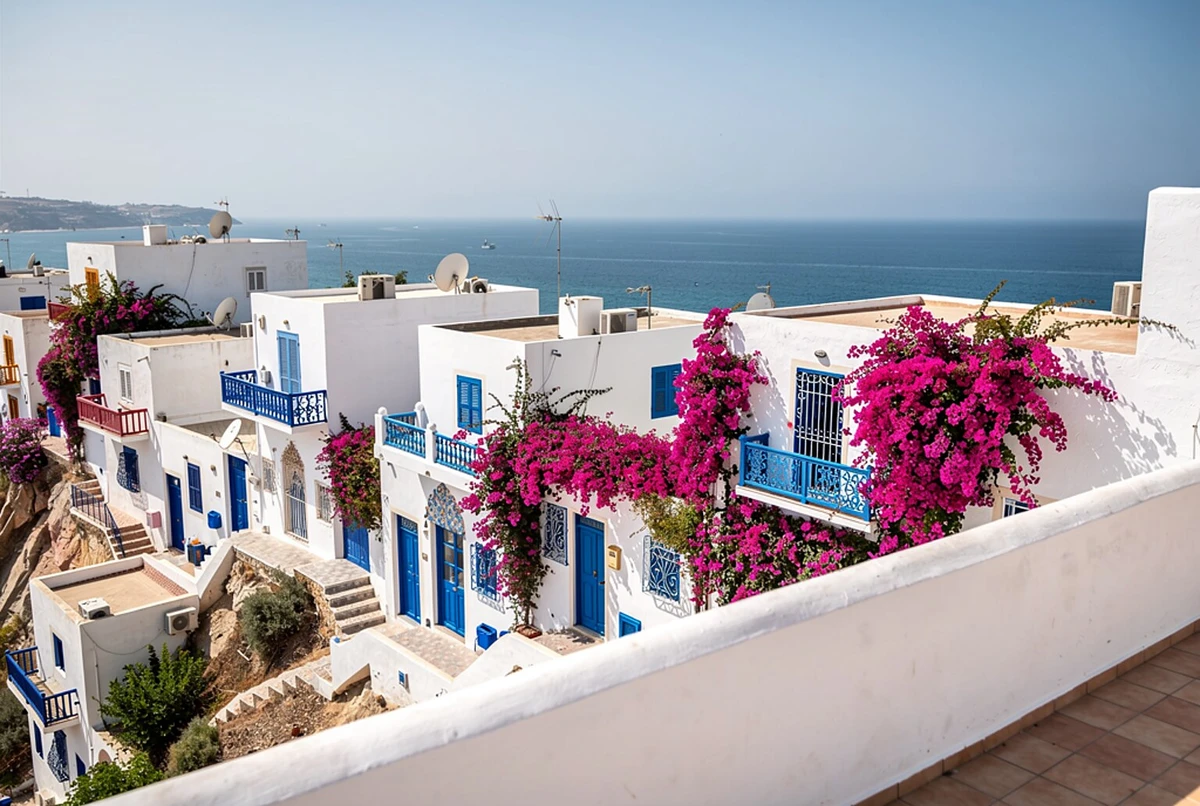
In 2014, the old lanes of Erriadh were transformed into an open-air museum when artists from around the world were invited to paint murals on the walls of houses, shops and courtyards. The project, called Djerbahood, gave new life to the village, and many of the artworks remain today, mixing calligraphy, portraits of local life, geometric patterns and playful animals against the white walls and blue doors.
You spend about 45 minutes strolling among the murals with your guide, who points out the most striking works and the stories behind them. It is a wonderful place for photos and a surprising contrast with the traditional architecture of the island. If you are wondering whether Djerbahood is worth visiting, it is one of the most original sights in Tunisia and a favourite of photographers.
Houmt Souk and Borj El Kebir
Houmt Souk is the island's main town and its lively commercial centre. You have about 45 minutes of free time to explore its covered souks and shaded squares, where shops sell woven rugs, leather slippers, silver jewellery, spices, olive oil and local sweets. Your guide gives tips on where to buy and how to bargain politely.
The tour ends with a photo stop at Borj El Kebir, a 15th-century fortress standing on the seafront near the harbour, built to defend the island against attacks from the sea. You see its thick walls and towers from outside; entry to the interior is not included and can be paid on site if you wish. Our minibus then takes you back to your hotel, about four hours after pickup.
Itinerary
- Hotel pickupPickup in front of your hotel in Djerba at around 07:45 or 14:00 by air-conditioned minibus.
- Roman causeway viewpointPanoramic stop and introduction to the history of Djerba, about 15 minutes.
- GuellalaVisit of a pottery workshop with a demonstration, about 1 hour.
- El Ghriba SynagogueGuided visit in Erriadh, about 20 minutes; exterior only on Saturdays.
- DjerbahoodStroll among the street-art murals of Erriadh, about 45 minutes.
- Houmt SoukFree time in the souks for shopping, about 45 minutes.
- Borj El KebirPhoto stop at the seafront fortress, about 20 minutes, then return to your hotel.
What's included
- Pickup in front of your hotel and drop-off
- Air-conditioned minibus sized for the group
- Local English-speaking guide
- Visit to a pottery workshop in Guellala
- Visit to El Ghriba Synagogue and the Djerbahood murals
- Free time in Houmt Souk
Not included
- Drinks
- Fortress interior entry
- Souvenirs and tips
Is this right for you?
Great for
- Travellers without a car — hotel pickup is included
- Travellers who want a proven choice — rated 4.8/5 by past travellers
Think twice if
- You want a private tour — this one is shared with other travellers
Not suitable for
- Travellers who cannot walk short distances on uneven lanes
Meeting point
Our guide picks you up in front of your hotel in Djerba with an air-conditioned minibus sized for the group. Morning tours start at around 07:45 and afternoon tours at around 14:00. We send you the exact pickup time and details the day before by WhatsApp.
Important information
- Bring your passport or ID card for the security check at El Ghriba
- Cover shoulders and knees for the synagogue visit
- El Ghriba cannot be visited inside on Saturdays
- Entry to the interior of Borj El Kebir is not included
- Bring cash in Tunisian dinars for souvenirs and drinks
- In busy periods a larger 29-seat bus may be used
- Wear comfortable shoes, a hat and sunscreen
Good to know
Frequently Asked Questions
Straight answers to what travellers ask us most, before they book.
Is this a shared or a private experience?
It is a shared tour in a small group, usually in a minibus of up to 14 seats.
How long does it take?
About 4 hours including hotel pickup and drop-off.
Is hotel pickup included?
Yes, the guide picks you up in front of your hotel in Djerba and brings you back.
What is included?
Hotel pickup and drop-off, the air-conditioned minibus, the local English-speaking guide, the pottery workshop, El Ghriba, Djerbahood and free time in Houmt Souk.
Is the price per person or per group?
The price is per person. The booking panel on this page shows the current price for adults and children.
Is it suitable for children or travellers with reduced mobility?
It suits children who enjoy crafts and colourful streets. The stops involve short walks on uneven lanes, which can be hard with reduced mobility.
Can I visit El Ghriba on a Saturday?
The interior is closed to visits on Saturdays; the guide presents it from outside on that day.
What should I bring?
Passport or ID, comfortable shoes, a hat, sunscreen and some cash for souvenirs.
Morning or afternoon: which is better?
The morning tour is cooler in summer; the afternoon tour suits late risers and gives soft light at Djerbahood.
Is Guellala pottery worth buying?
Yes. It is handmade in the village workshops and is one of the most authentic souvenirs of Djerba.
How do I book and confirm?
Choose your date and time in the booking panel and send your hotel name. Our team confirms your booking on WhatsApp within minutes.
More in Djerba
Top pick Popular choice Top pick