
Fukuoka
Plan Fukuoka with Haqqi Tours: day tours, private airport transfers, attraction tickets and packages, run by our own team and confirmed on WhatsApp in Arabic or English.
As evening falls along the Naka River in Fukuoka, small wooden food stalls appear on the pavement as if by magic, their lanterns glowing and steam rising from bubbling pots. Office workers and travellers squeeze onto narrow benches side by side, the cook slides bowls of noodles across the counter and conversation flows easily between strangers. Across the water, the lights of the city shimmer, and a gentle sea breeze drifts in from the harbour.
Nothing matches those filters yet. Widen your search or message us on WhatsApp.
Fukuoka Day Tours
View allFukuoka at first sight
Fukuoka, the largest city on the island of Kyushu, faces the sea toward Korea and China and has been Japan's gateway to Asia for many centuries. The old merchant town of Hakata and the castle town of Fukuoka grew up on either side of the river, and today they form a modern, easy-going city of shrines, temples, parks and beaches. It is also the perfect base for volcanoes, gorges and hot springs across Kyushu.
Why include Fukuoka in your itinerary?
- Japan's most relaxed big city. Fukuoka is compact, green and close to the sea, with a short ride from the airport to the centre, easy subways and a friendly, unhurried pace that many travellers love.
- A famous food city. Rich noodle soups, spicy cod roe, chicken hotpot and the city's open-air food stalls make Fukuoka one of the most exciting places to eat in Japan, with options for every taste.
- The gateway to wild Kyushu. Mount Aso's vast volcanic caldera, the deep blue gorge of Takachiho, the hot springs of Beppu and the history of Nagasaki all lie within reach on day trips or short journeys.
Signature experiences in Fukuoka
Mount Aso and Takachiho Gorge
Two of Kyushu's greatest landscapes make an unforgettable day out from Fukuoka. Mount Aso is one of the largest volcanic calderas in the world, with green grasslands, grazing horses and an active crater that can be viewed when gas levels allow. Further southeast, Takachiho Gorge is a narrow canyon of basalt columns where a waterfall falls into emerald water, explored by rowing boat or walking path. An open-air cart ride over a high bridge on an old railway line is a highlight.
The Open-Air Food Stalls
Fukuoka is famous for its yatai, small open-air food stalls that set up each evening along the river at Nakasu, in Tenjin and near the harbour. Each seats only a handful of guests around a counter, serving noodles, grilled skewers, dumplings and stews. Many dishes contain pork, so our team can point you to stalls and restaurants with seafood, chicken or vegetarian choices, and explain the simple etiquette of eating there.
Dazaifu and its Shrine
About forty minutes from the city, the town of Dazaifu was once the seat of government for all of Kyushu. Its great shrine, dedicated to a scholar honoured as the patron of learning, is visited by students hoping for exam success. A lane of shops leads to the gates, selling warm rice cakes filled with sweet bean paste, and in February and March thousands of plum trees blossom around the shrine. The striking Kyushu National Museum stands next door.
Ohori Park and the Castle Ruins
In the heart of the city, Ohori Park surrounds a large pond crossed by bridges and small islands, with a walking path loved by joggers and families. Beside it, the stone walls of Fukuoka Castle rise on a hill, offering views over the city, and in late March they are framed by clouds of cherry blossoms. A traditional Japanese garden with a tea house and koi ponds completes a peaceful half-day.
Hakata's Temples and the Festival Floats
Around Hakata Station, quiet temples hide among modern buildings. Shofukuji is considered the first Zen temple in Japan, and Tochoji houses a giant wooden seated Buddha. Nearby, Kushida Shrine is the guardian of Hakata and the centre of the summer festival of Yamakasa, when teams race huge floats through the streets at dawn. A towering decorated float is on display at the shrine for most of the year.
Neighbourhoods and quarters to know in Fukuoka
Hakata
The area around Hakata Station is the city's transport hub, with bullet trains, the subway to the airport, department stores and many hotels. Old temples and Kushida Shrine are a short walk away. It is the most convenient base for day trips across Kyushu and for travellers arriving by train or plane.
Tenjin
Across the river, Tenjin is Fukuoka's shopping and business centre, with department stores, a long underground shopping street, cafés and restaurants. It is lively by day and evening and close to the food stalls, Ohori Park and the castle ruins. Hotels here suit travellers who enjoy shopping and want to be in the centre of city life.
Nakasu and the Riverside
Nakasu is a small island between two branches of the river, joining Hakata and Tenjin. Its riverside promenade is where the food stalls glow in the evening, and modern hotels look over the water. It is lively at night, so some travellers prefer a hotel on the quieter riverbanks nearby while staying within a short walk of the stalls.
Momochi Seaside and Ohori
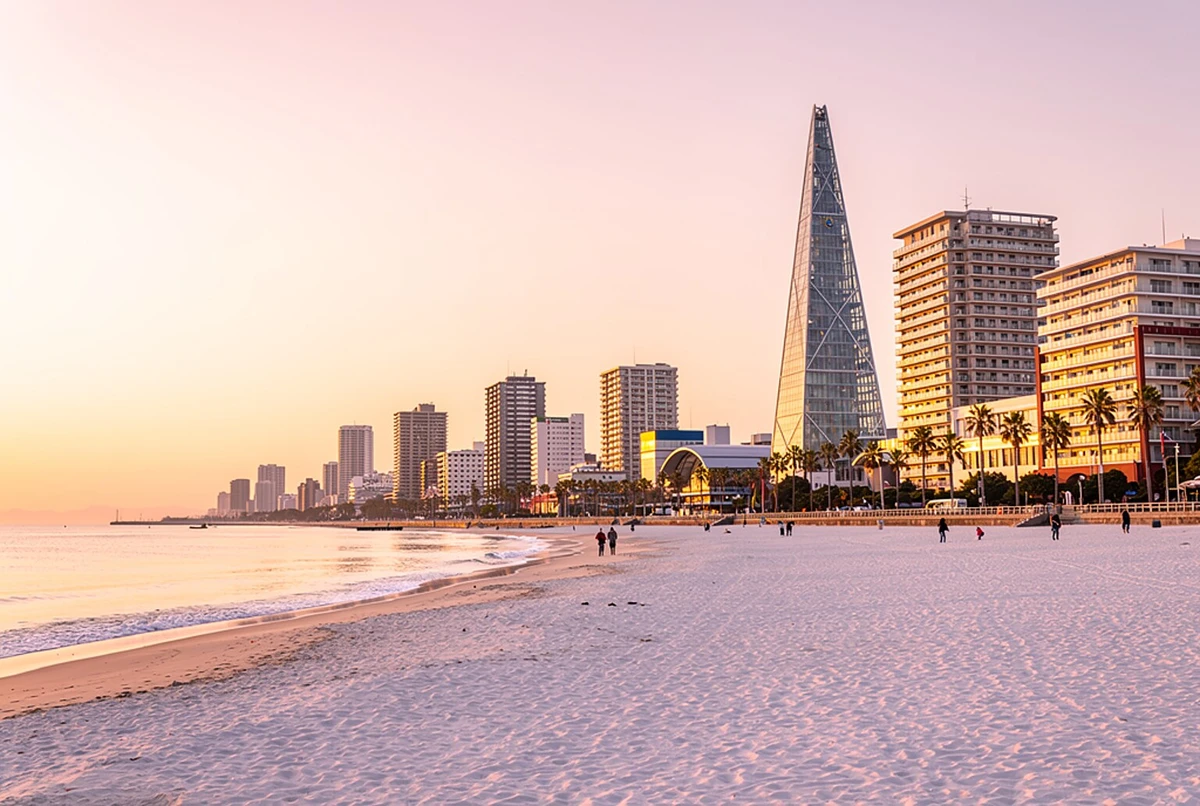
West of the centre, the Momochi seaside district holds the tall Fukuoka Tower, an artificial sandy beach, museums and resort-style hotels with sea views. Nearby, the residential area around Ohori Park is calm and green. It suits families and travellers who prefer space, sunsets over the sea and an easy subway or taxi ride into town.
How long to stay in Fukuoka and how to pair it
Recommended stay
We recommend three or four nights in Fukuoka. Two days let you explore Hakata, Tenjin, Ohori Park, the temples and the food stalls, with a half-day in Dazaifu. Add a full-day trip to Mount Aso and Takachiho Gorge, or to Yanagawa and its canals, and a fourth night for Itoshima's coast or a journey on to Nagasaki, Kumamoto or Beppu.
How to pair it
Fukuoka pairs naturally with Kumamoto, under forty minutes by bullet train, and with Nagasaki, around two hours away. The hot spring towns of Beppu and Yufuin lie about two hours east, and Hiroshima is around one hour by bullet train. A ten-day Kyushu trip can combine Fukuoka, Nagasaki, Kumamoto, Mount Aso and Beppu, with private transfers between every stop arranged by our team.
Best time to visit Fukuoka and the rhythm of the day
Best months
The best time to visit Fukuoka is March to May and October to November. Cherry blossoms bloom in late March and early April, and autumn brings clear skies and red maple leaves in the mountains. The rainy season runs from June to mid-July, followed by hot, humid summers with a risk of typhoons in August and September. Winter is mild and sunny, a good time for hot springs.
The daily rhythm
Fukuoka starts its day calmly, with commuters on time and temples quiet in the morning. Mornings suit shrines, parks and day trips into the countryside. Lunch is often a bowl of noodles in a small shop. Afternoons are for shopping in Tenjin or walking by the sea at Momochi. As darkness falls, the food stalls open along the river, and the city enjoys long, relaxed evenings of food and conversation.
On-the-ground logistics in Fukuoka
Arrival
Fukuoka Airport (FUK) is one of the most conveniently placed airports in the world, only about five minutes by subway or fifteen to twenty minutes by car from Hakata Station. International flights use a separate terminal linked by shuttle bus. Kitakyushu Airport (KKJ) lies about one hour and fifteen minutes away. Our private airport transfers meet you at arrivals and drive you straight to your hotel.
Getting around
Fukuoka is easy to explore by subway, buses and on foot, with three subway lines linking the airport, Hakata, Tenjin and the western districts. Taxis are plentiful and clean. Bullet trains from Hakata reach Kumamoto, Kagoshima and Hiroshima quickly. For Mount Aso, Takachiho Gorge, Itoshima and Yanagawa, where public transport is slow or limited, a private car with driver arranged by our team is the easiest choice.
Local etiquette tip
Japanese etiquette values quiet, order and respect. Queue neatly, keep voices low on trains and avoid phone calls on public transport. Remove your shoes where asked, bow lightly at shrines and wash your hands at the water basin before praying. Tipping is not expected. At the food stalls, order promptly and give up your seat when others are waiting, and avoid eating while walking in busy streets.
Must-do things in Fukuoka
- Explore Mount Aso's volcanic caldera and grasslands
- Take a rowing boat through Takachiho Gorge
- Ride an open-air cart over a high railway bridge
- Eat at an open-air food stall by the river
- Visit the shrine of learning in Dazaifu
- Walk around the pond in Ohori Park
- See the giant wooden Buddha at Tochoji
- Admire the festival floats at Kushida Shrine
- Watch sunset from the Momochi seaside
- Take a canal boat ride in Yanagawa
Do’s and don’ts in Fukuoka
Do
- Do carry some cash for small shops
- Do get a rechargeable transport card
- Do book bullet trains ahead in holidays
- Do check crater access before visiting Aso
- Do try a bowl of noodles at a local shop
Don’t
- Don't tip in restaurants or taxis
- Don't talk loudly on trains and buses
- Don't linger at food stalls when people wait
- Don't wear shoes in tatami rooms
- Don't eat while walking in crowded streets
Fukuoka at a glance
Plan Fukuoka with Haqqi Tours
Every option is confirmed by our team on WhatsApp before you pay, and delivered by our own people or by trusted local partners we work with in every city. Because we send travellers from all over the world, our partners give us special rates and priority, so you always receive the best. Prices are per person unless marked per vehicle.
About Haqqi Tours: About us Contact us Legal NoticePrivacy PolicyCookies & Marketing PreferencesTerms & ConditionsBooking, Payment & Refunds
Good to know
Frequently Asked Questions
Straight answers to what travellers ask most about Fukuoka.
Where should I stay in Fukuoka?
Most visitors stay around Hakata Station for easy access to the airport, bullet trains and day trips, or in Tenjin for shopping, restaurants and the food stalls. Nakasu and the riverside are central and lively, while Momochi and Ohori are calm and green, ideal for families. Our team suggests the best area for your plans and arranges your private airport transfer.
Can Mount Aso and Takachiho Gorge be visited as a day trip from Fukuoka?
Yes. A full-day trip by road can combine Mount Aso and Takachiho Gorge, with around two to two and a half hours to Aso and about three to three and a half hours to Takachiho from Fukuoka. It is a long but rewarding day, starting early. For a slower pace, we can arrange a night near Aso or in Takachiho to enjoy the gorge at its quietest.
What is the etiquette and dress code in Fukuoka?
There is no strict dress code, but neat, comfortable clothing and easy-to-remove shoes are practical for temples and traditional restaurants. Keep voices low on public transport, queue patiently and avoid eating while walking. At shrines, bow lightly and rinse your hands at the basin. Tipping is not customary, and a polite arigato is always appreciated.
Is Fukuoka suitable for families and Muslim travellers?
Yes. Fukuoka is safe, clean and easy with children, with parks, beaches, an aquarium and short travel times. Many local dishes contain pork, including the famous noodle soups, but the city has a growing number of halal-certified and Muslim-friendly restaurants, prayer spaces in some public places and a mosque in Higashi ward. Seafood and vegetarian dishes are easy to find, and our team can advise.
Is it safe to travel to Fukuoka now?
Fukuoka and Japan are generally considered among the safest destinations in the world. The main care points are summer heat, heavy rain in the rainy season, typhoons in late summer and volcanic gas restrictions at Mount Aso. Follow local guidance and check your own government's official travel advice before departure. Our WhatsApp team is available throughout your trip.
What are the must-do things in Fukuoka?
The must-do things in Fukuoka include an evening at the open-air food stalls by the river, Ohori Park and the castle ruins, the temples and festival floats of Hakata, the seaside at Momochi and the shrine town of Dazaifu. Beyond the city, a day trip to Mount Aso and Takachiho Gorge is unforgettable. Our private guides and drivers combine these in the best order.
How much time do you need in Fukuoka?
Plan at least two full days to enjoy the city, its parks, temples and food, plus a half-day in Dazaifu. Three or four nights are ideal, adding a full-day trip to Mount Aso and Takachiho Gorge or the canals of Yanagawa. Fukuoka is also the natural start for a longer journey across Kyushu to Nagasaki, Kumamoto and Beppu.
What can I book in Fukuoka with Haqqi Tours?
Day tours, including Takachiho Gorge & Amaterasu Railway Day Trip from Fukuoka and Mount Aso and Takachiho Gorge Day Tour from Fukuoka. Each has its own page, and the WhatsApp desk combines any of them into one plan with one written price.
How do I get from the airport to my hotel in Fukuoka?
With a private transfer: a driver at arrivals, flight tracking and a fixed price for the whole vehicle, door to door. Tell the desk the flight number and the hotel.
Is there public transport from the airport to Fukuoka?
Public options vary by airport and end at a station rather than your hotel; the private transfer starts at the arrivals door and ends at your door.
Which tours are available in Fukuoka?
Among them: Takachiho Gorge & Amaterasu Railway Day Trip from Fukuoka and Mount Aso and Takachiho Gorge Day Tour from Fukuoka. Each page says whether the day is private or small-group, what it includes and how long it lasts.
Are the tours private or in a group?
Both exist, and each tour page says which. A private tour has a vehicle and guide for your party alone; the desk can make most group tours private on request.
How do I book?
Fill in the form on any page or message us on WhatsApp with the date, the number of travellers and the hotel. A member of our team confirms the price and the details in writing within minutes.
Are the prices fixed?
Yes - every price is agreed in writing on WhatsApp before you travel and does not change on the day.
Do the drivers and guides speak Arabic or English?
It depends on the city and the day, so we do not promise a particular language; tell us your preference and we do our best. The WhatsApp desk always works in Arabic and English.
Can I change or cancel a booking in Fukuoka?
Yes, in the same WhatsApp conversation. The terms depend on the product and on how close to the date the change comes; the desk states them before you pay.