
Algeria
Haqqi Tours arranges day tours, private airport transfers, attraction tickets and multi-day packages across Algeria, confirmed on WhatsApp before you pay.
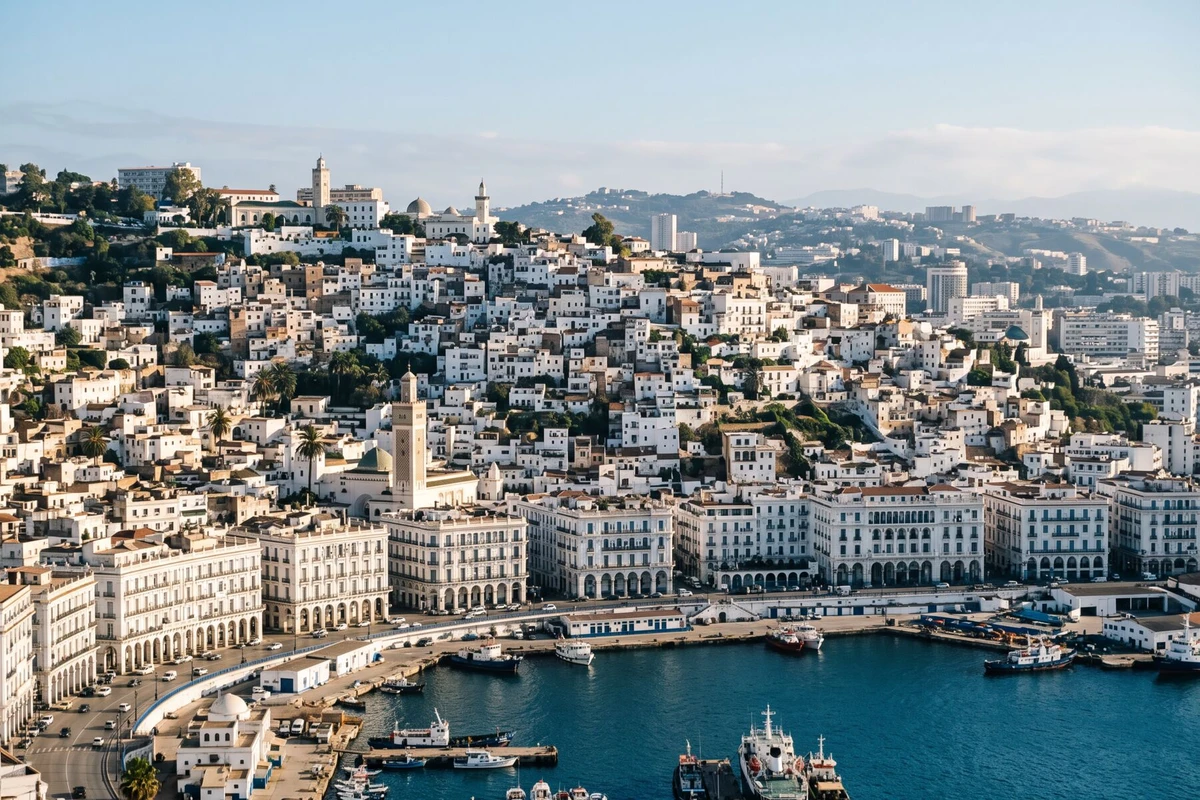
From the sea, Algiers rises in tiers of white: the arcaded French-era boulevards along the waterfront, the steep stairways and terraced roofs of the Casbah, and above them the hill where the Martyrs' Memorial lifts its three great concrete palm leaves into the sky. In the Casbah's lanes, carved wooden doors open onto cool tiled courtyards, a call to prayer drifts from Ketchaoua Mosque, and the smell of fresh bread and strong coffee follows you down every staircase.
Destinations
Choose a city to see everything we arrange there.
Services by city in Algeria
Tours
The essence of Algeria
Algeria is Africa's largest country, yet it remains one of the Mediterranean's least-known destinations. West of the capital, the Roman ruins of Tipaza lie among pines and wildflowers right on the shore, and the old harbour town of Cherchell guards statues and mosaics from the ancient city of Caesarea. Algeria is unique because Roman cities, Ottoman palaces and endless Sahara landscapes share one country that few travellers have yet discovered. We arrange city tours, day trips along the coast and private airport transfers, with calm, attentive service.
Why visit Algeria?
Numidian Kings, Roman Cities and the Casbah
Berber kingdoms ruled the land of Numidia long before Phoenician traders and then Rome built ports and cities such as Tipaza, Djemila and Timgad. Islam arrived in the seventh century, and dynasties from the Rustamids to the Zirids and Almoravids left mosques and cities across the north. From the sixteenth century, Algiers was the seat of an Ottoman regency. French rule began in 1830, and after a long war of independence Algeria became independent on 5 July 1962.
Mediterranean Shores, Atlas Mountains and the Sahara
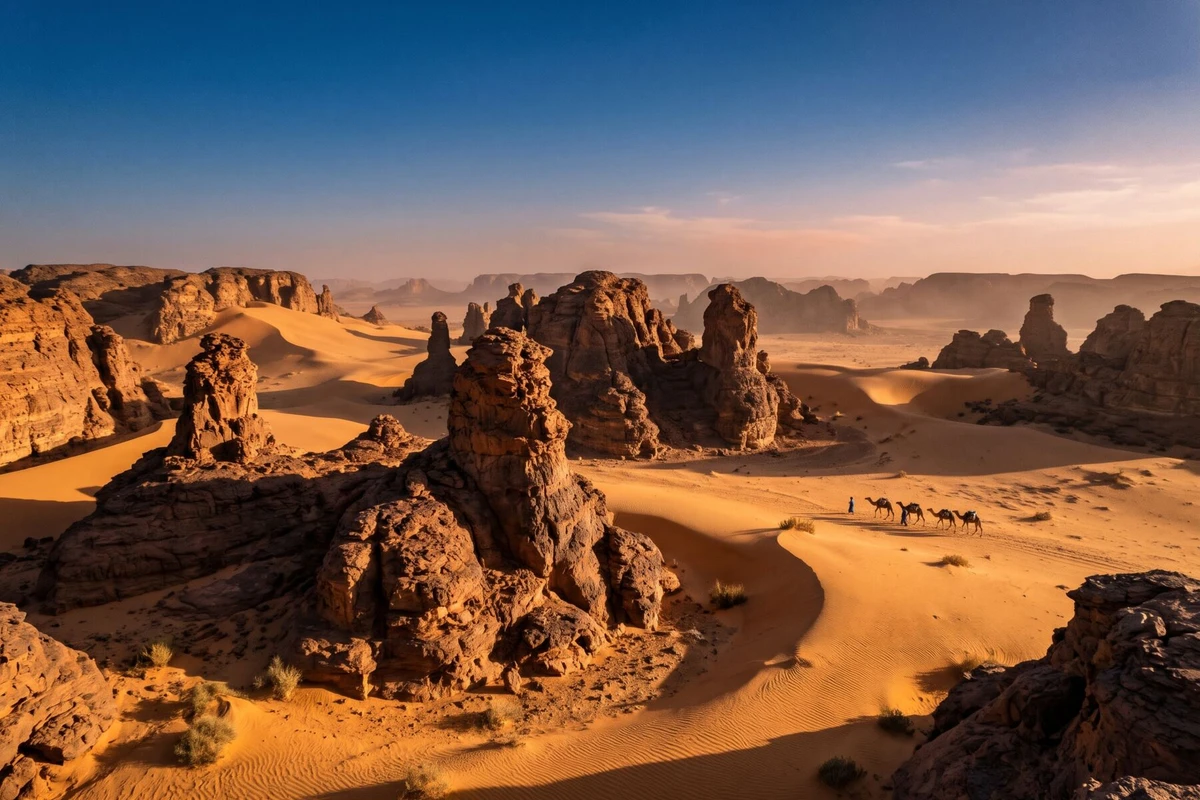
Algeria stretches from a long Mediterranean coastline of cliffs, coves and sandy beaches to the heart of the Sahara. Behind the coast rise the Tell Atlas and the green mountains of Kabylie, then high plateaus and the Saharan Atlas. Most of the country is desert, with the dunes of the Grand Erg, the oasis towns of the M'zab Valley, the rock art of Tassili n'Ajjer and the volcanic peaks of the Hoggar, all among the most dramatic landscapes in Africa.
Couscous, Chorba and Fresh Fish by the Sea
Algerian cooking is generous and rooted in family tradition. Couscous with lamb and vegetables is served on Fridays and at celebrations, chorba frik, a soup of cracked green wheat, opens the evening meal in Ramadan, and rechta, thin hand-cut noodles in a white chicken sauce, is an Algiers favourite. Street stalls sell karantika, a warm chickpea flan, and mhadjeb flatbreads, while coastal towns grill sardines and fresh fish at the harbour. Halal food is the norm everywhere.
Experiences You Can Only Have Here
Climb through the Casbah of Algiers to Ottoman palaces and hidden courtyards, stand beside the vast minaret of the Great Mosque of Algiers and watch the city glow from the terrace of the basilica of Notre-Dame d'Afrique. On the coast, walk among Roman columns, mosaics and an amphitheatre at Tipaza with the sea at your feet, see the round Royal Mausoleum of Mauretania on its hill, and end the day with grilled fish beside a fishing harbour.
Who is Algeria for?
Ideal for
- History lovers drawn to Roman and Islamic heritage
- Travellers seeking places few others have seen
- Muslim families looking for an easy halal destination
- Photographers and architecture enthusiasts
- Couples on a Mediterranean city break
- Repeat visitors to North Africa
Pace & travel style
- Base yourself in Algiers and explore the coast by day
- Visit the Casbah early, before the heat of the day
- Three or four nights cover the capital and Tipaza
- Plan around Friday prayers and the Friday–Saturday weekend
When to visit Algeria
Peak season · April–June, September–October
Spring and autumn are the best seasons for the coast, with warm sunshine, fresh sea breezes and comfortable temperatures for exploring the Casbah on foot and walking among the ruins of Tipaza and Cherchell. In April and May the hills behind the coast are green and covered in wildflowers, and in September and October the sea is still warm enough for swimming. These months are popular for cultural visits, so reserve day trips and transfers ahead.
Shoulder season · July–August
High summer is hot and humid on the coast, and the beaches west and east of Algiers fill with Algerian families on holiday, giving the seaside towns a lively, festive mood. Sightseeing is best kept to the early morning and late afternoon, with the middle of the day for shaded museums, a long lunch or the sea. Inland and in the Sahara the heat is intense, so desert travel is not recommended at this time of year.
Low season · November–March
Winter on the coast is mild and green, with rainy spells, cool evenings and quiet sites, a pleasant time for museums and city walks in Algiers. Snow may fall on the mountains of Kabylie and the Aurès. This is also the classic season for the Sahara, when the days in Djanet, Tamanrasset, Timimoun and the M'zab Valley are sunny and comfortable, while desert nights are cold, so pack warm layers for any southern trip.
The regions of Algeria and how to combine its cities
Algeria lies in North Africa, with the Mediterranean to the north, Tunisia and Libya to the east, Morocco to the west and the Sahel countries to the south. Algiers sits in the middle of the coast on a wide bay and is the natural gateway, with the country's busiest international airport. Oran, the great city of the west, has a Spanish-era fort above its harbour, and Constantine in the east is famous for its deep gorge and dizzying bridges.
Along the coast, Tipaza and Cherchell lie a short drive west of the capital, and Béjaïa and the Kabylie mountains rise to the east. Inland, the Roman cities of Djemila and Timgad are among the best preserved in North Africa. To the south, the Sahara opens with the fortified towns of the M'zab Valley around Ghardaïa, the red oasis of Timimoun, and far beyond the rock art of Tassili n'Ajjer near Djanet and the Hoggar mountains around Tamanrasset.
Our city directory below is anchored in Algiers, the most practical base for a first visit. From the capital we arrange guided tours of the Casbah and the city's landmarks, day trips along the coast to Tipaza and Cherchell with a fish lunch by the sea, and private transfers from Algiers airport (ALG). For a longer journey, Algiers combines naturally with Constantine, Oran or a flight south to the Sahara.
Before you go: practical tips for Algeria
Entry & visas
Most visitors need a visa for Algeria, arranged in advance through an Algerian embassy or consulate, usually with a hotel reservation or invitation and travel insurance. Citizens of a small number of countries are exempt, and visas on arrival are available for some organised tours to the far south through licensed local agencies. A passport valid for at least six months is expected. Rules change, so check the current requirements with official Algerian sources before you travel.
Money, cards & tipping
The currency is the Algerian dinar, which cannot be bought abroad, so you change money on arrival at banks, the airport or larger hotels. Algeria remains largely a cash economy: international cards work in some hotels and larger shops, but most restaurants, markets and taxis expect cash. Foreign currency above a certain level must be declared on arrival, so keep your form and exchange receipts. Tipping is modest, but appreciated by guides, drivers and restaurant staff.
Etiquette & dress code
Algerians are known for their warmth and hospitality, and a greeting of salam alaykum is always welcome; French and Algerian Arabic are both widely spoken, with Tamazight in many regions. Dress modestly in towns, covering shoulders and knees, and women may wish to carry a light scarf for mosques. The weekend falls on Friday and Saturday, and Friday midday prayers are an important moment. Ask before photographing people, and avoid photographing police, military or government buildings.
Getting around
Algiers has a modern metro line, a tramway along the eastern districts and several cable cars that climb the steep hills, and coastal trains link the capital with nearby towns. Domestic flights connect Algiers with Oran, Constantine and the Sahara. Taxis are plentiful, but traffic is heavy at rush hour, and some long-distance travel requires planning. For airport arrivals, the Casbah and the coastal drive to Tipaza and Cherchell, our private transfers with a driver are the most comfortable choice.
Must-do things in Algeria
- Explore the lanes and palaces of the Casbah of Algiers
- Visit the Ketchaoua Mosque at the foot of the Casbah
- See the Great Mosque of Algiers and its soaring minaret
- Stand beneath the Martyrs' Memorial above the city
- Walk through the Jardin d'Essai botanical garden
- Look over Algiers from Notre-Dame d'Afrique
- Walk among the seaside Roman ruins of Tipaza
- See the Royal Mausoleum of Mauretania on its hill
- Discover Roman statues and mosaics in Cherchell
- Taste rechta, karantika and grilled fish by the harbour
Do’s and don’ts in Algeria
Do
- Carry cash in Algerian dinars for daily needs
- Dress modestly, especially in the Casbah
- Wear comfortable shoes for steep stairways
- Keep your currency declaration form safe
- Learn a few words of French or Arabic
Don’t
- Don't photograph police, military or government buildings
- Don't explore the Casbah alone without a guide
- Don't plan Sahara trips in July and August
- Don't expect cards to work everywhere
- Don't schedule visits during Friday midday prayers
Algeria at a glance
Plan Algeria with Haqqi Tours
Every option is confirmed by our team on WhatsApp before you pay, and delivered by our own people or by trusted local partners we work with in every city. Because we send travellers from all over the world, our partners give us special rates and priority, so you always receive the best. Prices are per person unless marked per vehicle.
About Haqqi Tours: About us Contact us Legal NoticePrivacy PolicyCookies & Marketing PreferencesTerms & ConditionsBooking, Payment & Refunds
Where we operate in Algeria
Good to know
Frequently Asked Questions
Straight answers to what travellers ask most about Algeria.
Is it safe to visit Algeria?
Algiers and the coast around Tipaza and Cherchell are generally calm for visitors, and Algerians are famously welcoming. Take normal care with belongings in crowded places, visit the Casbah with a local guide and follow your guide's advice. Some remote border and desert areas have special restrictions. Check your own government's official travel advice before departure, and keep our WhatsApp line handy for help with tours and transfers.
How many days do I need in Algeria?
Four to five days work well for a first visit focused on the coast: two days in Algiers for the Casbah, the mosques, the Martyrs' Memorial and the botanical garden, and a full day for Tipaza and Cherchell. With a week or more you can add Constantine and the Roman city of Djemila, or fly south to the M'zab Valley or the Sahara in the cooler months.
What is there to see in Tipaza and Cherchell?
Tipaza, about an hour and a quarter west of Algiers, is a UNESCO-listed site where Punic and Roman ruins, including basilicas, baths, villas and an amphitheatre, stand among pines right on the sea. On the way lies the Royal Mausoleum of Mauretania, a vast round stone tomb on a hill. Cherchell, the ancient city of Caesarea, has a museum of Roman statues and mosaics and a lively fishing harbour.
Can a trip to Algeria be tailored for luxury or private travel?
Absolutely. Algiers has elegant international hotels with sea views and refined boutique stays. We can tailor private guided tours of the Casbah and the city, a dedicated driver for coastal day trips, a relaxed family pace and chauffeured airport transfers, then confirm every detail with you on WhatsApp before anything is paid.
What is the best time to visit Algeria?
For Algiers and the coast, the best times are April to June and September to October, with warm sunshine, green hills and comfortable days for walking. July and August are hot and busy at the beaches, while winter is mild and rainy on the coast. For the Sahara, the best season runs from November to March, when desert days are pleasant.
What is Algeria famous for?
Algeria is famous for the Casbah of Algiers, for some of the finest Roman ruins in the world at Tipaza, Djemila and Timgad, and for the bridges of Constantine. It is also known for the Sahara, with the M'zab Valley, Tassili n'Ajjer and the Hoggar mountains, for couscous and warm hospitality, and for being the largest country in Africa.
Is halal food available in Algeria?
Yes. Algeria is a Muslim-majority country, and halal food is the norm in restaurants, markets and street stalls throughout the country. You can enjoy couscous, chorba, rechta, grilled meats, fresh fish and pastries with complete peace of mind. During Ramadan, many restaurants close during the day and open for the evening meal, and our team can advise on the best places to eat.
How do I get to central Algiers from the airport?
Algiers airport (ALG) lies about twenty kilometres east of the city centre, around thirty to forty-five minutes by road depending on traffic. A train links the airport with the city, and taxis wait outside arrivals, but the easiest option after a flight is a private transfer. We arrange a driver who meets you at arrivals and takes you directly to your hotel in Algiers.
Which cities in Algeria does Haqqi Tours cover?
Algiers. Each city has its own page with everything available there, and a trip across several cities is planned in one WhatsApp conversation.
What can I book in Algeria?
Day tours - all run or confirmed by Haqqi Tours, each with a fixed price agreed on WhatsApp before you pay.
How do I book a tour or transfer in Algeria?
Fill in the form on the page you are interested in, or message us on WhatsApp with the date, the number of travellers and your hotel. A member of our team confirms the price and the details in writing within minutes.
Are the prices fixed?
Yes. Every price is agreed in writing on WhatsApp before you travel and does not change on the day - not for traffic, not for a late flight, not for the hour.
Do you arrange transfers between cities in Algeria?
Yes. Intercity transfers by private car or van are booked the same way as airport transfers; tell the desk the two hotels and the date and it quotes a fixed price for the whole vehicle.
Can you plan a full itinerary across Algeria?
Yes - tell the desk your dates, the cities you want and who is travelling, and it proposes a day-by-day plan with the tours, transfers and tickets priced in writing. You adjust it in the same chat before confirming.
Are your tours private or in a group?
Both exist, and the page of each tour says which. Private tours have a car and guide for your party alone; small-group tours share a guide with a few other travellers. The desk can convert most group tours into a private day on request.
Do the drivers and guides speak Arabic?
It depends on the country, the city and the day, so we do not promise a particular language for the driver or guide. Tell us your preference and we do our best; the WhatsApp desk itself always works in Arabic and English.