English Bus Tour to Sachsenhausen Concentration Camp from Berlin
- DurationAbout 4 hours (around 2 hours at the memorial)
- Daily
- Group
Some images are AI-generated for illustration. While we confirm your booking, just ask and we will send you the original photos.
- Fair, honest prices
- Real people, not bots
- Confirm, then pay
- Secure payment

Overview
This Sachsenhausen tour from Berlin is a guided half-day visit in English to the memorial on the site of the former concentration camp at Oranienburg, north of the city. You travel by air-conditioned bus from Friedrichstraße station, about 50 minutes each way, with commentary on the journey, and spend around two hours on the grounds with a professional licensed guide. The walk leads through the gate of Tower A to the roll-call area, the barracks, the camp prison, the infirmary and the execution site known as Station Z, and explains how the camp system worked and how Germany remembers it today. It is a shared public tour without hotel pickup; memorial entry, a donation to the memorial and a site map are included.
Highlights
- Return journey by air-conditioned bus from central Berlin, with no train changes
- Around two hours on site with a professional licensed English-speaking guide
- Tower A and the camp gate with its iron inscription
- The roll-call area, the surviving barracks and the camp prison
- The infirmary barracks and Station Z, the site of the crematorium and the executions
- Commentary on the way through the town of Oranienburg
- Memorial entry, a donation to the memorial and a site map included
Full Description
Sachsenhausen Memorial: the model camp at Oranienburg
Sachsenhausen was built in the summer of 1936 by prisoners brought from other camps, at the edge of the town of Oranienburg about 35 kilometres north of Berlin. It was the first concentration camp planned from the drawing board: a triangle, with the barracks fanned out in a semicircle so that a single machine gun on the gate tower could cover the whole ground. Because it lay so near the capital it served as a model and training camp, and from 1938 the central office that administered all concentration camps stood next door.
Between 1936 and 1945 more than 200,000 people from some forty countries were imprisoned here: political opponents, Jews, Sinti and Roma, homosexuals, Jehovah's Witnesses and, later, prisoners of war and civilians from occupied Europe. Tens of thousands died of hunger, disease, forced labour, medical experiments and systematic murder. A Sachsenhausen concentration camp tour with a licensed guide gives this history its context, and explains what the people of the town saw and knew.
Tower A and the roll-call area
Prisoners entered through Tower A, the gatehouse that was also the seat of the camp command. The iron gate carries the cynical slogan 'Arbeit macht frei', work sets you free. From the windows above, the guards overlooked the semicircular roll-call area, where prisoners had to stand to be counted every morning and evening, often for hours and in any weather.
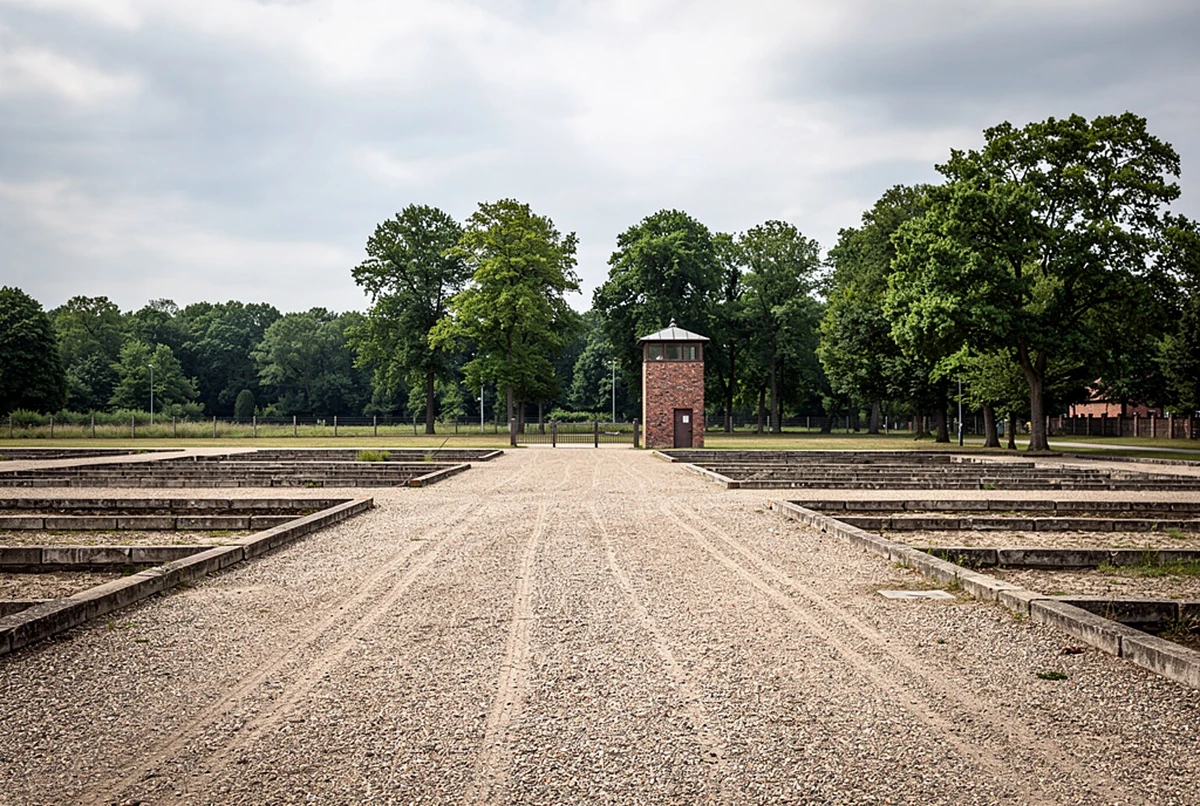
Around the roll-call area runs a track paved in sections with different surfaces: cobbles, gravel, sand and cinders. Prisoners of the punishment detail were forced to march along it all day, carrying loads, to test the soles of shoes for German manufacturers. Along the perimeter you see the reconstructed security system: the death strip, the electrified fence and the wall with its watchtowers. Your guide uses the site map to show where the barracks stood; their outlines are marked today on the open ground.
The barracks, the camp prison and the infirmary
Two original wooden barracks, numbers 38 and 39, survive in the area once called the small camp, where Jewish prisoners were held from 1938. Inside you see the three-tier bunks, the washroom and the latrine, and an exhibition on the fate of Jewish inmates. Nearby stands the remaining wing of the camp prison, a cell block where prisoners were kept in isolation and darkness, with punishment posts in the yard outside.
On the other side of the grounds, the former infirmary barracks hold an exhibition on medicine and crime in the camp: besides basic care for some prisoners, doctors here carried out experiments and selections. Your guide leads you through these buildings at a measured pace and leaves time for the documents and personal objects on display. Visitors often ask how long to spend at Sachsenhausen; the two hours of this tour cover the essential places, and the guide can suggest what to see if you return on your own.
Station Z and the places of remembrance
Beyond the camp wall, in the former industrial yard, lies the place the camp command called Station Z, a name taken from the last letter of the alphabet. Built in 1942, it combined a crematorium, a room for shooting prisoners and, from 1943, a gas chamber; the execution trench lies next to it. In the autumn of 1941 at least 10,000 Soviet prisoners of war were murdered in Sachsenhausen within a few weeks. The foundations are now protected by a white roof, where most groups pause in silence.
In April 1945 more than 30,000 prisoners were driven north-west on death marches; about 3,000 who were too ill to walk were liberated by Soviet and Polish soldiers on 22 April. From 1945 to 1950 the Soviet secret police used the site as a special camp, where a further 12,000 internees died. The tall obelisk on the grounds dates from the national memorial opened in 1961; today the memorial and museum are an international place of learning and mourning.
From Friedrichstraße to Oranienburg: the journey by bus
The tour meets outside Friedrichstraße station beside the Tränenpalast, the Palace of Tears. This glass pavilion was the departure hall of the border crossing between East and West Berlin from 1962 to 1989, where families separated by the Wall said goodbye; it is a fitting place to begin a day about German history. From here the bus takes about 50 minutes, and the guide uses the time to introduce the rise of the Nazi state and the camp system.
Travellers comparing how to get to Sachsenhausen from Berlin will find that the public route means a regional train or S-Bahn to Oranienburg and then a local bus or a twenty-minute walk; the direct bus saves that time in both directions and lets you rest after an emotionally demanding visit. On the way through Oranienburg you pass places where prisoners were forced to work. The bus returns to the same square at Friedrichstraße, in the centre of Berlin.
Itinerary
- Meet outside Friedrichstraße stationFind the guides with yellow umbrellas on the square beside the Palace of Tears for the 10:00 departure.
- Bus to OranienburgAbout 50 minutes by air-conditioned bus, with an introduction to the history on the way and a drive through the town.
- Tower A and the roll-call areaEnter through the gatehouse and learn how the camp was planned and guarded.
- Barracks, camp prison and infirmaryVisit the surviving buildings and their exhibitions on daily life, punishment and medical crimes.
- Station Z and the memorialWalk to the site of the crematorium and the execution trench; the guided visit of the memorial lasts about 2 hours in total.
- Return to BerlinBus back of about 50 minutes to the square at Friedrichstraße station, around 4 hours after departure.
What's included
- Professional licensed English-speaking guide
- Return transport by air-conditioned bus with driver
- Entry to the Sachsenhausen Memorial
- Donation to the Sachsenhausen Memorial for each participant
- Map of the former concentration camp
Not included
- Hotel pickup and drop-off
- Food and drinks (bring a light snack and a drink)
- Tips
Is this right for you?
Great for
- Travellers who want a proven choice — rated 4.9/5 by past travellers
Think twice if
- You want a private tour — this one is shared with other travellers
Not suitable for
- People with mobility impairments
- Wheelchair users
Meeting point
Meet outside Friedrichstraße train station, on the square between the station and the Tränenpalast (Palace of Tears), Reichstagufer 17, 10117 Berlin, for the 10:00 departure. Look for the guides holding yellow umbrellas and wearing blue lanyards with yellow name tags. Friedrichstraße is served by S-Bahn, U-Bahn and regional trains. There is no hotel pickup, and the tour ends at the same place.
Important information
- Wear weather-appropriate clothing and comfortable walking shoes; almost all of the visit is outdoors on open ground
- Bring a light snack and a drink, as there is no meal stop during the tour
- The site is a memorial and a place of mourning: please behave, dress and take photographs respectfully
- The tour is not wheelchair accessible and is not recommended for travellers with limited mobility
- The tour is held in English
- The subject is distressing; parents should decide whether it is appropriate for younger children
- Anyone under the influence of intoxicants cannot take part
- There is no hotel pickup; the bus leaves from and returns to Friedrichstraße station
Good to know
Frequently Asked Questions
Straight answers to what travellers ask us most, before they book.
Is this a shared or a private experience?
It is a shared public tour in English: you travel on the same bus and walk the memorial with other visitors, led by a professional licensed guide.
How long does the Sachsenhausen tour from Berlin take?
About 4 hours in total: roughly 50 minutes by bus each way and around 2 hours at the memorial.
Is hotel pickup included?
No. The tour starts and ends at a central meeting point outside Friedrichstraße station, which is easy to reach by S-Bahn, U-Bahn and regional train.
What is included?
A professional licensed English-speaking guide, return transport by air-conditioned bus with a driver, entry to the Sachsenhausen Memorial, a donation to the memorial for each participant and a map of the former camp. Food, drinks and tips are not included.
Is the price per person or per group?
The price is per person, and the youth category up to 17 years is shown separately. The booking panel on this page shows the current price for your date.
Is it suitable for children or reduced mobility?
Young people are admitted with their family, but the content is harrowing and we recommend the visit for teenagers and adults. The tour involves about two hours of walking on gravel and open ground, so it is not suitable for wheelchair users or travellers with mobility impairments.
What should I bring?
Comfortable walking shoes, clothing for the weather (the site is exposed to wind, rain and sun), a light snack, a drink and a camera if you wish.
Why visit Sachsenhausen with a guide?
Much of the camp was dismantled after the war, so the open ground says little without explanation. A licensed guide shows what stood where, puts the buildings and exhibitions in order and answers questions, which makes a short visit far more meaningful.
How do I get to Sachsenhausen from Berlin on this tour?
You do not need to plan anything: a bus takes the group directly from Friedrichstraße to the memorial and back. On public transport the same journey needs a train to Oranienburg and then a local bus or a walk.
What is the best time to visit Sachsenhausen?
The tour runs all year. Spring and autumn are the most comfortable for an outdoor visit; in winter dress very warmly, and in summer bring water and sun protection, as there is little shade.
What happens in bad weather?
The tour goes ahead in rain, cold or heat. Some stops are inside the barracks and exhibitions, but most of the walk is outside, so please dress for the conditions.
How do I book and confirm?
Choose your date in the booking panel on this page and send your request. Our team confirms your booking on WhatsApp within minutes and sends the meeting details.
More in Berlin

Getting to & around Berlin
Popular across Germany
-
-
-
-
-
-