Highlights and Hidden Gems Guided Walking Tour Savannah
- Duration2 hours
- Daily at 09:00 and 13:00
- Group
Some images are AI-generated for illustration. While we confirm your booking, just ask and we will send you the original photos.
- Fair, honest prices
- Real people, not bots
- Confirm, then pay
- Secure payment

Overview
This 2-hour guided walking tour explores the historic district of Savannah, Georgia, with a local guide and a small group of no more than ten people. Starting under the moss-draped live oaks of Forsyth Park, the route follows quiet side streets and some of the city's famous squares: Monterey Square with its grand mansions and monument, oak-shaded Jones Street, Madison Square and Lafayette Square with its twin-spired cathedral. Along the way you learn how the 18th-century Oglethorpe Plan shaped the city, how its brick and ironwork were made, and the stories behind its houses of worship. The pace is easy on flat ground, it is stroller- and wheelchair-friendly, and the tour ends in the heart of the district with tips on where to eat and what to visit next.
Highlights
- Live oaks, Spanish moss and the famous fountain of Forsyth Park
- The grand mansions and monument of Monterey Square
- Jones Street, often called the prettiest street in Savannah
- Madison Square's armory and the old Scottish Rite Temple
- The twin spires of the Cathedral Basilica on Lafayette Square
- How the Oglethorpe Plan of squares and wards still shapes the city
- Small group of up to 10 with a local guide
- Tips from your guide on restaurants, museums and shops
Full Description
Forsyth Park and the Armstrong-Kessler Mansion
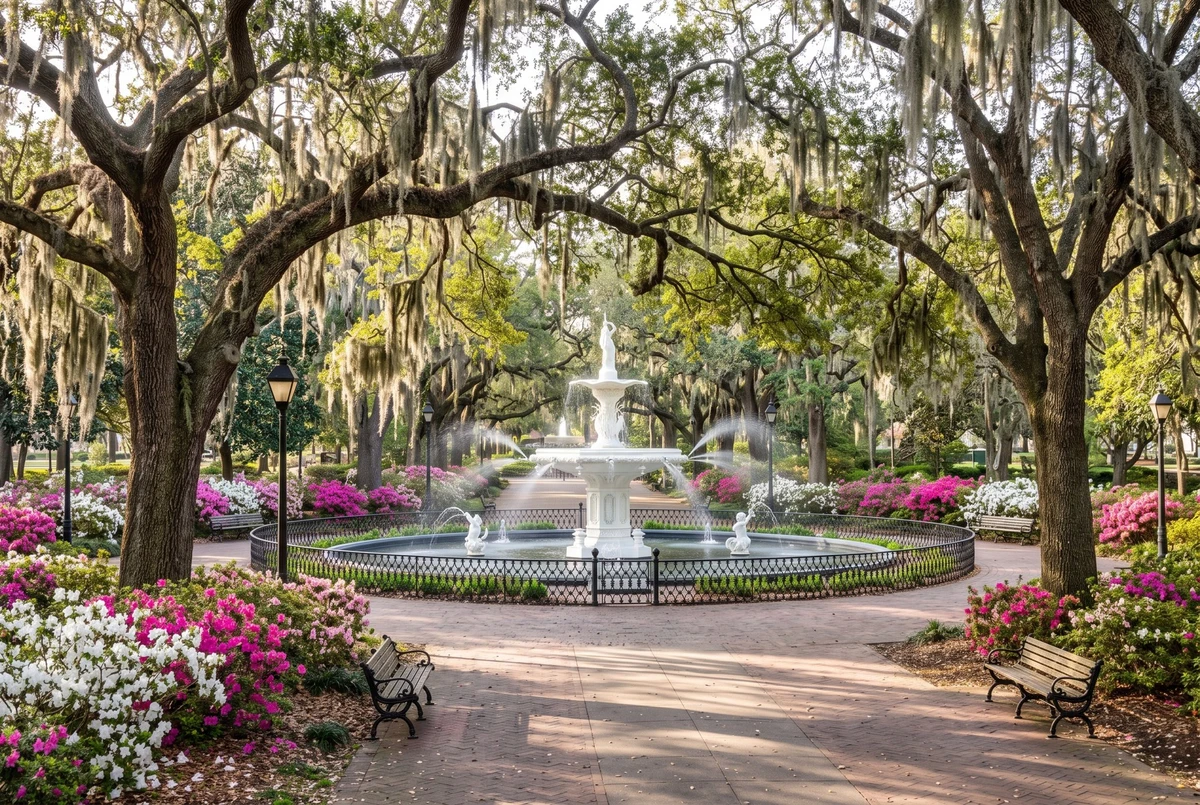
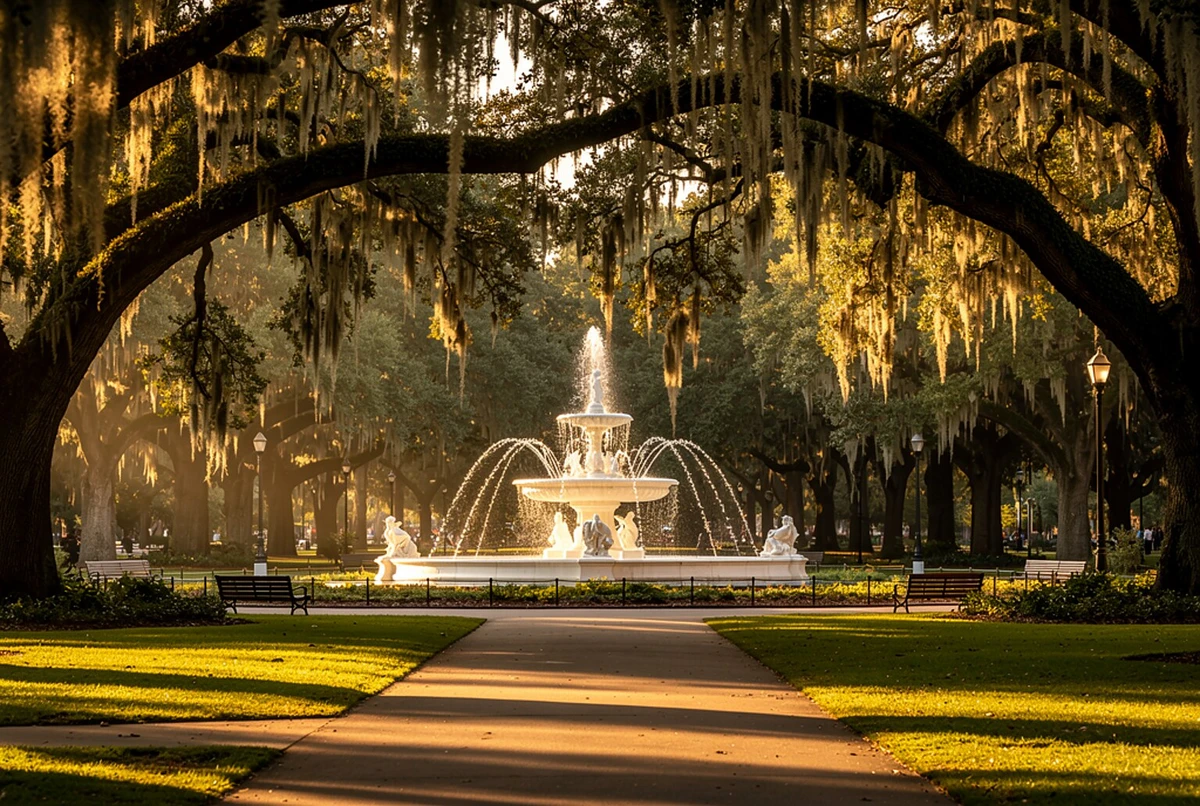
Your walk begins at the northwest corner of Forsyth Park, the 30-acre green space at the southern edge of the historic district. Laid out in the 1840s and 1850s, it is crossed by paths shaded by enormous live oaks hung with Spanish moss, which is in fact neither Spanish nor a moss but a flowering plant related to the pineapple. Your guide explains why these trees became the symbol of the Deep South.
The white cast-iron Forsyth Park fountain, installed in 1858, is the most photographed spot in the city and sits a short stroll from the start. Across Gaston Street rises the Armstrong-Kessler Mansion, a vast Italian Renaissance Revival house completed in 1919 with a curved colonnade and a roofline that stops passers-by in their tracks. It is one of the grandest private residences in the city, and the perfect first photo stop.
Monterey Square
Many locals call Monterey Square the most beautiful of the Savannah squares. Laid out in 1847, it is framed by stately 19th-century mansions with iron balconies and tall shuttered windows. At its centre stands the marble Pulaski Monument from 1854, honouring the Polish-born cavalry officer who was mortally wounded leading a charge during the Siege of Savannah in 1779, a key moment of the American Revolution here.
On one side of the square stands an Italianate red-brick mansion completed in 1868 that became the scene of a local true-crime case, and your guide tells how it changed the city's fortunes. On the east side is Congregation Mickve Israel, founded by settlers who arrived in 1733, whose 1878 synagogue surprises visitors with its Gothic Revival design, pointed windows and a look more often seen in churches.
Jones Street and the Savannah grey brick
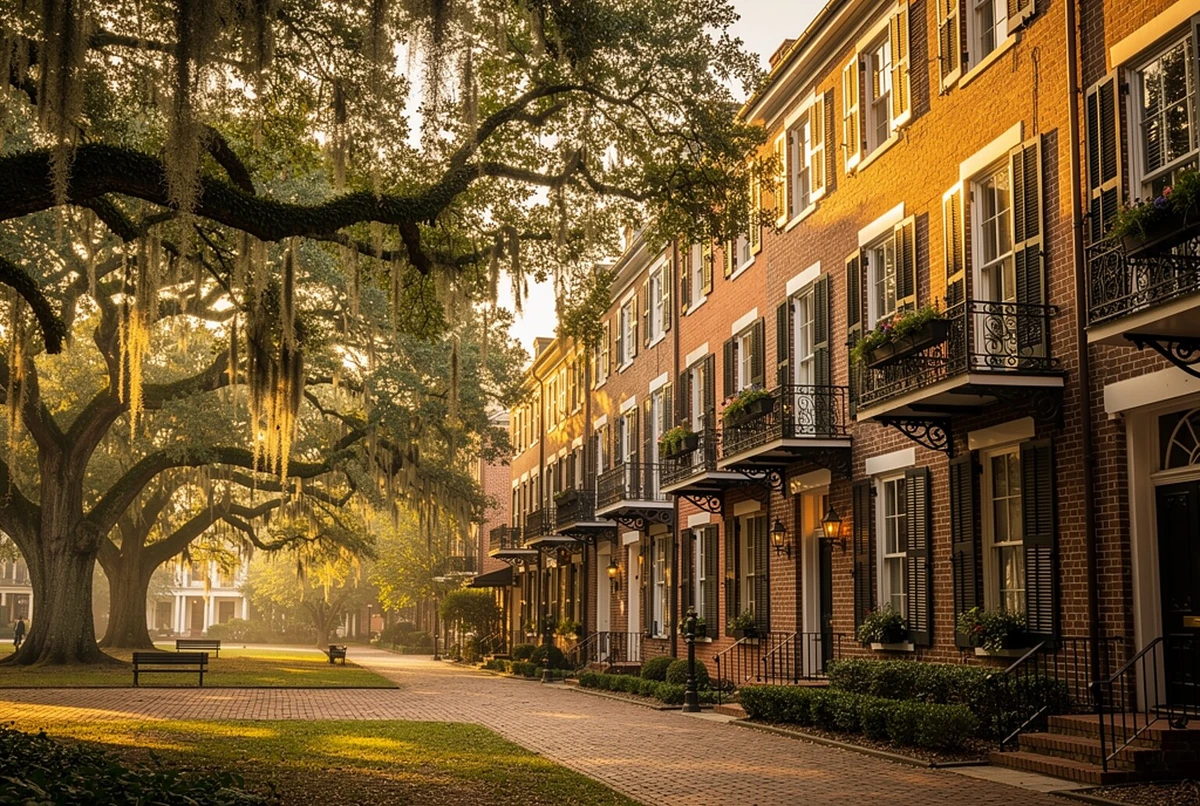
From Monterey Square the walk turns onto Jones Street, a quiet residential street of brick row houses, iron stair rails and front gardens, roofed by live oaks whose branches meet above the road. It is often called the prettiest street in Savannah, and it is a favourite for photos in every season, especially in spring when azaleas bloom along the stoops.
Here your guide explains the building materials of the historic district, above all the soft, pinkish Savannah grey brick fired from river clay. Much of it came from brickworks on plantations along the Savannah River, made by the forced labour of enslaved people, and the guide tells honestly what became of those plantations, which have now disappeared. You also learn to read the ironwork, the raised entrances and the hidden service lanes behind the houses.
Madison Square
Madison Square, laid out in 1837, mixes civic history with the creative energy of today's Savannah. At its centre is a bronze monument to a soldier of the Revolutionary War, and around it stand some of the district's most monumental buildings. The tall Scottish Rite Temple of 1913 still houses a traditional café at street level, where the group can pause for a cool drink or a snack.
Facing the square is the red-brick, castle-like Savannah Volunteer Guards Armory of 1892. Its story is closely tied to the Savannah College of Art and Design, the world-renowned art school that began restoring old buildings across the city in the late 1970s and turned this armory into one of its first halls. Your guide shows how the school helped save the historic district, which is one reason so many visitors say Savannah is worth visiting.
Lafayette Square and the Cathedral Basilica
Lafayette Square is dominated by the Cathedral Basilica of St. John the Baptist, a French Gothic church with twin spires, completed in 1896 and rebuilt after a fire only two years later. Inside are stained-glass windows and painted ceilings, and the cathedral sits at the centre of the city's Irish heritage, which comes alive every March when Savannah holds one of the largest St. Patrick's Day celebrations in the country.
Around the square your guide points out the house linked to the founding of the Girl Scouts in Savannah in 1912, and a grand Second Empire mansion from 1873 that is said to have been among the first in the city lit by electricity. The fountain in the middle of the square, with its quiet benches, is a pleasant place to stop for photos before the walk continues.
The Oglethorpe Plan and Troup Square
Savannah was founded in 1733, and its first plan arranged the city as a repeating grid of wards, each built around a public square with house lots on two sides and plots for churches and public buildings on the others. Known as the Oglethorpe Plan, it is still studied in urban design classes around the world, and most of the original squares survive, giving the historic district its shady, walkable rhythm.
If time allows, the tour ends at Troup Square, one of the smallest and quaintest, with its iron armillary sphere and a little fountain built for dogs, perfect since dogs on leashes are welcome on this walk. Facing it is the church where the composer of a world-famous Christmas song once directed the music. The walk finishes in the heart of the district, where your guide shares tips on things to do in Savannah next.
Itinerary
- Forsyth ParkMeet your guide at the northwest corner of the park; about 20 minutes among the live oaks and near the famous fountain.
- Armstrong-Kessler MansionA short stop across Gaston Street to hear the story of this grand 1919 mansion and take photos.
- Monterey SquareAbout 20 minutes with the Pulaski Monument, the surrounding mansions and the Gothic Revival synagogue.
- Jones StreetA slow walk along the oak-shaded street while the guide explains Savannah grey brick and the city's ironwork.
- Madison SquareAbout 15 minutes at the armory, the Scottish Rite Temple and its café, where you can buy a refreshment.
- Lafayette SquareAbout 15 minutes with the Cathedral Basilica of St. John the Baptist and the stories of the surrounding houses.
- Troup Square and finishIf time allows, a visit to the smallest square, then the tour ends in the historic district with your guide's tips; about 2 hours in total.
What's included
- 2-hour guided walking tour of the historic district
- Local guide
- Small group of up to 10
- Tips on places to eat, museums and shops after the tour
Not included
- Hotel pickup and drop-off
- Food and drinks
- Tips
Is this right for you?
Great for
- First-time visitors who want the highlights
- A short visit — about 2 hours
- Travellers who want a proven choice — rated 4.8/5 by past travellers
Think twice if
- You want a private tour — this one is shared with other travellers
- Walking is difficult for you — expect active parts
Meeting point
Meet your guide at the northwest corner of Forsyth Park, on the corner of Gaston Street and Whitaker Street, across the road from Hodgson Hall at 501 Whitaker Street. Your guide wears an orange tour guide ID. There is no hotel pickup. If you drive, Gaston Street has parking meters, while the side streets south of Gaston Street have free parking.
Important information
- The tour runs in light to medium rain or shine; bring an umbrella if rain is forecast
- Wear comfortable shoes and weather-appropriate clothing
- Light exercise on flat but sometimes uneven pavements
- Stroller- and wheelchair-friendly route
- Dogs are welcome on a leash
- Access to restrooms is limited during the walk
- Bring a camera and water, especially in the hot summer months
- Food, drinks and tips are not included
Good to know
Frequently Asked Questions
Straight answers to what travellers ask us most, before they book.
Is this a shared or a private experience?
It is a shared small-group walking tour with a local guide, limited to 10 participants.
How long does the walking tour take?
About 2 hours at an easy pace, with stops in each square for stories and photos.
Is hotel pickup included?
No. The tour starts at the northwest corner of Forsyth Park, which is easy to reach on foot or by car from hotels in the historic district.
What is included?
The guided walk with a local guide, a small group of up to 10 and tips on places to eat, museums and shops after the tour.
Is the price per person or per group?
The tour is priced per person. The booking panel on this page shows the current price for your date.
Is it suitable for children and travellers with reduced mobility?
Yes. The route is flat and is stroller- and wheelchair-friendly, though some pavements are uneven and tree roots lift the bricks in places.
What should I bring?
Comfortable shoes, weather-appropriate clothing, a camera, water and an umbrella if rain is forecast.
What is the best time to visit Savannah?
Spring, from March to May, when azaleas bloom in the squares, and autumn are the most pleasant. Summer is hot and humid, so the morning departure is the cooler choice.
What happens in bad weather?
The tour runs in light to medium rain. In a storm or severe weather our team contacts you on WhatsApp to move your tour to another time.
Which squares does the tour visit?
Forsyth Park, Monterey Square, Madison Square and Lafayette Square, with Jones Street between them and Troup Square at the end if time allows.
Can I bring my dog?
Yes, dogs are welcome on the walk as long as they are kept on a leash.
How do I book and confirm?
Choose your date and start time in the booking panel and send your request. Our team confirms your booking on WhatsApp within minutes.
More in Savannah
Getting to & around Savannah
Popular across United States
-
-

-
-
-

-