Bukhara Old Town Walking Tour with a Local Guide
- DurationAbout 3.5 hours
- Daily
- Group
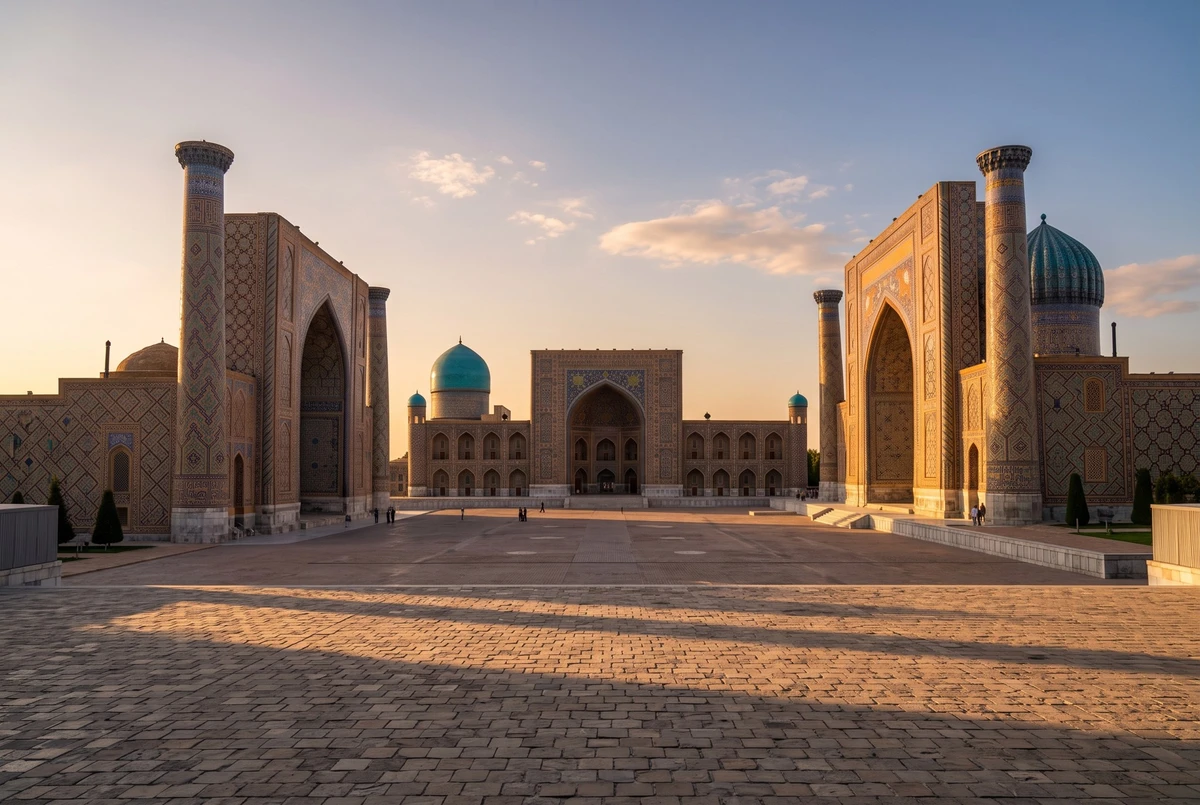
Some images are AI-generated for illustration. While we confirm your booking, just ask and we will send you the original photos.
- Fair, honest prices
- Real people, not bots
- Confirm, then pay
- Secure payment

Overview
This Bukhara walking tour takes you on foot through the old town with a licensed English-speaking local guide in a small group of up to 10 travellers. Starting beside the Lyabi-Hauz pool, you walk past the great madrasahs, through the covered trading domes and the old Jewish Quarter, up to the Kalyan Minaret and the Poi Kalyan ensemble, then on to the Ark Fortress walls, the Bolo-Hauz Mosque, Chashma-Ayub and the Samanid Mausoleum. Along the way you meet artisans at work, including carpet weavers. It suits first-time visitors who want the whole historic centre explained in one morning or afternoon. There is no hotel pickup: the walk starts at the Nodir Devonbegi Khanaka, and a sunset option is also available.
Highlights
- Walk the UNESCO-listed historic centre of Bukhara with a licensed local guide
- Start at Lyabi-Hauz, the shaded pool at the heart of the old town
- Pass under the 16th-century trading domes of jewellers, hat makers and money changers
- Stand below the 12th-century Kalyan Minaret on the Poi Kalyan square
- See the carved wooden columns of the Bolo-Hauz Mosque and the Ark Fortress walls
- Finish at the 10th-century Samanid Mausoleum, the oldest monument in the city
- Meet artisans at work, including a traditional carpet workshop
- Small group of up to 10 travellers, morning or sunset start
Full Description
Lyabi-Hauz and the Nodir Devonbegi ensemble
Every Bukhara walking tour begins best at Lyabi-Hauz, and ours starts right beside it at the gate of the Nodir Devonbegi Khanaka. The stone-edged pool was dug in the early 17th century, when water channels still fed dozens of such reservoirs across the city, and old mulberry trees still shade its banks. On three sides stand the khanaka, a former lodge where Sufi dervishes gathered for prayer, the Nodir Devonbegi Madrasah and the Kukeldash Madrasah, one of the largest Quranic schools in Central Asia.
Your guide points out the famous portal of the Nodir Devonbegi Madrasah, where two mosaic birds carry white deer towards a sun with a human face, a rare image on an Islamic building. The square is the social heart of the old town, busy with families in the evening, so it is the natural place to understand how Bukhara lived and traded along the Silk Road before you walk deeper into the lanes.
The trading domes, the Jewish Quarter and Magoki-Attori Mosque
From Lyabi-Hauz the route follows the old trade axis of the city. Toki Sarrafon was the dome of the money changers, Toki Telpakfurushon the dome of the hat sellers, and Tim Abdullakhan, built in the 16th century, a covered hall for fine silk. Further on, Toki Zargaron, the jewellers dome, sits at a crossroads where several streets meet. These brick domes still hold workshops of embroiderers, knife makers, miniature painters and metal engravers, so the walk feels alive rather than museum-like.
Between the domes your guide leads you into the old Jewish Quarter, where a small synagogue and courtyard houses recall a community that lived in Bukhara for centuries. Nearby, the Magoki-Attori Mosque sits half below street level: its 12th-century carved brick facade shows how much the ground has risen over a thousand years of building, and the site is one of the oldest surviving mosques in Central Asia.
Kalyan Minaret and the Poi Kalyan ensemble
The Kalyan Minaret is the symbol of Bukhara and the high point of the walk. Raised in 1127, it climbs about 46 metres in tapering bands of patterned baked brick, and for centuries it served as a landmark for caravans crossing the desert. At its foot, the Poi Kalyan square joins the Kalyan Mosque, a Friday mosque from the early 16th century whose arcaded courtyard can hold around 10,000 worshippers, and the Mir-i-Arab Madrasah with its pair of turquoise domes.
Mir-i-Arab is still a working religious school, so visitors usually admire it from the square and the portal. Many travellers ask whether Bukhara is worth visiting beyond Samarkand; this square answers the question, because nowhere else in Central Asia does a medieval ensemble of this scale stand so complete. Your guide gives you time here for photos, especially beautiful in the soft light of morning or late afternoon.
Ark Fortress and the Bolo-Hauz Mosque
Next the route reaches the massive sloping walls of the Ark, the citadel that was the residence of the rulers of Bukhara until 1920. People have lived on this mound since ancient times, and the gate ramp, the walls and the clock above the entrance are impressive seen from the square in front. The walk shows the Ark from the outside; the museum sections inside need a separate ticket, which you can buy on the spot if you want to return after the tour.
Across the road, the Bolo-Hauz Mosque was built in 1712 as the Friday mosque of the court. Its tall summer terrace rests on slender carved wooden columns, added in the early 20th century, which reflect in the pool in front, and locals say the reflection doubles them. It is one of the most photographed corners of the city and a quiet place to pause between the big monuments.
Chashma-Ayub and the Samanid Mausoleum
The last part of the walk crosses into Samanid Park. Chashma-Ayub, the Spring of Job, is a long brick building with an unusual conical dome over a spring that, according to legend, appeared when the prophet Job struck the ground with his staff. The present structure goes back to the 12th century with later rebuilding, and today it holds a small exhibition on water in this desert region, which explains why every pool in the old town mattered so much.
A short stroll away stands the Samanid Mausoleum, also known as the Ismail Samani Mausoleum, built in the early 10th century and the oldest preserved monument in Bukhara. Its walls are a masterpiece of brickwork, laid in basket-weave patterns that change with the sun through the day. Buried under earth for centuries, it was uncovered in the 1930s, and it is a perfect place to end a tour of the city.
Itinerary
- Meet at the Nodir Devonbegi KhanakaMeet your guide at the entrance gate of the khanaka beside Lyabi-Hauz and start with an introduction to the history of Bukhara.
- Lyabi-Hauz and its madrasahsWalk around the pool and see the Nodir Devonbegi and Kukeldash madrasahs, about 40 minutes with photo time.
- Jewish Quarter and Toki SarrafonStep into the old Jewish Quarter with its synagogue, then reach the money changers dome.
- Magoki-Attori Mosque and Toki TelpakfurushonSee one of the oldest mosques in Central Asia, then walk through the old hat sellers dome.
- Tim Abdullakhan and Toki ZargaronPass the silk hall and the jewellers dome, with artisan workshops and a carpet workshop on the way.
- Ulugbek and Abdulazizkhan madrasahsCompare two madrasahs facing each other, built more than two centuries apart.
- Kalyan Minaret, Kalyan Mosque and Mir-i-ArabSpend time on the Poi Kalyan square, the most famous view in Bukhara.
- Ark Fortress and Bolo-Hauz MosqueSee the citadel walls from outside, then the carved wooden terrace of Bolo-Hauz.
- Chashma-Ayub and the Samanid MausoleumFinish in Samanid Park at the Spring of Job and the 10th-century mausoleum; the tour ends here or near Bolo-Hauz.
What's included
- Licensed English-speaking local guide
- Guided walk through the historic centre of Bukhara
- Lyabi-Hauz, madrasahs, trading domes and the Kalyan ensemble
- Outside view of the Ark Fortress, Bolo-Hauz Mosque and Chashma-Ayub
- Ismail Samani Mausoleum
- Visits to artisan workshops, including a carpet workshop
Not included
- Entrance tickets to monuments
- Entry to the Ark Fortress museum sections
- Hotel pickup and drop-off
- Personal purchases and tips
Is this right for you?
Great for
- History and culture lovers
- First-time visitors who want the highlights
- Travellers who want a proven choice — rated 5.0/5 by past travellers
Think twice if
- You want a private tour — this one is shared with other travellers
- Walking is difficult for you — expect active parts
Not suitable for
- Travellers who cannot walk for about 3.5 hours
- People over 95 years
Meeting point
The walk starts at the entrance gate of the Nodir Devonbegi Khanaka, on the west side of the Lyabi-Hauz pool in Bukhara old town (if you see a donkey statue, you are on the wrong side of the square; check the map pin we send). The morning tour starts at 9:05 and the sunset tour at 15:45; please arrive 5 minutes early. The tour ends in Samanid Park near the Samanid Mausoleum or near the Bolo-Hauz Mosque, a short walk or taxi ride from most hotels.
Important information
- Wear comfortable shoes and light, comfortable clothes; the old town has uneven paving
- Cover shoulders and knees when entering mosques and madrasahs
- Bring some local currency in cash for entrance tickets, small purchases and tips; cards work in some places
- Entrance tickets and the Ark museum sections are not included and are paid on site
- Drones are not allowed on the tour
- Visits to workshops are cultural; shopping is never required
- Some monuments may be under restoration; your guide will suggest an alternative stop
- Please add your WhatsApp number when booking so the guide can reach you
- The tour may be cancelled in severe weather or if the minimum number of travellers is not reached
Good to know
Frequently Asked Questions
Straight answers to what travellers ask us most, before they book.
Is this a shared or a private experience?
This is a shared small-group walking tour with a licensed local guide, limited to 10 travellers.
How long does the Bukhara walking tour take?
About 3.5 hours on foot, at a relaxed pace with stops for explanations and photos.
Is hotel pickup included?
No. The walk starts at the Nodir Devonbegi Khanaka beside Lyabi-Hauz, which is within walking distance of most old town hotels.
What is included?
A licensed English-speaking guide, the walk through the main monuments of the old town and visits to artisan workshops. Entrance tickets are not included.
Is the price per person or per group?
The price is per person. The booking panel on this page shows the current price of each option for your date.
Is it suitable for children or reduced mobility?
Children who enjoy walking are welcome. The route is mostly flat and the main squares are accessible, but some streets are uneven and a few monuments have steps.
What should I bring?
Comfortable shoes, a hat and water in warm months, some cash and a card for tickets, and modest clothing for religious sites.
What is the best time to visit Bukhara?
Spring (April to early June) and autumn (September to October) are the most pleasant. In summer the morning walk or the sunset option avoids the strongest heat.
Is Bukhara worth visiting?
Yes. Its historic centre is a UNESCO World Heritage Site with more than a thousand years of monuments close together, which makes it one of the best cities in Central Asia to explore on foot.
Do we go inside the Ark Fortress?
The tour shows the Ark from outside. The museum sections inside need a separate ticket, and you can visit them on your own after the walk.
What happens in bad weather?
The walk runs in light rain or cold. In severe weather it may be cancelled, and we then offer you another date or a full refund.
How do I book and confirm?
Choose your date and option in the booking panel on this page and send your request. Our team confirms your booking on WhatsApp within minutes and sends you the meeting details.